Department of Neurology, Nanfang Hospital, Southern Medical University, Guangzhou, 510515, Guangdong, China.
Guangdong-Hong Kong-Macao Greater Bay Area Center for Brain Science and Brain-Inspired Intelligence, Guangzhou, 510515, Guangdong, China.
J Transl Med. 2023 Oct 24;21(1):747. doi: 10.1186/s12967-023-04638-x.
The pathogenesis of Parkinson's disease (PD) has not been fully elucidated, and there are no effective disease-modifying drugs for the treatment of PD. Mesenchymal stem cells have been used to treat several diseases, but are not readily available.
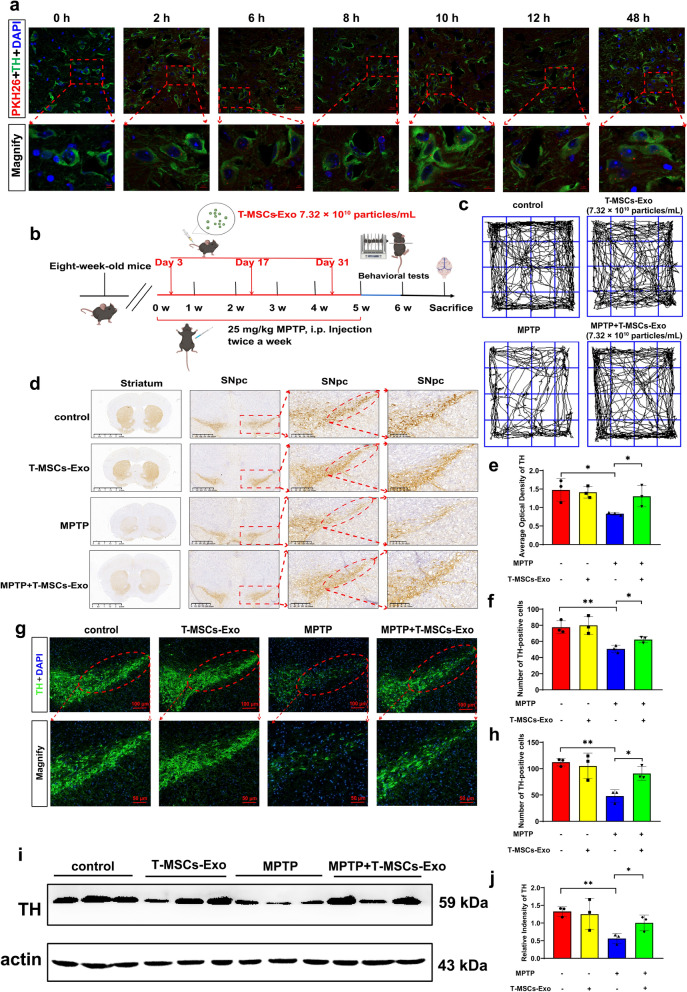
Here, we used phenotypically uniform trophoblast stage-derived mesenchymal stem cells (T-MSCs) from embryonic stem cells, which are capable of stable production, and their exosomes (T-MSCs-Exo) to explore the molecular mechanisms involved in dopaminergic (DA) neuron protection in PD models using experimental assays (e.g., western blotting, immunofluorescence and immunohistochemistry staining).
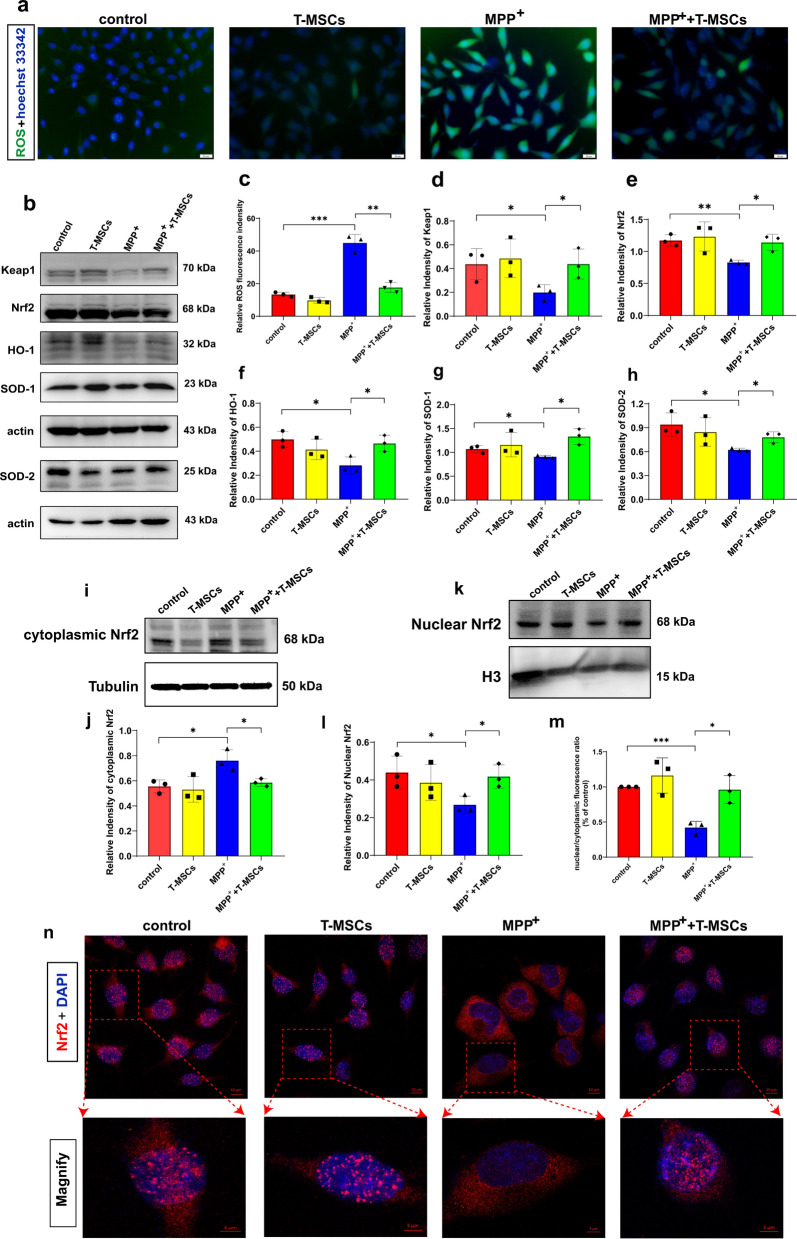
We assessed the levels of DA neuron injury and oxidative stress in MPTP-induced PD mice and MPP-induced MN9D cells after treating them with T-MSCs or T-MSCs-Exo. Furthermore, T-MSCs-Exo miRNA sequencing analysis revealed that miR-100-5p-enriched T-MSCs-Exo directly targeted the 3' UTR of NOX4, which could protect against the loss of DA neurons, maintain nigro-striatal system function, ameliorate motor deficits, and reduce oxidative stress via the Nox4-ROS-Nrf2 axis in PD models.
The study suggests that miR-100-5p-enriched T-MSCs-Exo may be a promising biological agent for the treatment of PD. Schematic summary of the mechanism underlying the neuroprotective actions of T-MSCs-Exo in PD. T-MSCs Exo may inhibit the expression level of the target gene NOX4 by delivering miR-100-5p, thereby reducing ROS production and alleviating oxidative stress via the Nox4-ROS-Nrf2 axis, thus improving DA neuron damage in PD.
帕金森病(PD)的发病机制尚未完全阐明,也没有有效的疾病修饰药物用于治疗 PD。间充质干细胞已被用于治疗多种疾病,但不易获得。
在这里,我们使用来自胚胎干细胞的表型均一的滋养层衍生的间充质干细胞(T-MSCs),其能够稳定生产,并使用它们的外泌体(T-MSCs-Exo),通过实验(例如,western blot、免疫荧光和免疫组织化学染色)来探索 PD 模型中多巴胺能(DA)神经元保护所涉及的分子机制。
我们评估了 MPTP 诱导的 PD 小鼠和 MPP 诱导的 MN9D 细胞中 DA 神经元损伤和氧化应激的水平,然后用 T-MSCs 或 T-MSCs-Exo 处理它们。此外,T-MSCs-Exo 的 miRNA 测序分析表明,富含 miR-100-5p 的 T-MSCs-Exo 可以直接靶向 Nox4 的 3'UTR,从而通过 Nox4-ROS-Nrf2 轴防止 DA 神经元丢失、维持黑质纹状体系统功能、改善运动缺陷,并减少 PD 模型中的氧化应激。
该研究表明,富含 miR-100-5p 的 T-MSCs-Exo 可能是治疗 PD 的有前途的生物制剂。T-MSCs-Exo 在 PD 中发挥神经保护作用的机制示意图总结。T-MSCs Exo 可能通过递送 miR-100-5p 抑制靶基因 NOX4 的表达水平,从而通过 Nox4-ROS-Nrf2 轴减少 ROS 产生并减轻氧化应激,从而改善 PD 中的 DA 神经元损伤。