Department of Biomedical Engineering, Texas A&M University, College Station, Texas; Engineering Medicine Program, Texas A&M University, Houston, Texas; Center for Theoretical Biological Physics, Rice University, Houston, Texas.
Biophys J. 2023 Nov 21;122(22):4414-4424. doi: 10.1016/j.bpj.2023.10.019. Epub 2023 Oct 24.
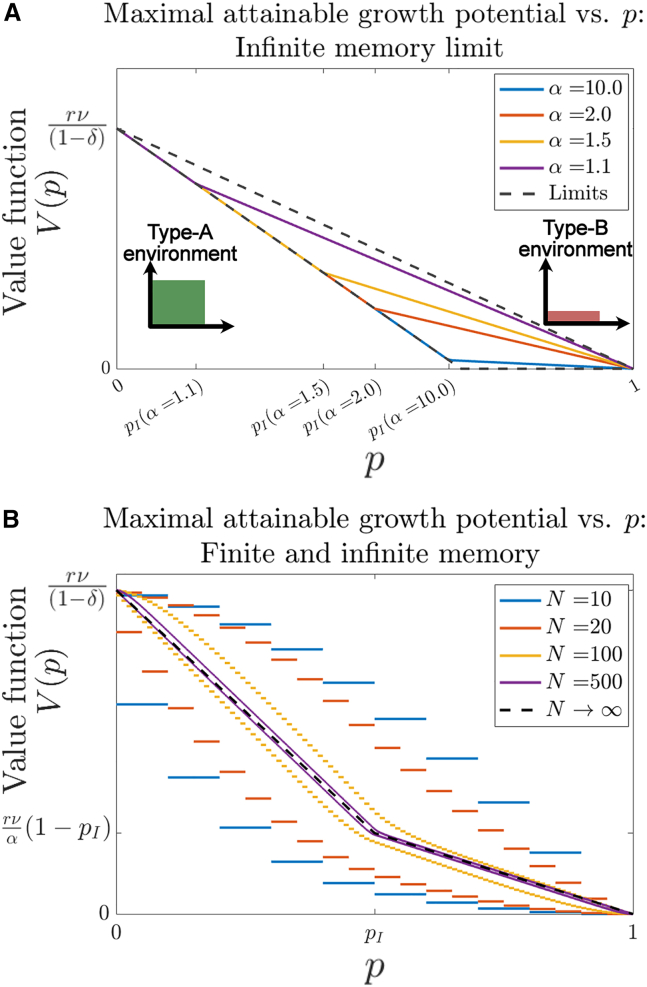
Phenotypic adaptation is a universal feature of biological systems navigating highly variable environments. Recent empirical data support the role of memory-driven decision making in cellular systems navigating uncertain future nutrient landscapes, wherein a distinct growth phenotype emerges in fluctuating conditions. We develop a simple stochastic mathematical model to describe memory-driven cellular adaptation required for systems to optimally navigate such uncertainty. In this framework, adaptive populations traverse dynamic environments by inferring future variation from a memory of prior states, and memory capacity imposes a fundamental trade-off between the speed and accuracy of adaptation to new fluctuating environments. Our results suggest that the observed growth reductions that occur in fluctuating environments are a direct consequence of optimal decision making and result from bet hedging and occasional phenotypic-environmental mismatch. We anticipate that this modeling framework will be useful for studying the role of memory in phenotypic adaptation, including in the design of temporally varying therapies against adaptive systems.
表型适应是生物系统在高度变化的环境中导航的普遍特征。最近的经验数据支持记忆驱动的决策在细胞系统中导航不确定的未来营养景观中的作用,其中在波动条件下出现明显的生长表型。我们开发了一个简单的随机数学模型来描述记忆驱动的细胞适应,这对于系统在这种不确定性中最优地导航是必要的。在这个框架中,适应性群体通过从先前状态的记忆中推断未来的变化来穿越动态环境,记忆容量在适应新的波动环境的速度和准确性之间施加了一个基本的权衡。我们的结果表明,在波动环境中观察到的生长减少是最优决策的直接结果,并且是由于赌注和偶尔的表型-环境不匹配造成的。我们预计,这个建模框架将有助于研究记忆在表型适应中的作用,包括在针对自适应系统的时间变化治疗的设计中。