Mj Hithish, Jain Gaurav, Gupta Priyanka, Kalia Roop Bhushan, Talawar Praveen
Department of Anaesthesiology and Critical Care, All India Institute of Medical Sciences, Rishikesh, Uttarakhand, India.
Department of Orthopaedics, All India Institute of Medical Sciences, Rishikesh, Uttarakhand, India.
Turk J Anaesthesiol Reanim. 2023 Oct 24;51(5):388-394. doi: 10.4274/TJAR.2023.231206.
Preoperative oral rehydration solution (ORS) supplementation offers wide postoperative benefits, but its role in reducing post-spinal myocardial ischaemia is uncertain. We evaluated this aspect in elective lower limb orthopaedic surgeries and compared it to conventional preoperative fasting.
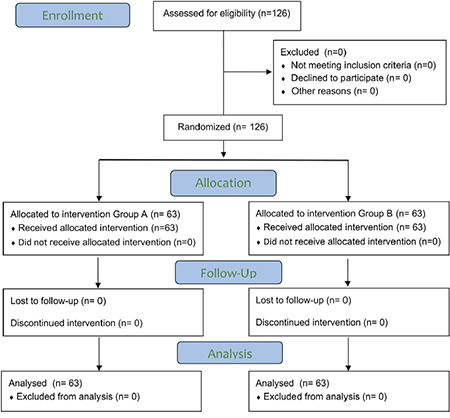
Prospectively, we randomised 126 patients aged >60 years into two groups: (A) received reconstituted ORS (1000 mL) during the overnight preoperative fasting, continued up to 2 hrs prior to spinal anaesthesia (SA) induction; (B) kept on conventional overnight preoperative fasting. This study evaluated electrocardiographic ischaemic changes at 2, 5, 10, 15, and 30 minutes after SA induction.
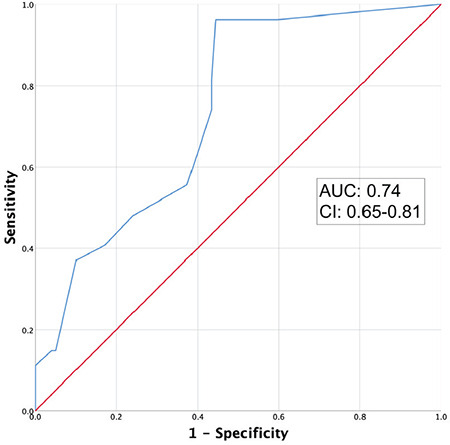
In total, 27 patients (group A: 7; group B: 20) developed transient electrocardiographic ischaemic changes. On intergroup comparison, group B had a significantly higher incidence at all time points, with highest statistical levels at 5- and 10-minutes (( < 0.001). The receiver operating characteristic curve at a threshold fasting duration (fluids) of >3 hours, had an area-under-curve of 0.74 to predict such changes within 30 minutes of SA induction (sensitivity 96.30%, specificity 55.56%, accuracy 64.29%, odds ratio 32.50, relative risk 20.80, ( < 0.001). Post-spinal hemodynamic changes were higher in group B than in A; hypotension and tachycardia were statistically significant ((=0.020). The pleth variability index was significantly higher (( < 0.001), while perfusion index was significantly lower ( < 0.001) in group B at all time points.
Preoperative ORS supplementation significantly reduced post-spinal transient ischaemic electrocardiographic changes in elderly patients than conventional overnight fasting.
术前补充口服补液盐(ORS)有诸多术后益处,但其在减少脊髓麻醉后心肌缺血方面的作用尚不确定。我们在择期下肢骨科手术中评估了这一方面,并将其与传统术前禁食进行比较。
前瞻性地,我们将126名年龄大于60岁的患者随机分为两组:(A)组在术前禁食过夜期间接受复溶的ORS(1000毫升),持续至脊髓麻醉(SA)诱导前2小时;(B)组进行传统的术前过夜禁食。本研究评估了SA诱导后2、5、10、15和30分钟时的心电图缺血性变化。
共有27名患者(A组:7名;B组:20名)出现短暂性心电图缺血性变化。组间比较时,B组在所有时间点的发生率均显著更高,在5分钟和10分钟时统计学水平最高(P<0.001)。在禁食持续时间(液体)阈值>3小时时的受试者工作特征曲线,曲线下面积为0.74,以预测SA诱导后30分钟内的此类变化(敏感性96.30%,特异性55.56%,准确性64.29%,优势比32.50,相对风险20.80,P<0.001)。B组脊髓麻醉后的血流动力学变化高于A组;低血压和心动过速具有统计学意义(P=0.020)。在所有时间点,B组的 pleth 变异指数显著更高(P<0.001),而灌注指数显著更低(P<0.001)。
与传统术前过夜禁食相比,术前补充ORS显著减少了老年患者脊髓麻醉后的短暂性缺血性心电图变化。