Colette Marie, Guentas Linda, Della Patrona Luc, Ansquer Dominique, Callac Nolwenn
French Institute for Research in the Science of the Sea (IFREMER), Research Institute for Development (IRD), University of New Caledonia, University of Reunion, CNRS, UMR 9220 ENTROPIE, Nouméa, New Caledonia.
Institute of Exact and Applied Sciences (ISEA), University of New Caledonia, Nouméa, New Caledonia.
Front Microbiol. 2023 Oct 9;14:1260585. doi: 10.3389/fmicb.2023.1260585. eCollection 2023.
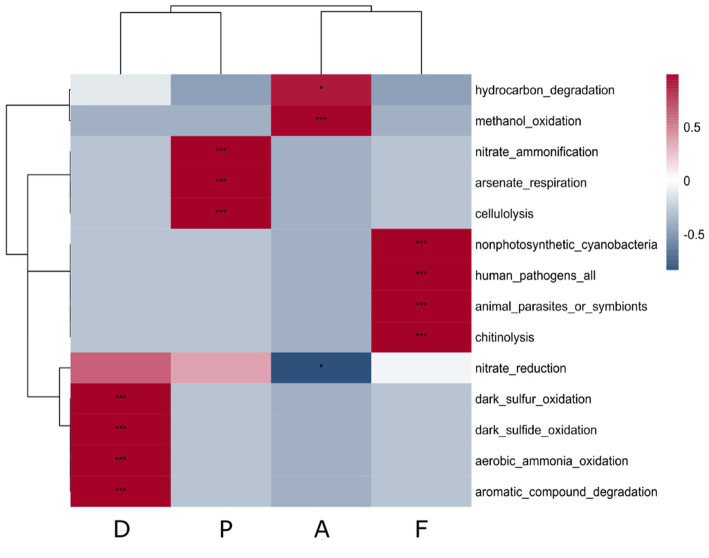
Shrimp rearing generate organic waste that is trapped in the pond sediment. In excess, these wastes may impair aquaculture ecosystem and shrimps' health. To promote the biological oxidation of accumulated organic waste, the pond is drained and dried at the end of each production cycle. However, this practice is not always conducive to maintaining microbial decomposition activities in sediments. Shrimp production in New Caledonia is no exception to this problem of pollution of pond bottoms. One promising way of treating this waste would be bioremediation, using a native halophyte plant and its microbiota. Thus, this study explored the nutrient removal potential of and its microbiota on sediments from four shrimp farms. was grown in an experimental greenhouse for 6 months. In order to mimic the drying out of the sediments, pots containing only sediments were left to dry in the open air without halophytes. An analysis of the chemical composition and active microbiota was carried out initially and after 6 months in the sediments of the halophyte cultures and in the dry sediments for each farm, respectively. In the initial state, the chemical parameters and the microbial diversity of the sediment varied considerably from one farm to another. Growing reduced the nitrogen, phosphorus and sulfur content in all type of sediment. However, this reduction varied significantly from one sediment to another. The rhizosphere of is mainly composed of micro-organisms belonging to the class. However, the families recruited from this class vary depending on the farm in question. Depending on the sediment, the variation in microbiota leads to different putative biochemical functions. For two of the farms, a similar reduction in nitrogen concentration was observed in both dry and cultivated sediments. This suggests that certain initial chemical characteristics of the sediments influence the nutrient removal efficiency of . Our study therefore highlights the need to control the pH of sediments before cultivation or in dry sediments in order to ensure optimal microbial decomposition of organic waste and nutrient cycling.
对虾养殖会产生被困在池塘沉积物中的有机废物。如果这些废物过多,可能会损害水产养殖生态系统和对虾的健康。为了促进积累的有机废物的生物氧化,每个生产周期结束时都会将池塘排水并晒干。然而,这种做法并不总是有利于维持沉积物中的微生物分解活动。新喀里多尼亚的对虾养殖也存在池塘底部污染的问题。一种有前景的处理这种废物的方法是生物修复,即使用本地盐生植物及其微生物群。因此,本研究探讨了[盐生植物名称]及其微生物群对四个对虾养殖场沉积物的养分去除潜力。[盐生植物名称]在实验温室中种植了6个月。为了模拟沉积物的干燥过程,只装有沉积物的花盆在露天晾干,没有种植盐生植物。分别对每个养殖场盐生植物培养沉积物和干燥沉积物的初始状态以及6个月后的化学成分和活性微生物群进行了分析。在初始状态下,不同养殖场沉积物的化学参数和微生物多样性差异很大。种植[盐生植物名称]降低了所有类型沉积物中的氮、磷和硫含量。然而,这种降低在不同沉积物之间差异显著。[盐生植物名称]的根际主要由属于[微生物类别名称]类的微生物组成。然而,从该类别中招募的科因所讨论的养殖场而异。根据沉积物的不同,微生物群的变化导致不同的推定生化功能。对于其中两个养殖场,在干燥沉积物和种植沉积物中都观察到了类似的氮浓度降低。这表明沉积物的某些初始化学特征会影响[盐生植物名称]的养分去除效率。因此,我们的研究强调在种植前或干燥沉积物中控制沉积物pH值的必要性,以确保有机废物的最佳微生物分解和养分循环。