Palmerini Emanuela, Frega Giorgio, Gambarotti Marco, Frisoni Tommaso, Cesari Marilena, Bazzocchi Alberto, Miceli Marco, Donati Davide Maria, Fanti Stefano, Nanni Cristina, Benini Stefania, Longhi Alessandra, Paioli Anna, Marrari Andrea, Hakim Rossella, Righi Alberto, Ibrahim Toni
Osteoncology, Soft Tissue and Bone Sarcomas, Innovative Therapy Unit, IRCCS Istituto Ortopedico Rizzoli, Bologna, Italy.
Department of Pathology, IRCCS Istituto Ortopedico Rizzoli, Bologna, Italy.
Front Oncol. 2023 Oct 9;13:1252359. doi: 10.3389/fonc.2023.1252359. eCollection 2023.
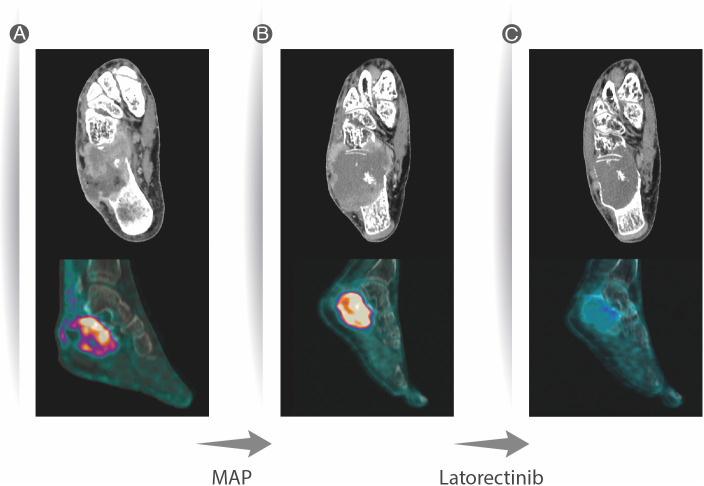
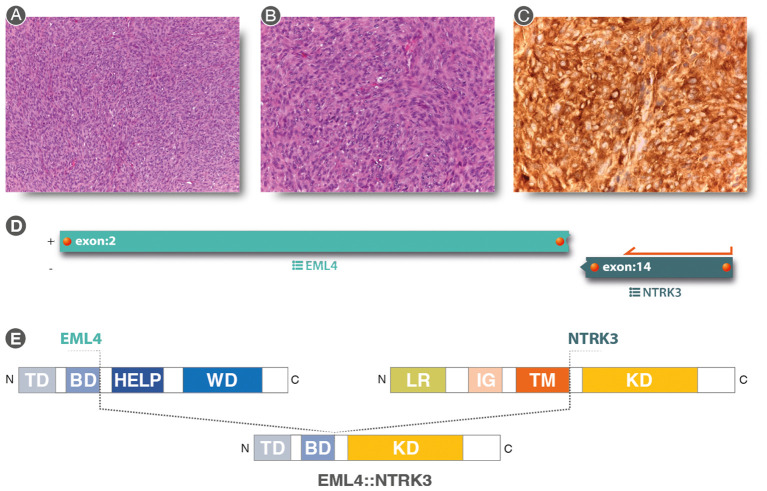
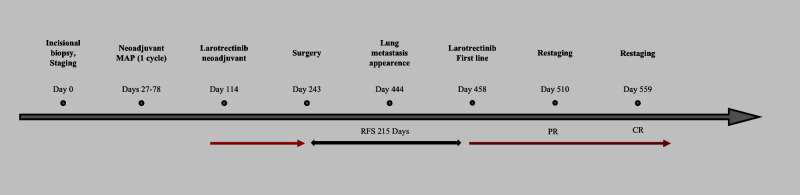
Neurotrophic tyrosine receptor kinase (NTRK) gene-fusion targeted molecules revolutionized the paradigm of treatment of a limited subgroup of cancers of various histologies. Entrectinib and larotrectinib obtained unprecedented response rates in patients with cancer harboring NTRK rearrangements. This evidence recently led to the agnostic approval of these drugs, and evidence (confirmation) of their activity in a broader disease setting is emerging. Here, we report the case of a patient affected by EML4-NTRK3 rearranged undifferentiated spindle cell bone sarcoma treated with larotrectinib, and we argue (discuss about) the incidence and clinical presentation of NTRK gene-fusion positive bone sarcomas, the potential use of upfront treatment with NTRK inhibitors in neoadjuvant setting, and the role of a multidisciplinary tumor board. Despite the rarity of these rearrangements in patients with primitive bone sarcomas, the therapy with NTRK inhibitors represents a highly effective strategy to be pursued in selected cases even in neoadjuvant settings. The management of these very rare cancers should always be discussed in a multidisciplinary board of reference centers.
神经营养性酪氨酸受体激酶(NTRK)基因融合靶向分子彻底改变了各种组织学类型的一小部分癌症的治疗模式。恩曲替尼和拉罗替尼在携带NTRK重排的癌症患者中取得了前所未有的缓解率。这一证据最近导致了这些药物的不限癌种批准,并且它们在更广泛疾病背景下活性的证据(确认)正在出现。在此,我们报告1例接受拉罗替尼治疗的EML4-NTRK3重排的未分化梭形细胞骨肉瘤患者的病例,并讨论NTRK基因融合阳性骨肉瘤的发病率和临床表现、NTRK抑制剂在新辅助治疗中作为一线治疗的潜在用途以及多学科肿瘤委员会的作用。尽管这些重排在原发性骨肉瘤患者中罕见,但NTRK抑制剂治疗即使在新辅助治疗中也是一种在特定病例中应采用的高效策略。这些极为罕见癌症的管理应始终在参考中心的多学科委员会中进行讨论。