Oregon Health & Science University, Portland, OR, United States.
J Med Internet Res. 2023 Oct 25;25:e47050. doi: 10.2196/47050.
Fire seasons are longer, with more and larger wildfires, placing increased demands and risks on those fighting wildland fires. There are multiple agencies involved with fighting wildland fires and unique worksite conditions make meeting these workers' needs a challenge.
The aim of the study is to develop and establish the effectiveness of a web-based safety and health program for those fighting wildland fires.
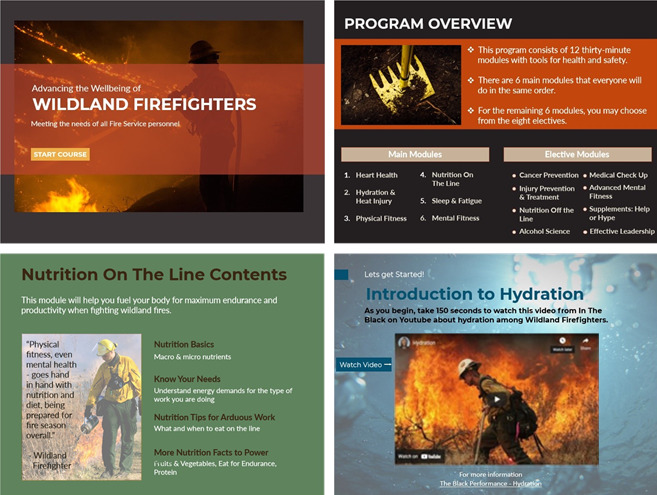
This mixed methods project had 3 phases. The initial qualitative phase assessed the needs of 150 diverse firefighters through interviews and focus groups across 11 US sites to establish and prioritize program content. Interview transcripts were read for thematic content with iterative readings used to identify, code, and rank health and safety issues. The second phase used that information to build a comprehensive Total Worker Health program for those fighting wildfires. The program content was based on the qualitative interview data and consisted of 6 core and 8 elective 30-minute, web-based modules primarily done individually on a smartphone or computer. The final, third phase evaluated the program with a quantitative prospective proof-of-concept, usability, and effectiveness trial among wildland firefighter participants. Effectiveness was assessed with paired 2-tailed t tests for pre- and post-Likert agreement scale survey items, adjusted for multiple comparisons. In addition to assessing mean and SD at baseline and postsurvey, observed effect sizes were calculated (Cohen d). Usability and reaction to the program among firefighters who responded to postsurvey were also assessed.
The qualitative themes and subthemes were used to inform the program's content. For the effectiveness trial, 131 firefighters completed the presurvey, and 50 (38.2%) completed the postsurvey. The majority of the participants were White (n=123, 93.9%), male (n=117, 89.3%), with an average age of 41 (SD 12.9) years. Significant increases in knowledge and desired health and safety behaviors were found for both cancer (P<.001) and cardiovascular risk (P=.01), nutrition behaviors (P=.01), hydration or overheating (P=.001), binge drinking (P=.002), and getting medical checkups (P=.001). More than 80% (n=40) of postsurvey respondents agreed or strongly agreed that the program was easy to use and would recommend it to others.
An innovative web-based safety and health promotion program for those fighting wildland fires was feasible, scalable, and usable. It improved the health and safety of those fighting wildland fires.
ClinicalTrials.gov NCT05753358; https://classic.clinicaltrials.gov/ct2/show/NCT05753358.
火灾季节更长,野火更多更大,这对扑灭野火的人员提出了更高的要求和更大的风险。有多个机构参与扑灭野火,独特的工作场所条件使得满足这些工人的需求成为一项挑战。
本研究旨在为扑灭野火的人员开发和建立一个基于网络的安全和健康计划,并评估其效果。
该混合方法项目分为 3 个阶段。在最初的定性阶段,通过在 11 个美国地点进行的 150 名不同消防员的访谈和焦点小组,评估了他们的需求,以确定和优先考虑计划内容。通过迭代阅读来阅读采访记录中的主题内容,以识别、编码和对健康和安全问题进行排名。第二阶段使用这些信息为扑灭野火的人员建立了一个全面的总工人健康计划。该计划内容基于定性访谈数据,由 6 个核心模块和 8 个选修 30 分钟的、基于网络的模块组成,主要在智能手机或计算机上单独完成。第三阶段,通过对参与野火消防员的定量前瞻性概念验证、可用性和有效性试验,对该计划进行了评估。使用配对的 2 尾 t 检验评估有效性,对预先和事后李克特同意量表调查项目进行了调整,以进行多次比较。除了评估基线和调查后的平均值和标准差外,还计算了观察到的效应大小(Cohen d)。还评估了消防员对调查后回复的计划的可用性和反应。
定性主题和子主题被用来为计划的内容提供信息。在有效性试验中,131 名消防员完成了预调查,50 名(38.2%)完成了后调查。大多数参与者为白人(n=123,93.9%),男性(n=117,89.3%),平均年龄为 41 岁(SD 12.9)。癌症(P<.001)和心血管风险(P=.01)、营养行为(P=.01)、水合或过热(P=.001)、狂饮(P=.002)和进行体检(P=.001)方面的知识和所需的健康和安全行为显著增加。超过 80%(n=40)的后调查受访者表示同意或强烈同意该计划易于使用,并将向他人推荐该计划。
为扑灭野火的人员开发的一种创新的基于网络的安全和健康促进计划是可行的、可扩展的和可用的。它提高了扑灭野火人员的健康和安全。
ClinicalTrials.gov NCT05753358;https://classic.clinicaltrials.gov/ct2/show/NCT05753358。
