Chantal BIYA International Reference Centre for Research on HIV/AIDS prevention and management, Yaoundé, Cameroon.
Faculty of Medicine and Biomedical Sciences, Yaoundé, Cameroon.
PLoS One. 2023 Oct 25;18(10):e0293326. doi: 10.1371/journal.pone.0293326. eCollection 2023.
We sought to evaluate the variability of HIV-1 and its effect on immuno-virological response among adolescents living with perinatally acquired HIV (APHI).
A cohort study was conducted from 2018-2020 among 311 APHI receiving antiretroviral therapy (ART) in Cameroon. Sequencing of protease and reverse transcriptase regions was performed for participants experiencing virological failure, VF, (Plasma viral load, PVL ≥ 1000 RNA copies/ml). HIV-1 subtypes were inferred by phylogeny; immuno-virological responses were monitored at 3-time points (T1-T3). Cox regression modeling was used to estimate adjusted hazard ratios (aHRs) of progression to: CD4 < 250, and PVL > 5log10, adjusted for acquired drug resistance, gender, ART line, adherence, and duration on treatment; p < 0.05 was considered statistically significant.
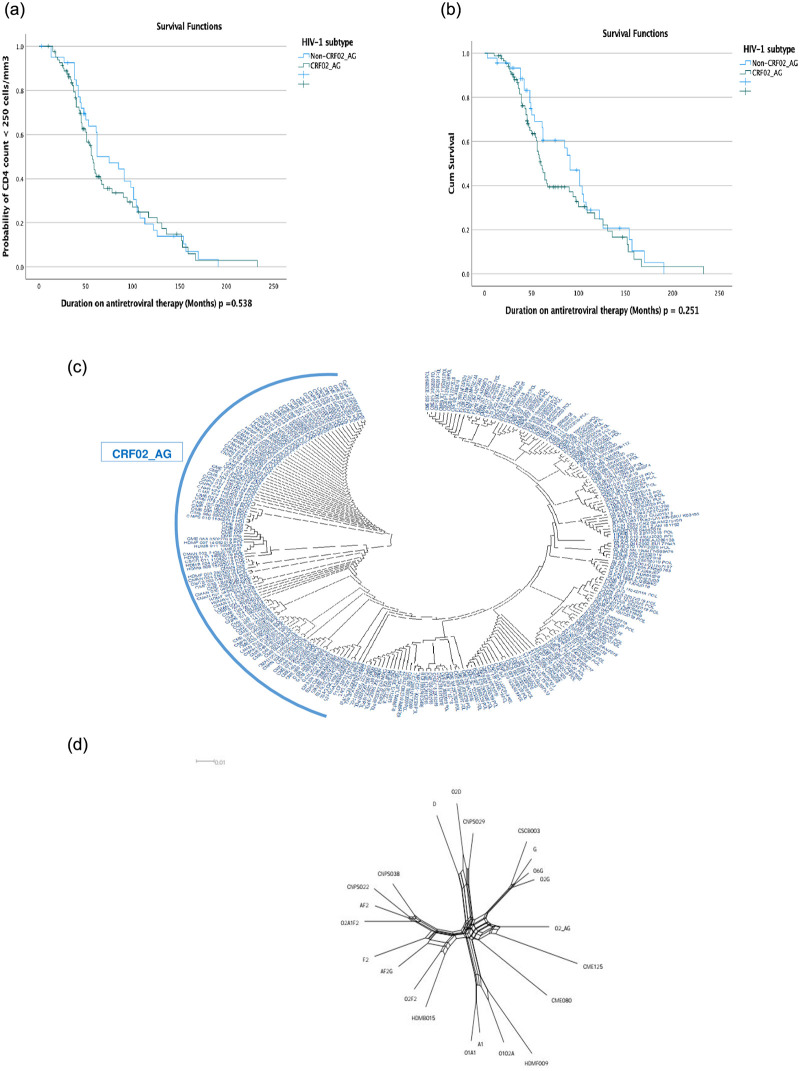
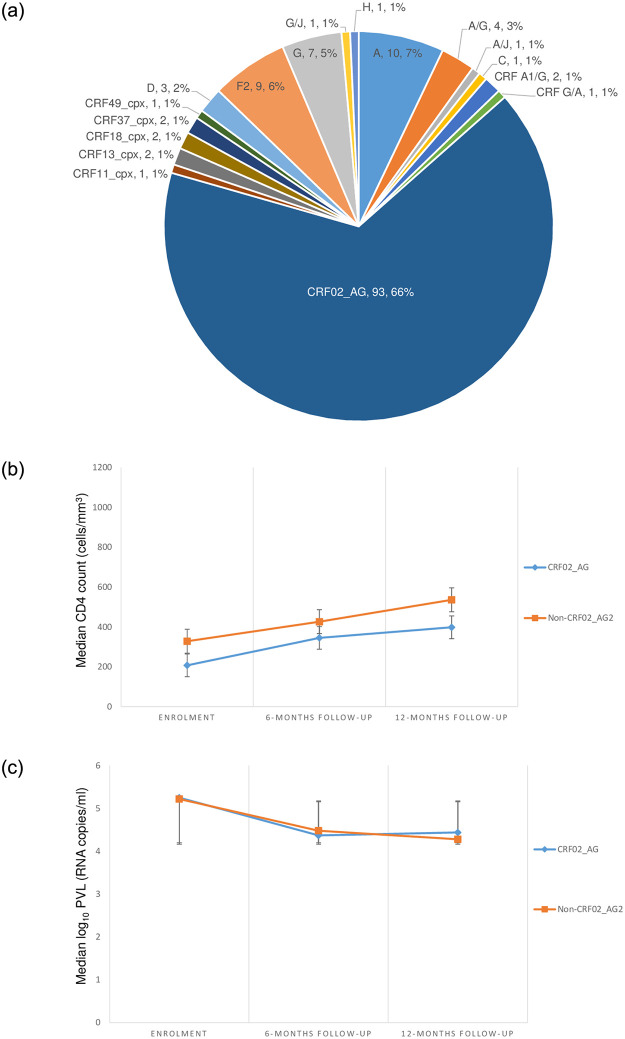
Of the 141 participants in VF enrolled, the male-female ratio was 1:1; mean age was 15 (±3) years; and median [IQR] duration on ART was 51 [46-60] months. In all phases, 17 viral clades were found with a predominant CRF02_AG (58.2%, 59.4%, and 58.3%). From T1-T3 respectively, there was an increasing CD4 count (213 [154-313], 366 [309-469], and 438 [364-569] cells/mm3) and decline log10 PVL (5.23, 4.43, and 4.43), similar across subtypes. Among participants with CRF02_AG infection, duration of treatment was significantly associated with both rates of progression to CD4 < 250, and PVL > 5log10, aHR = 0.02 (0.001-0.52), and aHR = 0.05 (0.01-0.47) respectively. Moreover, four potential new HIV-1 recombinants were identified (CRF02_AG/02D, CRF02_AG/02A1F2, D/CRF02_AG, and AF2/CRF02_AG), indicating a wide viral diversity.
Among APHI in settings like Cameroon, there is a wide genetic diversity of HIV-1, driven by CRF02_AG and with potential novel clades due to ongoing recombination events. Duration of treatment significantly reduces the risk of disease progression.
我们旨在评估 HIV-1 的变异性及其对围生期感染 HIV(APHI)的青少年免疫病毒学反应的影响。
2018 年至 2020 年期间,在喀麦隆对 311 名接受抗逆转录病毒治疗(ART)的 APHI 患者进行了一项队列研究。对出现病毒学失败(VF)的患者(血浆病毒载量,PVL≥1000 RNA 拷贝/ml)进行蛋白酶和逆转录酶区域的测序。通过系统发育推断 HIV-1 亚型;在 3 个时间点(T1-T3)监测免疫病毒学反应。使用 Cox 回归模型来估计进展为 CD4<250 和 PVL>5log10 的调整后的危险比(aHR),调整了获得性耐药、性别、ART 线、依从性和治疗持续时间;p<0.05 被认为具有统计学意义。
在纳入的 141 名 VF 患者中,男女比例为 1:1;平均年龄为 15(±3)岁;ART 治疗的中位数[IQR]持续时间为 51[46-60]个月。在所有阶段均发现了 17 个病毒分支,其中主要为 CRF02_AG(58.2%、59.4%和 58.3%)。从 T1 到 T3 分别为,CD4 计数增加(213[154-313]、366[309-469]和 438[364-569]个/mm3)和 log10 PVL 下降(5.23、4.43 和 4.43),各亚型相似。在感染 CRF02_AG 的参与者中,治疗持续时间与进展为 CD4<250 和 PVL>5log10 的风险显著相关,aHR=0.02(0.001-0.52)和 aHR=0.05(0.01-0.47)。此外,还鉴定了四种潜在的新 HIV-1 重组体(CRF02_AG/02D、CRF02_AG/02A1F2、D/CRF02_AG 和 AF2/CRF02_AG),表明存在广泛的病毒多样性。
在喀麦隆等环境中,APHI 中存在广泛的 HIV-1 遗传多样性,由 CRF02_AG 驱动,并由于持续的重组事件而具有潜在的新型分支。治疗持续时间显著降低疾病进展的风险。