Key Laboratory of Biomechanics and Mechanobiology, Ministry of Education, Beijing Advanced Innovation Center for Biomedical Engineering, School of Engineering Medicine, Beihang University, Beijing, 100191, China.
Department of Neurosurgery, Beijing Tiantan Hospital, Capital Medical University, Beijing, 100070, China.
J Transl Med. 2023 Oct 25;21(1):751. doi: 10.1186/s12967-023-04445-4.
Analyzing meningioma of distinct pathological types at the single-cell level can provide new and valuable insights into the specific biological mechanisms of each cellular subpopulation, as well as their vital interplay within the tumor microenvironment.
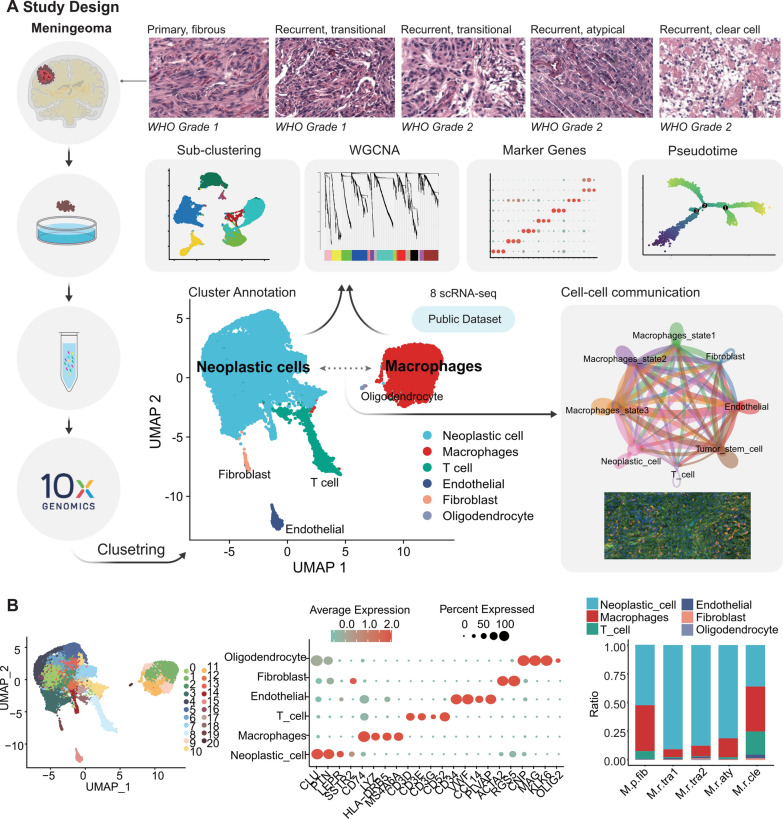
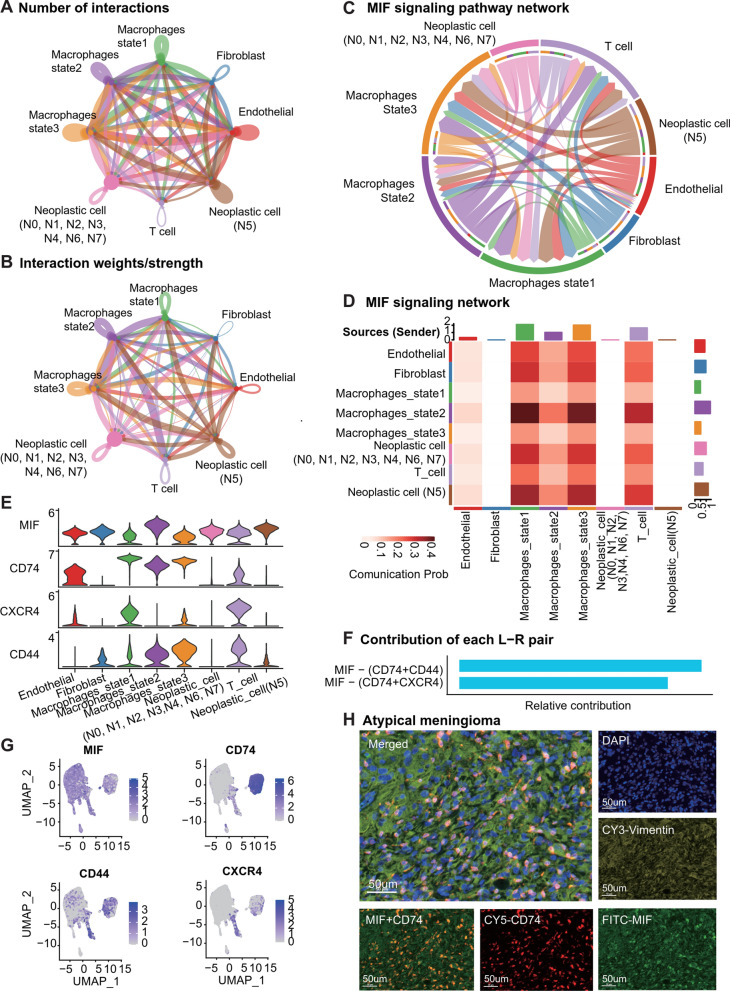
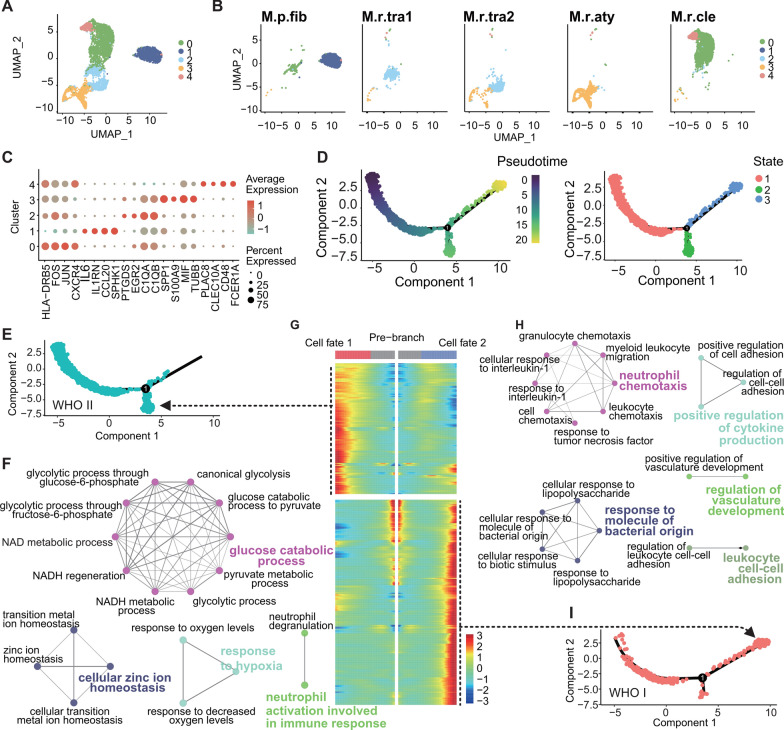
We recruited patients diagnosed with four distinct types of meningioma and performed single-cell RNA sequencing on their tumor samples, concurrently analyzing a publicly available dataset for comparison. Next, we separated the cells into discrete clusters and identified their unique identities. Using pseudotime analysis, we demonstrated cellular differentiation and dynamics. To investigate biological function, we employed weighted gene co-expression network analysis, gene regulatory network, and gene set enrichment analysis. Additionally, we conducted cell-cell communication analyses to characterize interactions among different clusters and validated a crucial interaction using multiple immunofluorescence staining.
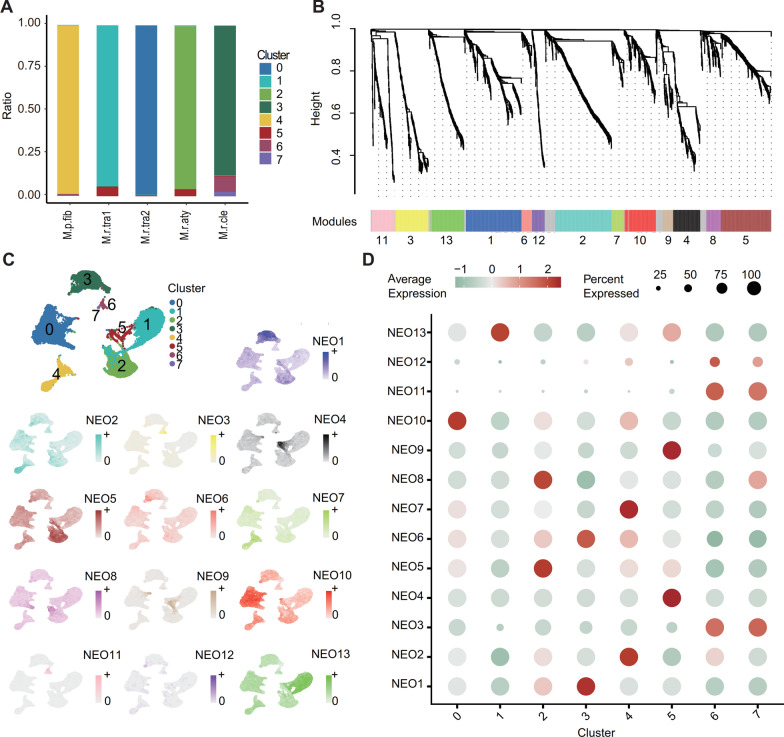
The single-cell transcriptomic profiles for five meningioma of different pathological types demonstrated that neoplastic cells exhibited high inter-sample heterogeneity and diverse biological functions featured by metabolic regulation. A small cluster of neoplastic cells (N5 cluster, < 3%) was most proliferative, indicated by high expression of MKI67 and TOP2A. They were primarily observed in our atypical and transitional meningioma samples and located at the beginning of the pseudotime differentiation branch for neoplastic cells. Macrophages, the most abundant immune cells present, showed two distinct developmental trajectories, one promoting and the other suppressing meningioma growth, with the MIF-CD74 interaction serving as the primary signaling pathway for MIF signals in the tumor environment. Unexpectedly, despite its small cluster size, the N5 cluster demonstrated a significant contribution in this interaction. By staining pathological sections of more samples, we found that this interaction was widely present in different types of meningiomas.
Meningioma neoplastic cells' diverse types cause inter-sample heterogeneity and a wide range of functions. Some proliferative neoplastic cell may educate macrophages, which promotes tumorigenesis possibly through the MIF-CD74 interaction. It provides novel clues for future potential therapeutic avenues.
在单细胞水平上分析不同病理类型的脑膜瘤,可以为每个细胞亚群的特定生物学机制提供新的、有价值的见解,以及它们在肿瘤微环境中的重要相互作用。
我们招募了诊断为四种不同类型脑膜瘤的患者,并对其肿瘤样本进行单细胞 RNA 测序,同时分析了一个公开的数据集进行比较。接下来,我们将细胞分离成离散的簇,并确定它们的独特身份。通过拟时分析,我们展示了细胞分化和动态。为了研究生物学功能,我们采用了加权基因共表达网络分析、基因调控网络和基因集富集分析。此外,我们进行了细胞间通讯分析,以描述不同簇之间的相互作用,并使用多种免疫荧光染色验证了一个关键的相互作用。
五种不同病理类型的脑膜瘤的单细胞转录组图谱表明,肿瘤细胞表现出高度的样本间异质性和多样化的生物学功能,其特征是代谢调节。一小簇肿瘤细胞(N5 簇,<3%)增殖能力最强,表现为 MKI67 和 TOP2A 的高表达。它们主要存在于我们的非典型和过渡型脑膜瘤样本中,位于肿瘤细胞拟时分化分支的起始处。巨噬细胞是最丰富的免疫细胞,表现出两种不同的发育轨迹,一种促进脑膜瘤的生长,另一种抑制脑膜瘤的生长,其中 MIF-CD74 相互作用是肿瘤微环境中 MIF 信号的主要信号通路。出乎意料的是,尽管 N5 簇的簇大小较小,但它在这种相互作用中具有显著的贡献。通过对更多样本的病理切片染色,我们发现这种相互作用广泛存在于不同类型的脑膜瘤中。
脑膜瘤肿瘤细胞的多种类型导致样本间异质性和广泛的功能。一些增殖性肿瘤细胞可能会教育巨噬细胞,通过 MIF-CD74 相互作用促进肿瘤发生。这为未来潜在的治疗途径提供了新的线索。