The School of Biomedicine, Faculty of Health and Medical Sciences, The University of Adelaide, Adelaide, SA, Australia.
Supportive Oncology Research Group, Precision Cancer Medicine Theme, South Australian Health and Medical Research Institute (SAHMRI), Adelaide, SA, Australia.
Br J Cancer. 2024 Jan;130(1):19-30. doi: 10.1038/s41416-023-02466-w. Epub 2023 Oct 26.
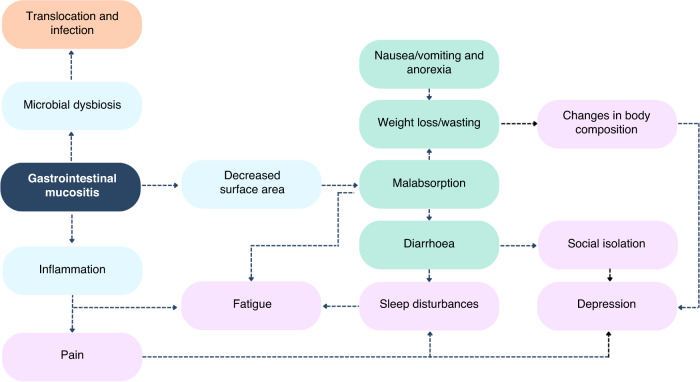
The side effects of cancer therapy continue to cause significant health and cost burden to the patient, their friends and family, and governments. A major barrier in the way in which these side effects are managed is the highly siloed mentality that results in a fragmented approach to symptom control. Increasingly, it is appreciated that many symptoms are manifestations of common underlying pathobiology, with changes in the gastrointestinal environment a key driver for many symptom sequelae. Breakdown of the mucosal barrier (mucositis) is a common and early side effect of many anti-cancer agents, known to contribute (in part) to a range of highly burdensome symptoms such as diarrhoea, nausea, vomiting, infection, malnutrition, fatigue, depression, and insomnia. Here, we outline a rationale for how, based on its already documented effects on the gastrointestinal microenvironment, medicinal cannabis could be used to control mucositis and prevent the constellation of symptoms with which it is associated. We will provide a brief update on the current state of evidence on medicinal cannabis in cancer care and outline the potential benefits (and challenges) of using medicinal cannabis during active cancer therapy.
癌症治疗的副作用继续给患者、他们的朋友和家人以及政府带来重大的健康和经济负担。这些副作用管理中的一个主要障碍是高度孤立的思维方式,导致症状控制的方法支离破碎。人们越来越认识到,许多症状是共同潜在病理生物学的表现,胃肠道环境的变化是许多症状后遗症的关键驱动因素。粘膜屏障的破坏(粘膜炎)是许多抗癌药物的常见且早期的副作用,已知它会导致一系列非常负担沉重的症状,如腹泻、恶心、呕吐、感染、营养不良、疲劳、抑郁和失眠。在这里,我们概述了一个基于其已经记录的对胃肠道微环境的影响的基本原理,药用大麻如何用于控制粘膜炎并预防与之相关的一系列症状。我们将简要介绍药用大麻在癌症治疗中的当前证据状况,并概述在癌症治疗期间使用药用大麻的潜在益处(和挑战)。