Humanity Inc, Humanity, 177 Huntington Ave, Ste 1700, Humanity Inc - 91556, Boston, MA, 02115, USA.
Department of Epidemiology and Biostatistics, School of Public Health, Faculty of Medicine, Imperial College London, London, UK.
Commun Biol. 2023 Oct 26;6(1):1089. doi: 10.1038/s42003-023-05456-z.
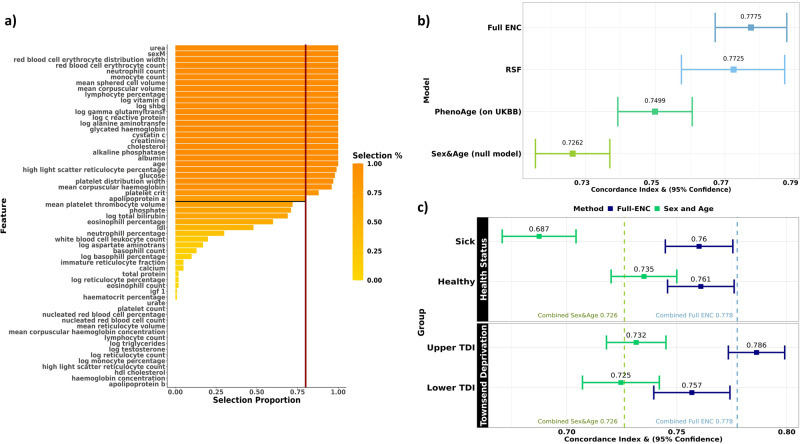
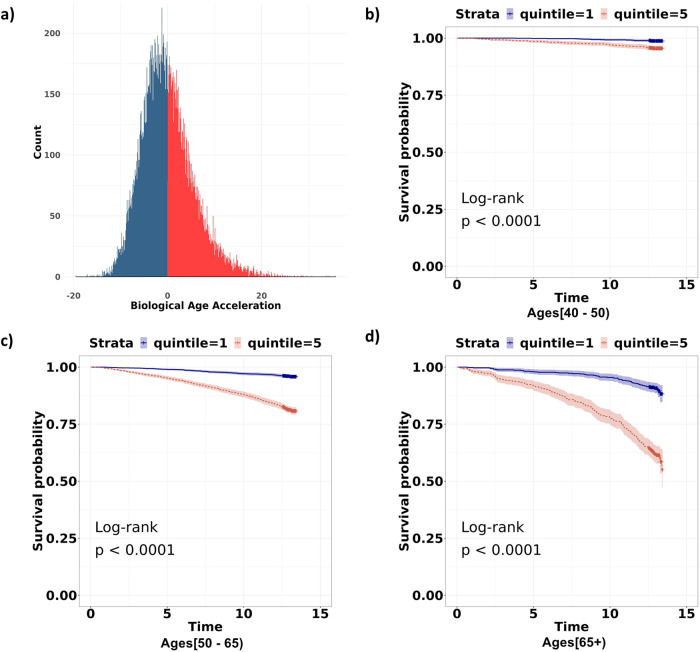
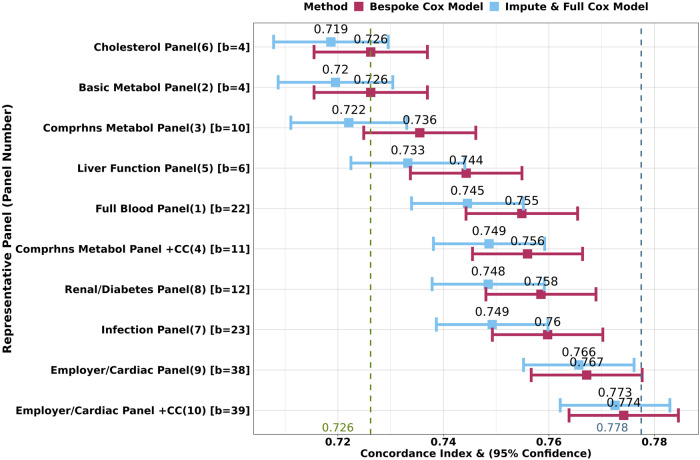
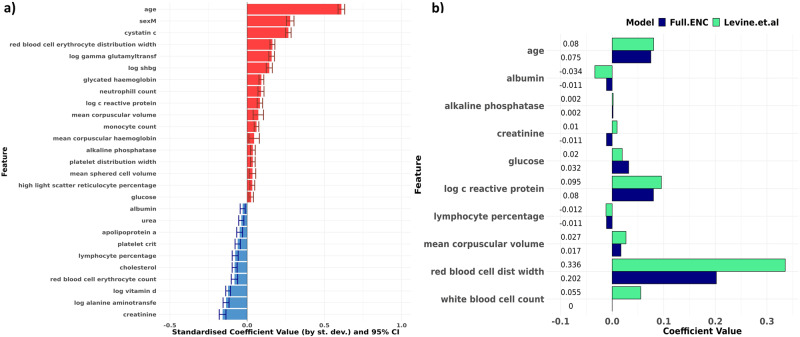
Biological age captures physiological deterioration better than chronological age and is amenable to interventions. Blood-based biomarkers have been identified as suitable candidates for biological age estimation. This study aims to improve biological age estimation using machine learning models and a feature-set of 60 circulating biomarkers available from the UK Biobank (n = 306,116). We implement an Elastic-Net derived Cox model with 25 selected biomarkers to predict mortality risk (C-Index = 0.778; 95% CI [0.767-0.788]), which outperforms the well-known blood-biomarker based PhenoAge model (C-Index = 0.750; 95% CI [0.739-0.761]), providing a C-Index lift of 0.028 representing an 11% relative increase in predictive value. Importantly, we then show that using common clinical assay panels, with few biomarkers, alongside imputation and the model derived on the full set of biomarkers, does not substantially degrade predictive accuracy from the theoretical maximum achievable for the available biomarkers. Biological age is estimated as the equivalent age within the same-sex population which corresponds to an individual's mortality risk. Values ranged between 20-years younger and 20-years older than individuals' chronological age, exposing the magnitude of ageing signals contained in blood markers. Thus, we demonstrate a practical and cost-efficient method of estimating an improved measure of Biological Age, available to the general population.
生物年龄比实际年龄更能反映生理衰退情况,并且可以通过干预加以改善。基于血液的生物标志物已被确定为生物年龄估算的合适候选者。本研究旨在使用机器学习模型和来自英国生物库(n=306116)的 60 种循环生物标志物的特征集来改善生物年龄估算。我们实施了一种基于弹性网络的 Cox 模型,使用 25 种选定的生物标志物来预测死亡率风险(C-指数=0.778;95%CI[0.767-0.788]),这优于著名的基于血液生物标志物的 PhenoAge 模型(C-指数=0.750;95%CI[0.739-0.761]),提供了 0.028 的 C-指数提升,代表预测价值相对增加了 11%。重要的是,我们随后表明,使用常见的临床检测面板和少数生物标志物,以及基于完整生物标志物集的推断和模型,不会从可用于生物标志物的理论最大预测精度上大幅降低预测准确性。生物年龄被估计为与个体死亡率风险相对应的同性别人群中的等效年龄。这些值在个体实际年龄的 20 岁以内或以外变化,揭示了血液标志物中包含的衰老信号的幅度。因此,我们展示了一种实用且具有成本效益的方法来估计生物年龄的改进指标,该指标可供一般人群使用。