Department of Epidemiology, Gillings School of Global Public Health, University of North Carolina, 123 W. Franklin St., Chapel Hill, NC 27517, USA; Epidemiology Branch, National Institute of Environmental Health Sciences, 111 TW Alexander Dr, Research Triangle Park, NC 27709, USA.
Epidemiology Branch, National Institute of Environmental Health Sciences, 111 TW Alexander Dr, Research Triangle Park, NC 27709, USA.
Environ Int. 2023 Nov;181:108270. doi: 10.1016/j.envint.2023.108270. Epub 2023 Oct 17.
DNA methylation-based measures of biological aging have been associated with air pollution and may link pollutant exposures to aging-related health outcomes. However, evidence is inconsistent and there is little information for Black women.
We examined associations of ambient particulate matter <2.5 μm and <10 μm in diameter (PM and PM) and nitrogen dioxide (NO) with DNA methylation, including epigenetic aging and individual CpG sites, and evaluated whether associations differ between Black and non-Hispanic White (NHW) women.
Validated models were used to estimate annual average outdoor residential exposure to PM, PM, and NO in a sample of self-identified Black (n=633) and NHW (n=3493) women residing in the contiguous US. We used sampling-weighted generalized linear regression to examine the effects of pollutants on six epigenetic aging measures (primary: DunedinPACE, GrimAgeAccel, and PhenoAgeAccel; secondary: Horvath intrinsic epigenetic age acceleration [EAA], Hannum extrinsic EAA, and skin & blood EAA) and epigenome-wide associations for individual CpG sites. Wald tests of nested models with and without interaction terms were used to examine effect measure modification by race/ethnicity.
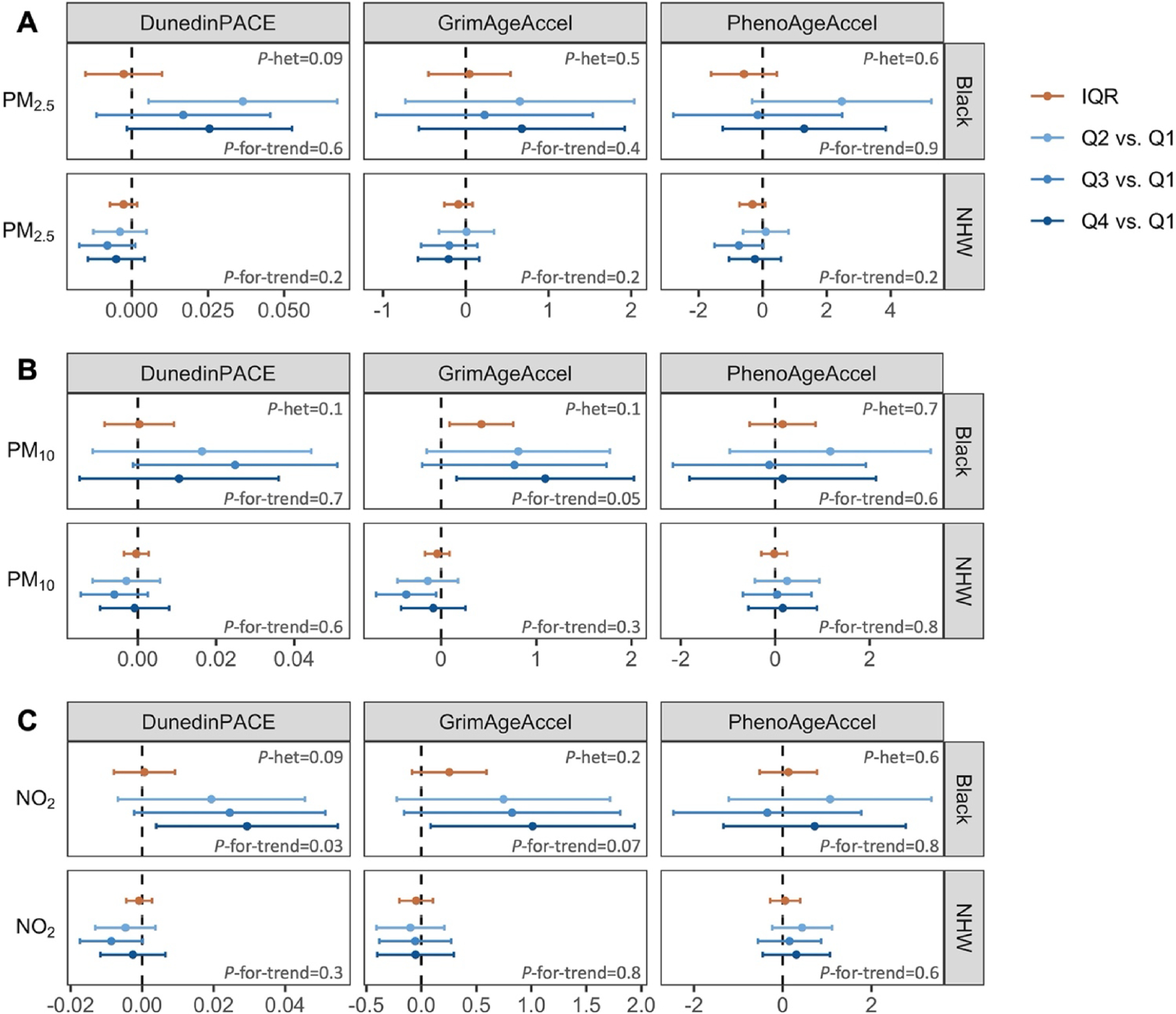
Black participants had higher median air pollution exposure than NHW participants. GrimAgeAccel was associated with both PM and NO among Black participants, (Q4 versus Q1, PM: β=1.09, 95% CI: 0.16-2.03; NO: β=1.01, 95% CI 0.08-1.94) but not NHW participants (p-for-heterogeneity: PM=0.10, NO=0.20). In Black participants, we also observed a monotonic exposure-response relationship between NO and DunedinPACE (Q4 versus Q1, NO: β=0.029, 95% CI: 0.004-0.055; p-for-trend=0.03), which was not observed in NHW participants (p-for-heterogeneity=0.09). In the EWAS, pollutants were significantly associated with differential methylation at 19 CpG sites in Black women and one in NHW women.
In a US-wide cohort study, our findings suggest that air pollution is associated with DNA methylation alterations consistent with higher epigenetic aging among Black, but not NHW, women.
基于 DNA 甲基化的生物年龄衡量指标与空气污染有关,可能将污染物暴露与与衰老相关的健康结果联系起来。然而,证据并不一致,而且针对黑人女性的信息很少。
我们研究了环境细颗粒物<2.5μm 和<10μm 直径(PM 和 PM)和二氧化氮(NO)与 DNA 甲基化的关联,包括表观遗传衰老和个体 CpG 位点,并评估了这些关联在黑人女性和非西班牙裔白人(NHW)女性之间是否存在差异。
在一个自我认定的黑人(n=633)和 NHW(n=3493)女性的样本中,使用经过验证的模型来估计户外住宅的年平均 PM、PM 和 NO 暴露。我们使用采样加权广义线性回归来研究污染物对六种表观遗传衰老衡量指标的影响(主要指标:邓迪表观遗传年龄加速(DunedinPACE)、GrimAgeAccel 和 PhenoAgeAccel;次要指标:Horvath 内在表观遗传年龄加速(EAA)、Hannum 外在 EAA 和皮肤和血液 EAA)以及单个 CpG 位点的全基因组关联。使用包含和不包含交互项的嵌套模型的 Wald 检验来检查种族/民族的效应修正。
黑人参与者的平均空气污染物暴露量高于 NHW 参与者。在黑人参与者中,GrimAgeAccel 与 PM 和 NO 均有关联(Q4 与 Q1 相比,PM:β=1.09,95%CI:0.16-2.03;NO:β=1.01,95%CI:0.08-1.94),但 NHW 参与者没有(p 异质性=0.10,NO=0.20)。在黑人参与者中,我们还观察到 NO 与 DunedinPACE 之间存在单调的暴露-反应关系(Q4 与 Q1 相比,NO:β=0.029,95%CI:0.004-0.055;p 趋势=0.03),而 NHW 参与者则没有(p 异质性=0.09)。在 EWAS 中,污染物与黑人女性 19 个 CpG 位点和一个 NHW 女性的差异甲基化显著相关。
在一项美国范围内的队列研究中,我们的研究结果表明,空气污染与黑人女性而非 NHW 女性的 DNA 甲基化改变有关,这些改变与更高的表观遗传衰老一致。