Department of Anesthesiology, School of Medicine, Washington University in St. Louis, St. Louis, MO, USA.
Institute for Informatics, Data Science and Biostatistics, School of Medicine, Washington University in St. Louis, St. Louis, MO, USA.
BMC Health Serv Res. 2023 Oct 27;23(1):1175. doi: 10.1186/s12913-023-10186-3.
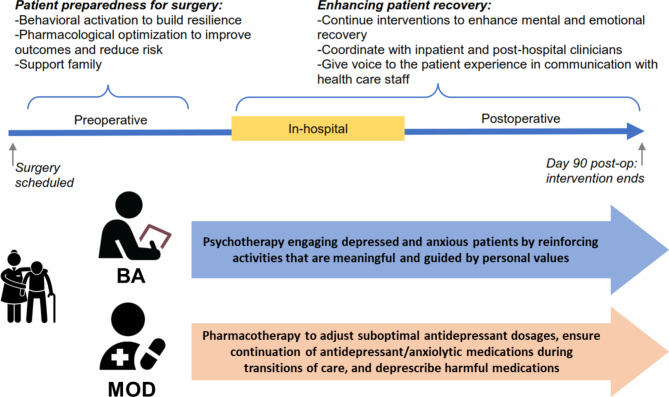
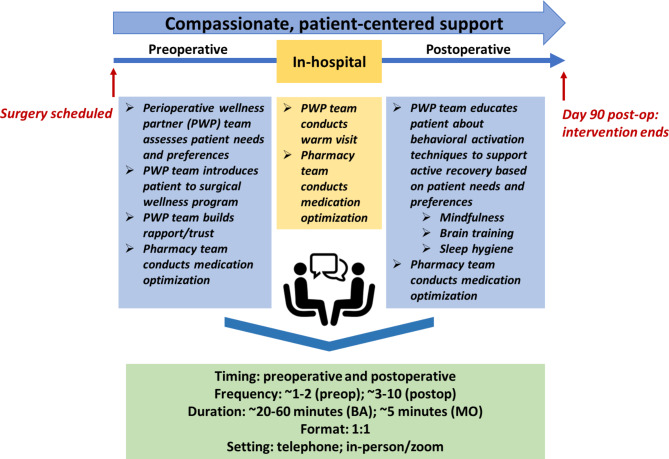
Anxiety and depression are common among older adults and can intensify during perioperative periods, but few mental health interventions are designed for older surgical patients' unique needs. As part of the feasibility trial, we developed and adapted a perioperative mental health (PMH) bundle for older patients comprised of behavioral activation (BA) and medication optimization (MO) to ameliorate anxiety and depressive symptoms before, during, and after cardiac, orthopedic, and oncologic surgery.
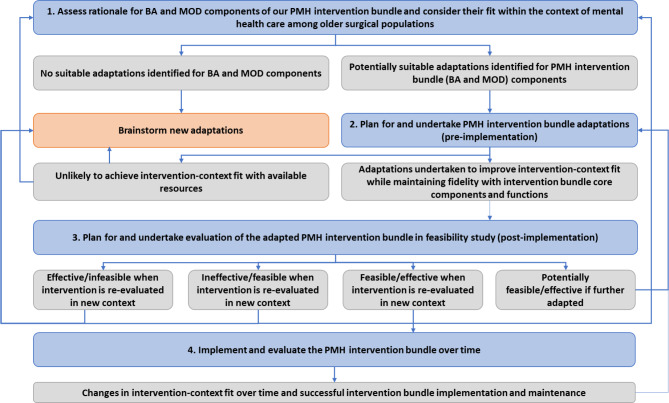
We used mixed-methods including workshop studios with patients, caregivers, clinicians, researchers, and interventionists; intervention refinement and reflection meetings; patient case review meetings; intervention session audio-recordings and documentation forms; and patient and caregiver semi-structured interviews. We used the results to refine our PMH bundle. We used multiple analytical approaches to report the nature of adaptations, including hybrid thematic analysis and content analysis informed by the Framework for Reporting Adaptations and Modifications - Expanded.
Adaptations were categorized by content (intervention components), context (how the intervention is delivered, based on the study, target population, intervention format, intervention delivery mode, study setting, study personnel), training, and evaluation. Of 51 adaptations, 43.1% involved content, 41.2% involved context, and 15.7% involved training and evaluation. Several key adaptations were noted: (1) Intervention content was tailored to patient preferences and needs (e.g., rewording elements to prevent stigmatization of mental health needs; adjusting BA techniques and documentation forms to improve patient buy-in and motivation). (2) Cohort-specific adaptations were recommended based on differing patient needs. (3) Compassion was identified by patients as the most important element.
We identified evidence-based mental health intervention components from other settings and adapted them to the perioperative setting for older adults. Informed by mixed-methods, we created an innovative and pragmatic patient-centered intervention bundle that is acceptable, feasible, and responsive to the needs of older surgical populations. This approach allowed us to identify implementation strategies to improve the reach, scalability, and sustainability of our bundle, and can guide future patient-centered intervention adaptations.
NCT05110690 (11/08/2021).
焦虑和抑郁在老年人中很常见,并且在围手术期会加重,但针对老年手术患者的特殊需求,很少有心理健康干预措施。作为可行性试验的一部分,我们为老年患者开发并调整了围手术期心理健康 (PMH) 包,其中包括行为激活 (BA) 和药物优化 (MO),以在心脏、骨科和肿瘤科手术之前、期间和之后改善焦虑和抑郁症状。
我们使用了混合方法,包括与患者、护理人员、临床医生、研究人员和干预人员一起进行工作坊工作室;干预措施的改进和反思会议;患者病例审查会议;干预会议的音频记录和文件表格;以及患者和护理人员的半结构化访谈。我们使用这些结果来改进我们的 PMH 包。我们使用了多种分析方法来报告适应的性质,包括混合主题分析和内容分析,这些分析方法是根据适应和修改框架 - 扩展报告的。
适应措施按内容(干预组成部分)、背景(根据研究、目标人群、干预格式、干预提供模式、研究设置、研究人员进行干预的方式)、培训和评估进行分类。在 51 项适应措施中,有 43.1%涉及内容,41.2%涉及背景,15.7%涉及培训和评估。我们注意到了几个关键的适应措施:(1)干预内容根据患者的偏好和需求进行了调整(例如,重新措辞以防止对心理健康需求的污名化;调整 BA 技术和记录表格以提高患者的认同和积极性)。(2)根据不同患者的需求推荐了特定于队列的适应措施。(3)患者认为同情心是最重要的因素。
我们从其他环境中确定了基于证据的心理健康干预措施,并将其适应于老年人的围手术期环境。通过混合方法,我们创建了一个创新且实用的以患者为中心的干预包,该干预包是可以接受的、可行的,并能满足老年手术人群的需求。这种方法使我们能够确定实施策略,以提高我们的干预措施的覆盖范围、可扩展性和可持续性,并为未来的以患者为中心的干预措施的适应提供指导。
NCT05110690(2021 年 11 月 8 日)。