Personalized Medicine Laboratory, National Institute of Gastroenterology "S. de Bellis", IRCCS Research Hospital, Via Turi 27, 70013, Castellana Grotte, BA, Italy.
Scientific Direction, National Institute of Gastroenterology "S. de Bellis", IRCCS Research Hospital, Via Turi 27, 70013, Castellana Grotte, BA, Italy.
J Biomed Sci. 2023 Oct 27;30(1):90. doi: 10.1186/s12929-023-00983-7.
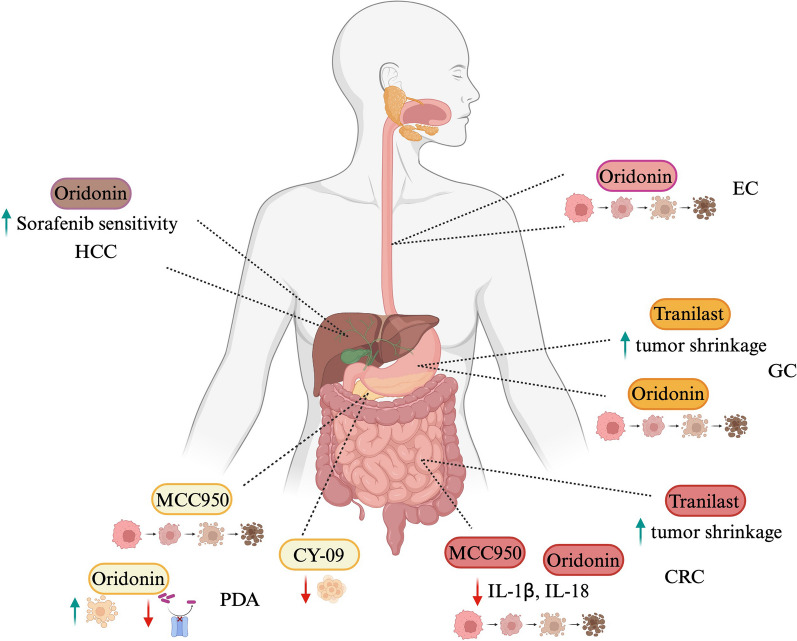
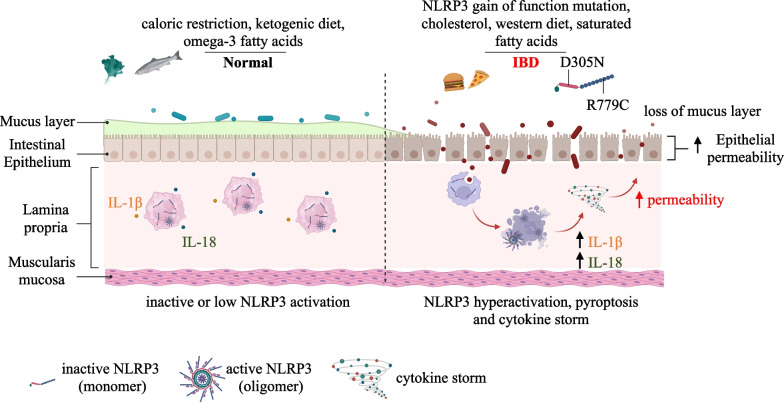
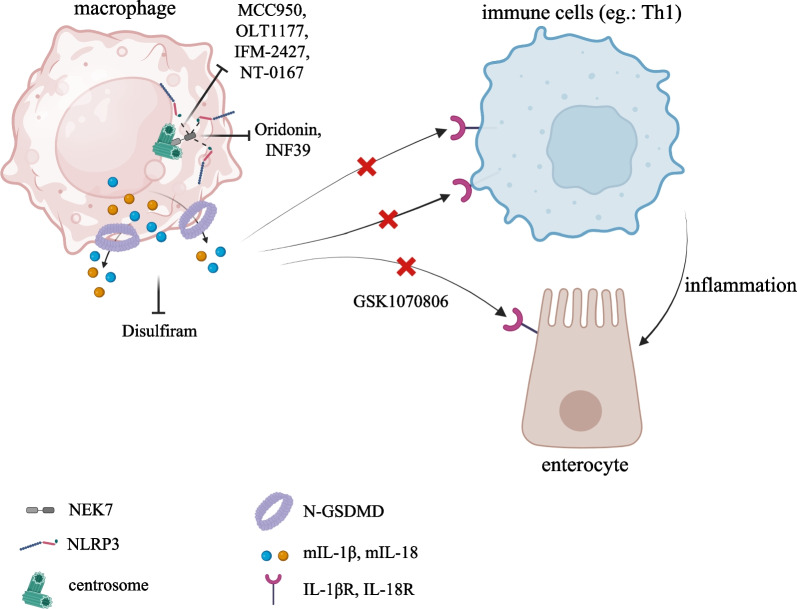
The NLRP3 inflammasome is an intracellular sensor and an essential component of the innate immune system involved in danger recognition. An important hallmark of inflammasome activation is the formation of a single supramolecular punctum, known as a speck, per cell, which is the site where the pro-inflammatory cytokines IL-1β and IL-18 are converted into their bioactive form. Speck also provides the platform for gasdermin D protein activation, whose N-terminus domain perforates the plasma membrane, allowing the release of mature cytokines alongside with a highly inflammatory form of cell death, namely pyroptosis. Although controlled NLRP3 inflammasome-pyroptosis pathway activation preserves mucosal immunity homeostasis and contributes to host defense, a prolonged trigger is deleterious and could lead, in genetically predisposed subjects, to the onset of inflammatory bowel disease, including Crohn's disease and ulcerative colitis, as well as to gastrointestinal cancer. Experimental evidence shows that the NLRP3 inflammasome has both protective and pathogenic abilities. In this review we highlight the impact of the NLRP3-pyroptosis axis on the pathophysiology of the gastrointestinal tract at molecular level, focusing on newly discovered features bearing pro- and anti-inflammatory and neoplastic activity, and on targeted therapies tested in preclinical and clinical trials.
NLRP3 炎性小体是一种细胞内传感器,也是参与危险识别的固有免疫系统的重要组成部分。炎性小体激活的一个重要标志是每个细胞中形成一个单一的超分子小点,称为斑点,这是促炎细胞因子 IL-1β 和 IL-18 转化为其生物活性形式的部位。斑点也是 gasdermin D 蛋白激活的平台,其 N 端结构域穿孔质膜,允许成熟细胞因子与一种高度炎症性的细胞死亡形式(即细胞焦亡)一起释放。虽然受控的 NLRP3 炎性小体-细胞焦亡途径激活可维持黏膜免疫稳态并有助于宿主防御,但长期触发则是有害的,并且可能导致遗传易感性的个体出现炎症性肠病,包括克罗恩病和溃疡性结肠炎,以及胃肠道癌症。实验证据表明,NLRP3 炎性小体具有保护和致病能力。在这篇综述中,我们强调了 NLRP3-细胞焦亡轴在分子水平上对胃肠道生理学的影响,重点介绍了具有促炎、抗炎和致癌活性的新发现特征,以及在临床前和临床试验中测试的靶向治疗。