CRIMEDIM - Center for Research and Training in Disaster Medicine, Humanitarian Aid and Global Health, Università del Piemonte Orientale, 28100, Novara, Italy.
Department for Sustainable Development and Ecological Transition, Università del Piemonte Orientale, 13100, Vercelli, Italy.
Int J Equity Health. 2023 Oct 27;22(1):227. doi: 10.1186/s12939-023-02038-7.
Conflicts exacerbate dynamics of power and inequalities through violence normalization, which acts as a facilitator for conflict-related sexual violence. Literature addressing its negative outcomes on survivors is scant. The aim of this systematic review was to analyze the qualitative evidence reported in scientific literature and focusing on the negative consequences of conflict-related sexual violence on victims' physical, psychological, and social dimensions of health in a gender-inclusive and disaggregated form.
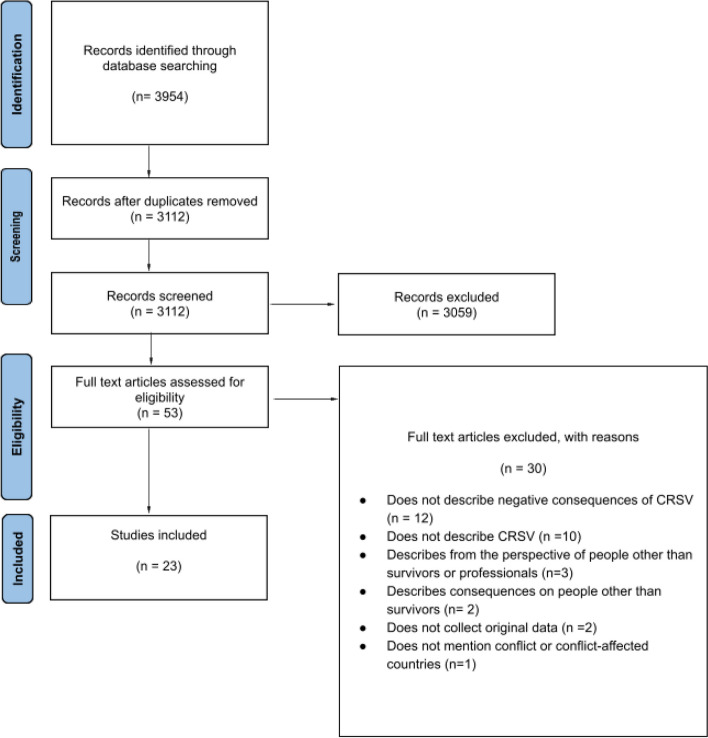
A literature search was conducted on January 13, 2023 on Pubmed, Scopus, and PsychArticles. The search strings combined two blocks of terms related to sexual violence and conflict. A time filter was applied, limiting the search to studies published in the last ten years. Information regarding the main characteristics and design of the study, survivors and their experience, and about conflict-related sexual violence was collected. The negative consequences of conflict-related sexual violence on the physical, psychological, and social dimension of victims were extracted according to the Biopsychosocial model of health. The review followed the Joanna Briggs Institute methodology for systematic reviews and relied on the Preferred Reporting Items for Systematic reviews and Meta-Analyses.
After full text review, 23 articles met the inclusion criteria, with 18 of them reporting negative repercussions on physical health, all of them highlighting adverse psychological outcomes, and 21 disclosing unfavorable social consequences. The negative outcomes described in multiple studies were sexual and reproductive health issues, the most mentioned being pregnancy, manifestations of symptoms attributable to post-traumatic stress disorder, and stigma. A number of barriers to access to care were presented as emerging findings.
This review provided an analysis of the negative consequences of conflict-related sexual violence on survivors, thus highlighting the importance of qualitative evidence in understanding these outcomes and addressing barriers to access to care. Conflict-related sexual violence is a sexual and reproductive health issue. Sexuality education is needed at individual, community, and provider level, challenging gender norms and roles and encompassing gender-based violence. Gender-inclusive protocols and services need to be implemented to address the specific needs of all victims. Governments should advocate for SRHRs and translate health policies into services targeting survivors of CRSV.
冲突通过暴力常态化加剧了权力和不平等的动态,而暴力常态化是与冲突相关的性暴力的促进因素。关于其对幸存者产生的负面影响的文献很少。本系统评价的目的是分析科学文献中报告的定性证据,并以性别包容和分类的形式关注与冲突相关的性暴力对受害者身心健康的负面影响。
2023 年 1 月 13 日,在 Pubmed、Scopus 和 PsychArticles 上进行了文献检索。检索词结合了与性暴力和冲突相关的两个词块。应用时间过滤器,将搜索范围限制在过去十年发表的研究中。收集了研究的主要特征和设计、幸存者及其经历以及与冲突相关的性暴力的信息。根据健康的生物心理社会模型,提取与冲突相关的性暴力对受害者身体、心理和社会维度的负面影响。本评价遵循乔安娜·布里格斯研究所的系统评价方法,并依赖系统评价和荟萃分析的首选报告项目。
经过全文审查,有 23 篇文章符合纳入标准,其中 18 篇报告了对身体健康的负面影响,所有文章都强调了不良的心理后果,21 篇文章披露了不利的社会后果。多项研究中描述的负面结果是性健康和生殖健康问题,最常提到的是怀孕、创伤后应激障碍症状的表现和耻辱感。还提出了一些获得护理的障碍作为新出现的发现。
本评价对与冲突相关的性暴力对幸存者的负面影响进行了分析,从而强调了定性证据在理解这些结果和解决获得护理的障碍方面的重要性。与冲突相关的性暴力是性健康和生殖健康问题。需要在个人、社区和提供者层面开展性教育,挑战性别规范和角色,并包含基于性别的暴力。需要实施性别包容的方案和服务,以满足所有受害者的特定需求。政府应倡导性健康和生殖健康权利,并将卫生政策转化为针对与冲突相关的性暴力幸存者的服务。