Brito Suneeta, Williams Allison, Fox Jenny, Mohammed Tazuddin, Chahin Nayef, McCarthy Kaitlin, Nubayaat Lamisa, Nunlist Shirley, Brannon Mason, Xu Jie, Hendricks-Muñoz Karen D
Division of Neonatal Medicine, Department of Pediatrics, Children's Hospital of Richmond at VCU, Virginia Commonwealth University School of Medicine, P.O. Box 980646, Richmond, VA 23298-0646, USA.
Department of Psychology, Virginia Commonwealth University School of Medicine, P.O. Box 980646, Richmond, VA 23298-0646, USA.
Children (Basel). 2023 Sep 30;10(10):1635. doi: 10.3390/children10101635.
Lactation support is an important measure of Family-Centered Care (FCC) in the Neonatal Intensive Care Unit (NICU). Life-limiting conditions (LLCs) raise complex ethical care issues for providers and parents in the NICU and represent a key and often overlooked population for whom FCC is particularly important. We investigated healthcare disparities in FCC lactation support quality in infants with LLCs.
A retrospective cohort of inborn infants with or without LLCs admitted to the NICU between 2015-2023 included 395 infants with 219 LLC infants and 176 matched non-LLC infants and were compared on LLC supports.
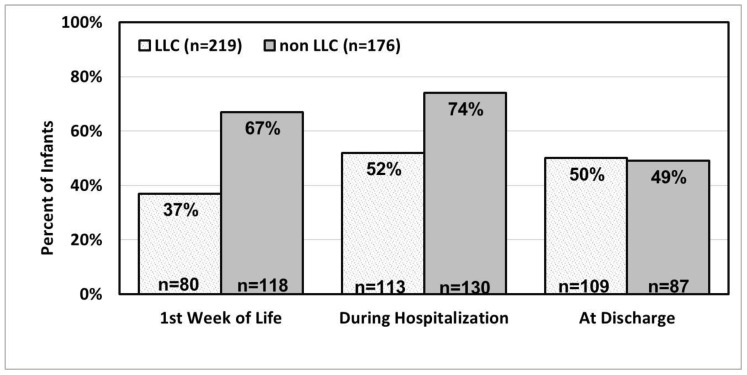
The LLC cohort experienced greater skin-to-skin support, but less lactation specialist visits, breast pumps provided, and human milk oral care use. LLC infants also experienced less maternal visitation, use of donor milk (LLC: 15.5%, non-LLC: 33.5%), and breastfeeds (LLC: 24.2%, non-LLC: 43.2%), with lower mean human milk provision (LLC: 36.6%, non-LLC: 67.1%). LLC infants who survived to discharge had similar human milk use as non-LLC infants (LLC: 49.8%, non-LLC: 50.6%).
Lactation support was significantly absent for families and infants who presented with LLCs in the NICU, suggesting that policies can be altered to increase lactation support FCC quality for this population.
泌乳支持是新生儿重症监护病房(NICU)以家庭为中心的护理(FCC)的一项重要措施。危及生命的疾病(LLCs)给NICU的医护人员和家长带来了复杂的伦理护理问题,并且是FCC尤为重要但常被忽视的关键人群。我们调查了患有LLCs的婴儿在FCC泌乳支持质量方面的医疗保健差异。
一项回顾性队列研究,纳入了2015年至2023年间入住NICU的有或无LLCs的出生婴儿,其中包括395名婴儿,219名患有LLCs的婴儿和176名匹配的无LLCs婴儿,并对LLCs支持情况进行了比较。
患有LLCs的队列接受了更多的皮肤接触支持,但泌乳专家访视、提供的吸奶器和使用人乳口腔护理较少。患有LLCs的婴儿接受的母亲探视、使用捐赠母乳(LLCs:15.5%,无LLCs:33.5%)和母乳喂养(LLCs:24.2%,无LLCs:43.2%)也较少,平均人乳供应量较低(LLCs:36.6%,无LLCs:67.1%)。存活至出院的患有LLCs的婴儿与人乳使用情况与无LLCs的婴儿相似(LLCs:49.8%,无LLCs:50.6%)。
NICU中患有LLCs的家庭和婴儿明显缺乏泌乳支持,这表明可以改变政策,以提高该人群的FCC泌乳支持质量。