Programa de Pós-Graduação em Biociências, Universidade Federal de Ciências da Saúde de Porto Alegre (UFCSPA), Rua Sarmento Leite, 245, Porto Alegre 90050-170, Brazil.
Graduação em Nutrição, Universidade Federal de Ciências da Saúde de Porto Alegre (UFCSPA), Rua Sarmento Leite, 245, Porto Alegre 90050-170, Brazil.
Nutrients. 2023 Oct 17;15(20):4396. doi: 10.3390/nu15204396.
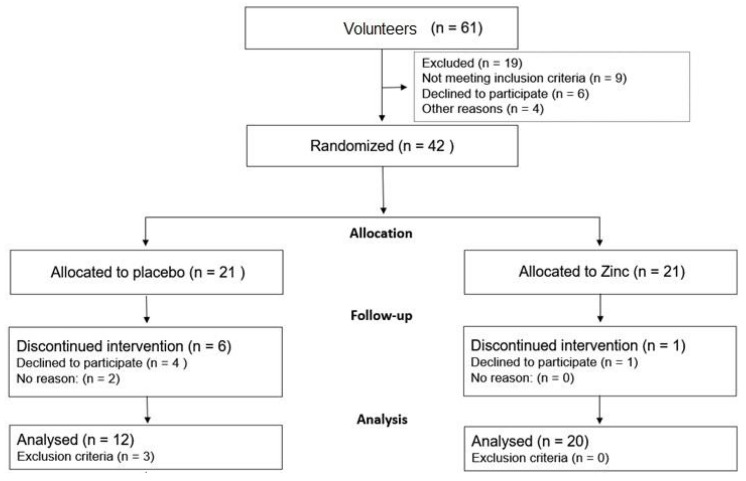
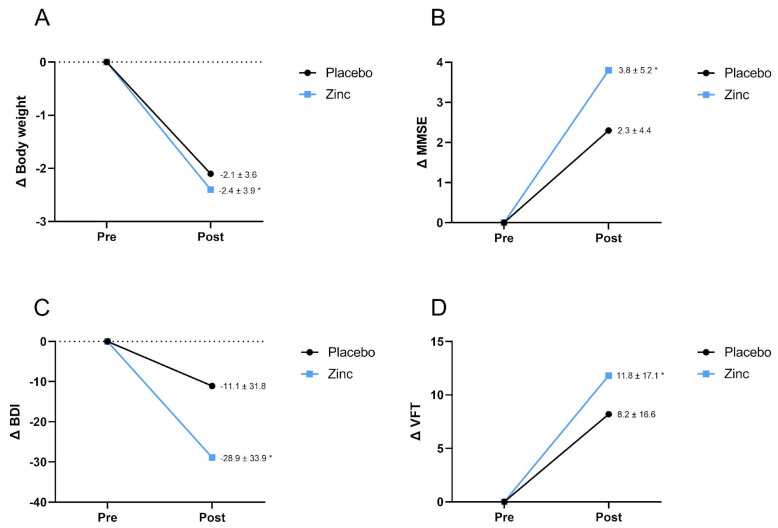
Obesity has been linked to cognitive decline and adverse effects on brain health. Zinc (Zn) is a mineral with important metabolic functions that can modulate obesity-related neurological impairment. Thus, the present study aimed to evaluate the effects of 12 weeks of Zn supplementation on the inflammatory profile, cognitive function, and mood of overweight or obese women through a double-blind, placebo-controlled study. The study included 42 women aged between 40 and 60, randomly divided into two groups: Zn supplementation (30 mg/day) or placebo for 12 weeks. Data regarding sociodemographic, anthropometric, dietary, and physical activity were collected. Mini-mental state examination (MMSE), verbal fluency test, clock drawing test, and Stroop test were performed. Anxiety and depression symptoms were assessed using the Beck anxiety inventory and the BDI-II, respectively. Saliva samples were collected to evaluate IL-1β, IL-6, TNF-α, insulin, nitrite, and Zn levels. Of the 42 participants (mean age 49.58 ± 6.46 years), 32 were included in the study analyses. Changes in body weight and macronutrient consumption were not different between placebo and Zn supplementation groups. Cognitive scores on the MMSE and Stroop tests were higher in the Zn supplementation group than in the placebo group. Salivary levels of IL-1b and Zn increased in the Zn group compared to placebo. There was no significant change in the adjusted means of the BDI-II and BECK scores between the zinc vs. placebo groups. Twelve weeks of Zn supplementation was able to partially improve the cognitive scores assessed in overweight or obese women, regardless of weight loss. These findings suggest that Zn supplementation can be considered an adjunct strategy to enhance cognitive health in overweight or obese women.
肥胖与认知能力下降和大脑健康不良影响有关。锌(Zn)是一种具有重要代谢功能的矿物质,可调节肥胖相关的神经损伤。因此,本研究旨在通过一项双盲、安慰剂对照研究评估 12 周锌补充对超重或肥胖女性的炎症谱、认知功能和情绪的影响。该研究纳入了 42 名年龄在 40 至 60 岁之间的女性,随机分为两组:锌补充(30 毫克/天)或安慰剂组,持续 12 周。收集了社会人口统计学、人体测量学、饮食和身体活动的数据。进行了简易精神状态检查(MMSE)、言语流畅性测试、画钟测试和斯特鲁普测试。使用贝克焦虑量表和 BDI-II 分别评估焦虑和抑郁症状。收集唾液样本以评估 IL-1β、IL-6、TNF-α、胰岛素、亚硝酸盐和 Zn 水平。在 42 名参与者(平均年龄 49.58 ± 6.46 岁)中,有 32 名参与者纳入了研究分析。安慰剂和锌补充组之间的体重和宏量营养素摄入量的变化没有差异。在 MMSE 和 Stroop 测试中,锌补充组的认知评分高于安慰剂组。与安慰剂组相比,锌组唾液中 IL-1b 和 Zn 的水平升高。在锌组与安慰剂组之间,BDI-II 和 BECK 评分的调整均值没有显著变化。12 周的锌补充能够部分改善超重或肥胖女性的认知评分,而与体重减轻无关。这些发现表明,锌补充可以被认为是增强超重或肥胖女性认知健康的辅助策略。