Department of Pathology, Texas Tech University Health Sciences Center, Lubbock, TX 79430, USA.
Department of Biochemistry, Texas Tech University, Lubbock, TX 79409, USA.
Nutrients. 2023 Oct 17;15(20):4403. doi: 10.3390/nu15204403.
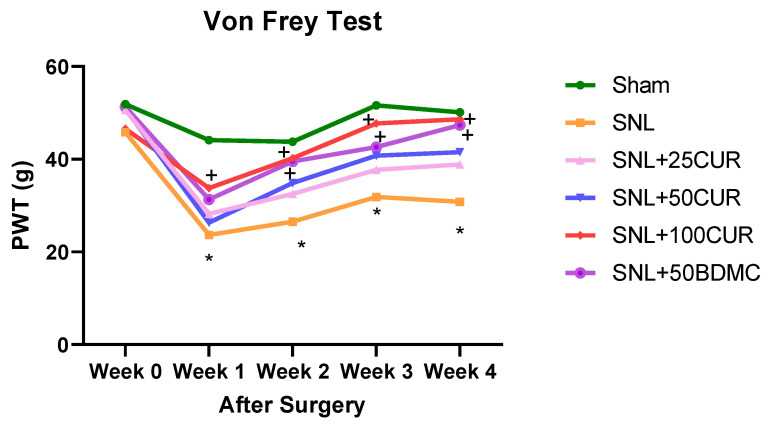
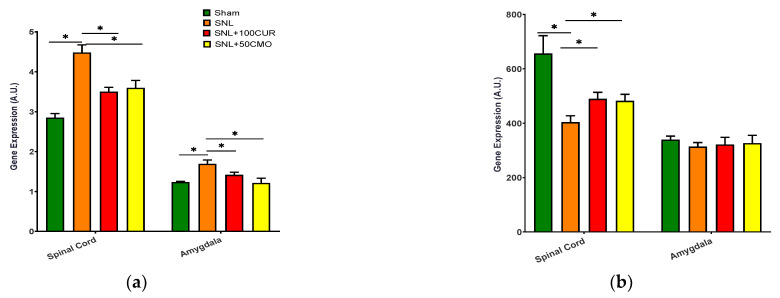
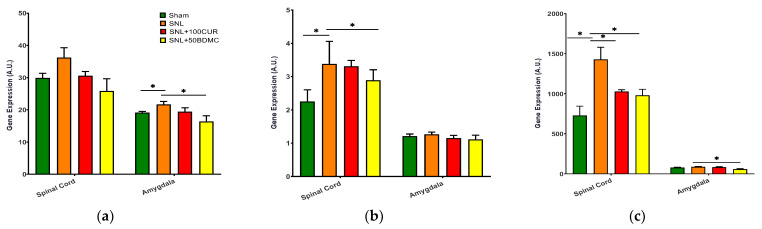
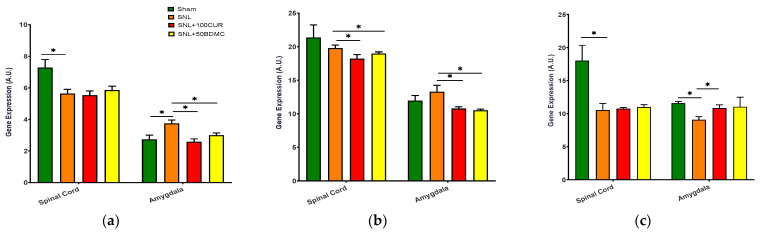
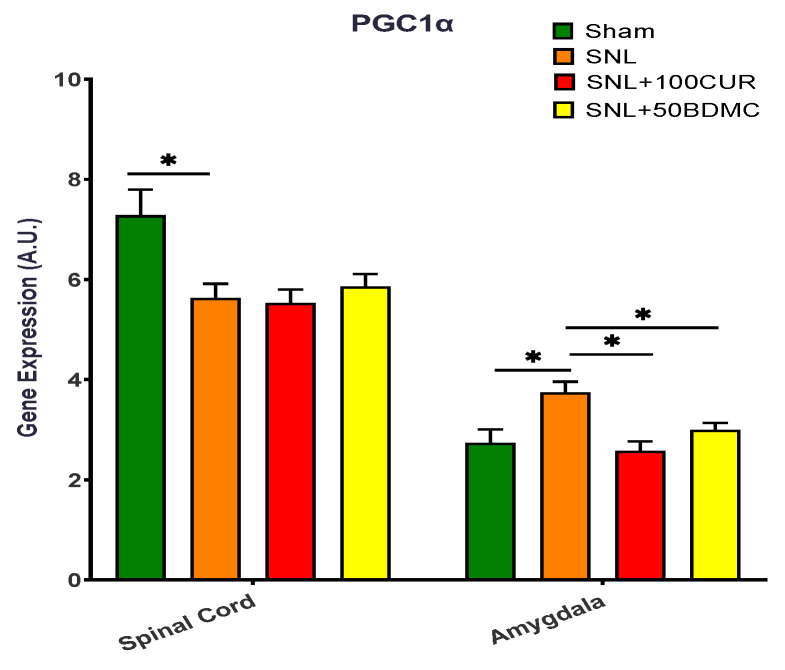
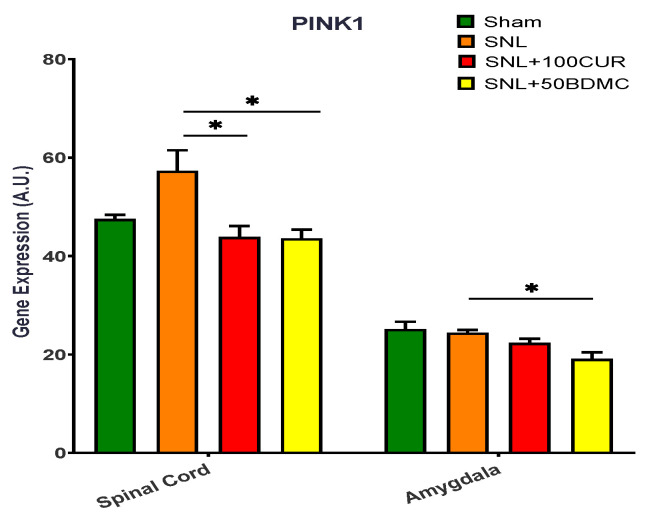
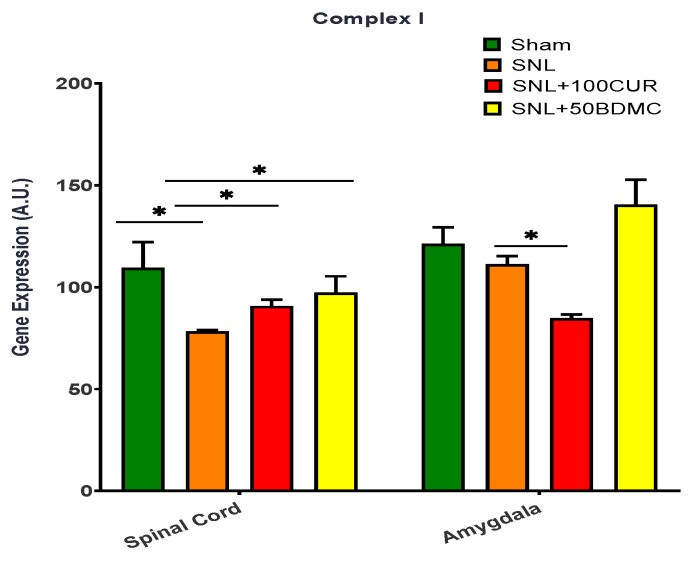
This study examined the effects of turmeric bioactive compounds, curcumin C3 complex® (CUR) and bisdemethoxycurcumin (BDMC), on mechanical hypersensitivity and the gene expression of markers for glial activation, mitochondrial function, and oxidative stress in the spinal cord and amygdala of rats with neuropathic pain (NP). Twenty-four animals were randomly assigned to four groups: sham, spinal nerve ligation (SNL, an NP model), SNL+100 mg CUR/kg BW p.o., and SNL+50 mg BDMC/kg BW p.o. for 4 weeks. Mechanical hypersensitivity was assessed by the von Frey test (VFT) weekly. The lumbosacral section of the spinal cord and the right amygdala (central nucleus) were collected to determine the mRNA expression of genes (IBA-1, CD11b, GFAP, MFN1, DRP1, FIS1, PGC1α, PINK, Complex I, TLR4, and SOD1) utilizing qRT-PCR. Increased mechanical hypersensitivity and increased gene expression of markers for microglial activation (IBA-1 in the amygdala and CD11b in the spinal cord), astrocyte activation (GFAP in the spinal cord), mitochondrial dysfunction (PGC1α in the amygdala), and oxidative stress (TLR4 in the spinal cord and amygdala) were found in untreated SNL rats. Oral administration of CUR and BDMC significantly decreased mechanical hypersensitivity. CUR decreased CD11b and GFAP gene expression in the spinal cord. BDMC decreased IBA-1 in the spinal cord and amygdala as well as CD11b and GFAP in the spinal cord. Both CUR and BDMC reduced PGC1α gene expression in the amygdala, PINK1 gene expression in the spinal cord, and TLR4 in the spinal cord and amygdala, while they increased Complex I and SOD1 gene expression in the spinal cord. CUR and BDMC administration decreased mechanical hypersensitivity in NP by mitigating glial activation, oxidative stress, and mitochondrial dysfunction.
本研究探讨了姜黄生物活性化合物姜黄素 C3 复合物(CUR)和双去甲氧基姜黄素(BDMC)对神经病理性疼痛(NP)大鼠脊髓和杏仁核中神经胶质细胞激活标志物、线粒体功能和氧化应激基因表达的影响。24 只动物随机分为四组:假手术组、脊神经结扎组(NP 模型)、脊神经结扎+100mgCUR/kgBW 灌胃组和脊神经结扎+50mgBDMC/kgBW 灌胃组,共 4 周。每周通过 von Frey 测试(VFT)评估机械性超敏反应。收集腰骶段脊髓和右侧杏仁核(中央核),利用 qRT-PCR 检测基因(IBA-1、CD11b、GFAP、MFN1、DRP1、FIS1、PGC1α、PINK1、Complex I、TLR4 和 SOD1)的 mRNA 表达。未经处理的 SNL 大鼠出现机械性超敏反应增加和小胶质细胞激活标志物(杏仁核中 IBA-1 和脊髓中 CD11b)、星形胶质细胞激活标志物(脊髓中 GFAP)、线粒体功能障碍标志物(杏仁核中 PGC1α)和氧化应激标志物(脊髓和杏仁核中 TLR4)基因表达增加。CUR 和 BDMC 口服给药可显著降低机械性超敏反应。CUR 降低脊髓中 CD11b 和 GFAP 基因表达。BDMC 降低脊髓和杏仁核中的 IBA-1 以及脊髓中的 CD11b 和 GFAP。CUR 和 BDMC 降低杏仁核中的 PGC1α 基因表达、脊髓中的 PINK1 基因表达和脊髓和杏仁核中的 TLR4,同时增加脊髓中的 Complex I 和 SOD1 基因表达。CUR 和 BDMC 给药通过减轻神经胶质细胞激活、氧化应激和线粒体功能障碍降低 NP 大鼠的机械性超敏反应。