Ermakov Artem M, Afanasyeva Vera A, Lazukin Alexander V, Shlyapnikov Yuri M, Zhdanova Elizaveta S, Kolotova Anastasia A, Blagodatski Artem S, Ermakova Olga N, Chukavin Nikita N, Ivanov Vladimir K, Popov Anton L
Hospital of the Pushchino Scientific Center of the Russian Academy of Sciences, 142290 Pushchino, Russia.
Institute of Theoretical and Experimental Biophysics of the Russian Academy of Sciences, 142290 Pushchino, Russia.
Biomedicines. 2023 Oct 13;11(10):2780. doi: 10.3390/biomedicines11102780.
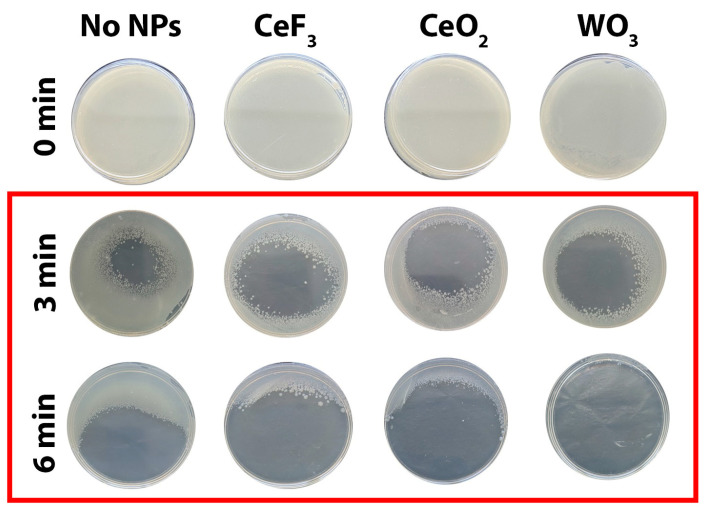
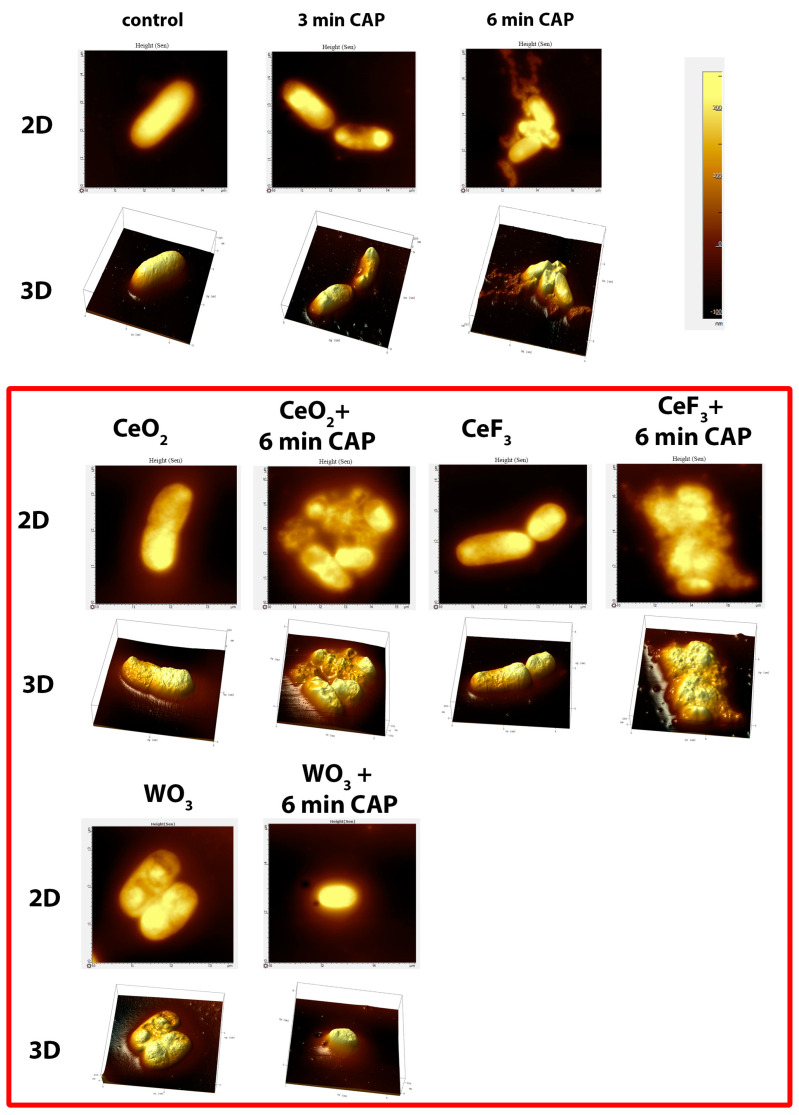
Cold argon plasma (CAP) and metal oxide nanoparticles are well known antimicrobial agents. In the current study, on an example of , a series of analyses was performed to assess the antibacterial action of the combination of these agents and to evaluate the possibility of using cerium oxide and cerium fluoride nanoparticles for a combined treatment of bacterial diseases. The joint effect of the combination of cold argon plasma and several metal oxide and fluoride nanoparticles (CeO, CeF, WO) was investigated on a model of colony growth on agar plates. The mutagenic effect of different CAP and nanoparticle combinations on bacterial DNA was investigated, by means of a blue-white colony assay and RAPD-PCR. The effect on cell wall damage, using atomic force microscopy, was also studied. The results obtained demonstrate that the combination of CAP and redox-active metal oxide nanoparticles (RAMON) effectively inhibits bacterial growth, providing a synergistic antimicrobial effect exceeding that of any of the agents alone. The combination of CAP and CeF was shown to be the most effective mutagen against plasmid DNA, and the combination of CAP and WO was the most effective against bacterial genomic DNA. The analysis of direct cell wall damage by atomic force microscopy showed the combination of CAP and CeF to be the most effective antimicrobial agent. The combination of CAP and redox-active metal oxide or metal fluoride nanoparticles has a strong synergistic antimicrobial effect on bacterial growth, resulting in plasmid and genomic DNA damage and cell wall damage. For the first time, a strong antimicrobial and DNA-damaging effect of CeF nanoparticles has been demonstrated.
冷氩等离子体(CAP)和金属氧化物纳米颗粒是众所周知的抗菌剂。在本研究中,以……为例,进行了一系列分析,以评估这些药剂组合的抗菌作用,并评估使用氧化铈和氟化铈纳米颗粒联合治疗细菌性疾病的可能性。研究了冷氩等离子体与几种金属氧化物和氟化物纳米颗粒(CeO、CeF、WO)组合对琼脂平板上菌落生长模型的联合作用。通过蓝白菌落试验和随机扩增多态性DNA聚合酶链反应(RAPD-PCR)研究了不同CAP与纳米颗粒组合对细菌DNA的诱变作用。还利用原子力显微镜研究了对细胞壁损伤的影响。获得的结果表明,CAP与氧化还原活性金属氧化物纳米颗粒(RAMON)的组合有效抑制细菌生长,提供了超过任何单一药剂的协同抗菌效果。CAP与CeF的组合被证明是针对质粒DNA最有效的诱变剂,而CAP与WO的组合对细菌基因组DNA最有效。通过原子力显微镜对直接细胞壁损伤的分析表明,CAP与CeF的组合是最有效的抗菌剂。CAP与氧化还原活性金属氧化物或金属氟化物纳米颗粒的组合对细菌生长具有强烈的协同抗菌作用,导致质粒和基因组DNA损伤以及细胞壁损伤。首次证明了CeF纳米颗粒具有强大的抗菌和DNA损伤作用。