Bouranis John A, Wong Carmen P, Beaver Laura M, Uesugi Sandra L, Papenhausen Ethan M, Choi Jaewoo, Davis Edward W, Da Silva Adilson Nunes, Kalengamaliro Newton, Chaudhary Rekha, Kharofa Jordan, Takiar Vinita, Herzog Thomas J, Barrett William, Ho Emily
Linus Pauling Institute, Oregon State University, Corvallis, OR 97331, USA.
School of Public Health and Nutrition, Oregon State University, Corvallis, OR 97331, USA.
Foods. 2023 Oct 15;12(20):3784. doi: 10.3390/foods12203784.
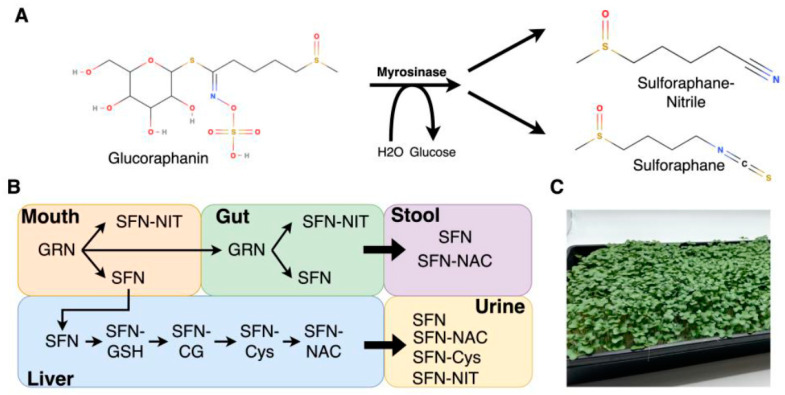
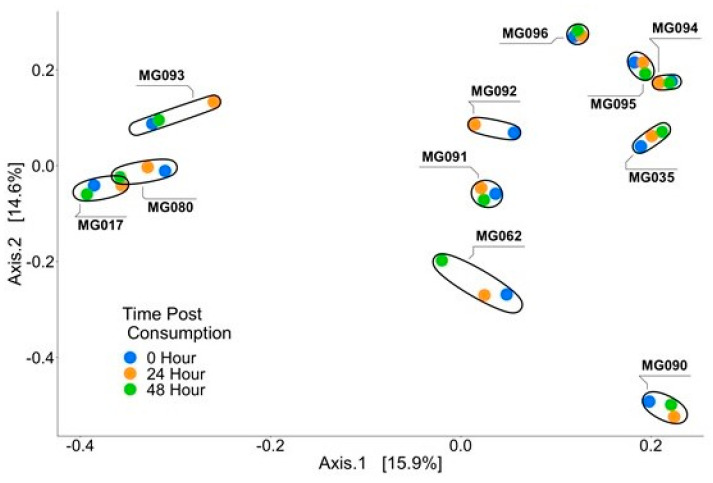
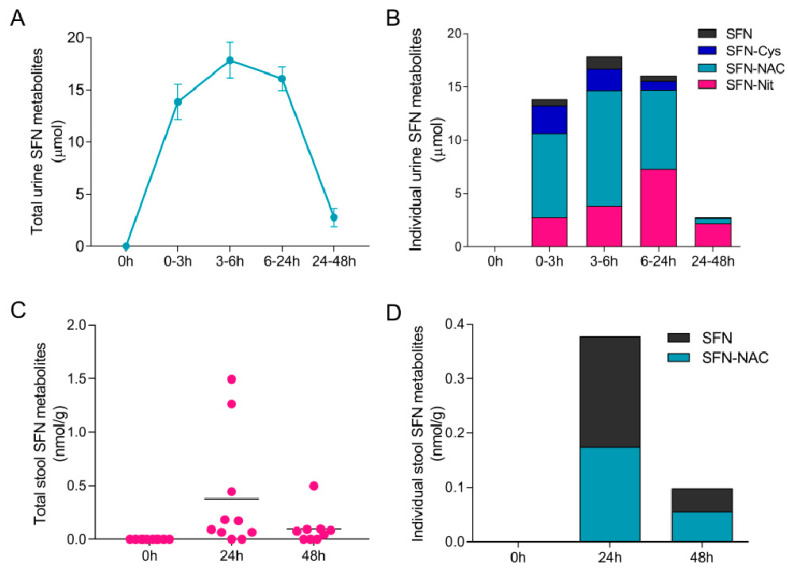
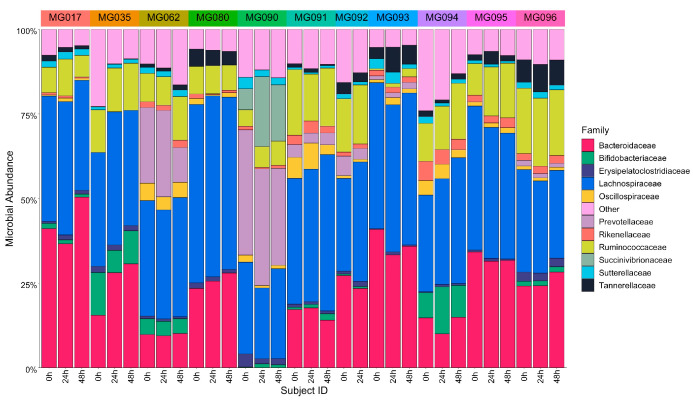
Cruciferous vegetable consumption is associated with numerous health benefits attributed to the phytochemical sulforaphane (SFN) that exerts antioxidant and chemopreventive properties, among other bioactive compounds. Broccoli sprouts, rich in SFN precursor glucoraphanin (GRN), have been investigated in numerous clinical trials. Broccoli microgreens are similarly rich in GRN but have remained largely unexplored. The goal of this study was to examine SFN bioavailability and the microbiome profile in subjects fed a single serving of fresh broccoli microgreens. Eleven subjects participated in a broccoli microgreens feeding study. Broccoli microgreens GRN and SFN contents and stability were measured. Urine and stool SFN metabolite profiles and microbiome composition were examined. Broccoli microgreens had similar GRN content to values previously reported for broccoli sprouts, which was stable over time. Urine SFN metabolite profiles in broccoli microgreens-fed subjects were similar to those reported previously in broccoli sprouts-fed subjects, including the detection of SFN-nitriles. We also reported the detection of SFN metabolites in stool samples for the first time. A single serving of broccoli microgreens did not significantly alter microbiome composition. We showed in this study that broccoli microgreens are a significant source of SFN. Our work provides the foundation for future studies to establish the health benefits of broccoli microgreens consumption.
食用十字花科蔬菜与诸多健康益处相关,这些益处归因于植物化学物质萝卜硫素(SFN),它具有抗氧化和化学预防特性,以及其他生物活性化合物。富含SFN前体萝卜硫苷(GRN)的西兰花芽苗菜已在众多临床试验中得到研究。西兰花嫩苗同样富含GRN,但在很大程度上仍未得到充分探索。本研究的目的是检测食用一份新鲜西兰花嫩苗的受试者体内SFN的生物利用度和微生物组特征。11名受试者参与了一项西兰花嫩苗喂养研究。测量了西兰花嫩苗的GRN和SFN含量及稳定性。检测了尿液和粪便中SFN代谢物谱及微生物组组成。西兰花嫩苗的GRN含量与先前报道的西兰花芽苗菜的值相似,且随时间稳定。食用西兰花嫩苗的受试者尿液中的SFN代谢物谱与先前报道的食用西兰花芽苗菜的受试者相似,包括SFN腈的检测。我们还首次报道了在粪便样本中检测到SFN代谢物。一份西兰花嫩苗并未显著改变微生物组组成。我们在本研究中表明,西兰花嫩苗是SFN的重要来源。我们的工作为未来研究确定食用西兰花嫩苗的健康益处奠定了基础。