Domínguez-Oliva Adriana, Olmos-Hernández Adriana, Hernández-Ávalos Ismael, Lecona-Butrón Hugo, Mora-Medina Patricia, Mota-Rojas Daniel
Master in Science Program "Maestría en Ciencias Agropecuarias", Universidad Autónoma Metropolitana, Xochimilco Campus, Mexico City 04960, Mexico.
Neurophysiology of Pain, Behavior and Assessment of Welfare in Domestic Animals, DPAA, Universidad Autónoma Metropolitana (UAM), Mexico City 04960, Mexico.
Animals (Basel). 2023 Oct 10;13(20):3161. doi: 10.3390/ani13203161.
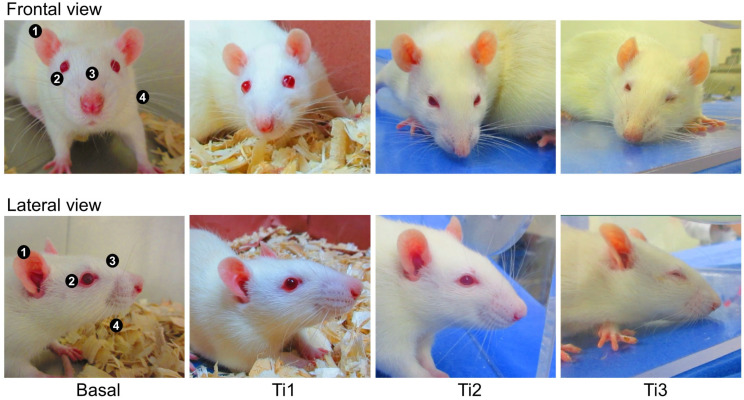
Refinement of experimental procedures in animal research has the objective of preventing and minimizing pain/distress in animals, including the euthanasia period. This study aimed to evaluate pain associated with six methods of euthanasia in Wistar rats (injectable, inhalational, and physical), by applying the Rat Grimace Scale (RGS), comparing the scores, and determining the method with the highest score that might indicate pain for laboratory rodents. Sixty adult male and female Wistar rats were used and assigned to six treatments: pentobarbital, CO, decapitation, isoflurane, ketamine + xylazine, and ketamine + CO. Video recording to assess the RGS scores was performed in four events: basal: 24 h before the procedure; Ti: three minutes before the procedure; Ti: during the application of the euthanasia method; and Ti: immediately after the application until LORR. The main findings of this study showed that, during Ti, decapitation and ketamine + xylazine had the highest scores (0.6 ± 0.26 and 0.6 ± 0.16, respectively) ( < 0.0001), while at Ti, CO (0.9 ± 0.18) and isoflurane (1.2 ± 0.20) recorded the highest scores ( < 0.0001). According to the present results, decapitation and ketamine + xylazine elicited short-term acute pain, possibly due to tissue damage caused by both methods (injection and guillotine). In contrast, isoflurane's RGS scores recorded during Ti might be associated with nociception/pain due to the pungency of the drug or to the pharmacological muscle relaxant effect of isoflurane. Further research is needed to establish a comprehensive study of pain during euthanasia, where RGS could be used minding the limitations that anesthetics might have on facial expression.
改进动物研究中的实验程序旨在预防和尽量减少动物的疼痛/痛苦,包括安乐死期间的疼痛/痛苦。本研究旨在通过应用大鼠痛苦量表(RGS),评估Wistar大鼠(注射、吸入和物理方法)六种安乐死方法相关的疼痛,比较得分,并确定得分最高的可能表明实验室啮齿动物疼痛的方法。使用了60只成年雄性和雌性Wistar大鼠,并将其分为六种处理组:戊巴比妥、一氧化碳、断头、异氟烷、氯胺酮+赛拉嗪和氯胺酮+一氧化碳。在四个时间点进行视频记录以评估RGS得分:基础期:操作前24小时;T1:操作前3分钟;T2:应用安乐死方法期间;T3:应用后直至失去翻正反射。本研究的主要结果表明,在T2期间,断头和氯胺酮+赛拉嗪得分最高(分别为0.6±0.26和0.6±0.16)(P<0.0001),而在T3时,一氧化碳(0.9±0.18)和异氟烷(1.2±0.20)得分最高(P<0.0001)。根据目前的结果,断头和氯胺酮+赛拉嗪引发短期急性疼痛,可能是由于这两种方法(注射和断头台)造成的组织损伤。相比之下,T3期间记录的异氟烷RGS得分可能与药物的刺激性或异氟烷的药理肌肉松弛作用导致的伤害感受/疼痛有关。需要进一步研究以建立对安乐死期间疼痛的全面研究,其中使用RGS时要考虑到麻醉剂对面部表情可能产生的局限性。