Eljilany Islam, Saghand Payman Ghasemi, Chen James, Ratan Aakrosh, McCarter Martin, Carpten John, Colman Howard, Ikeguchi Alexandra P, Puzanov Igor, Arnold Susanne, Churchman Michelle, Hwu Patrick, Conejo-Garcia Jose, Dalton William S, Weiner George J, El Naqa Issam M, Tarhini Ahmad A
Departments of Cutaneous Oncology and Immunology, H. Lee Moffitt Cancer Center and Research Institute, Tampa, FL 33612, USA.
Department of Machine Learning, H. Lee Moffitt Cancer Center and Research Institute, Tampa, FL 33612, USA.
Cancers (Basel). 2023 Oct 10;15(20):4913. doi: 10.3390/cancers15204913.
We aimed to determine the prognostic value of an immunoscore reflecting CD3+ and CD8+ T cell density estimated from real-world transcriptomic data of a patient cohort with advanced malignancies treated with immune checkpoint inhibitors (ICIs) in an effort to validate a reference for future machine learning-based biomarker development.
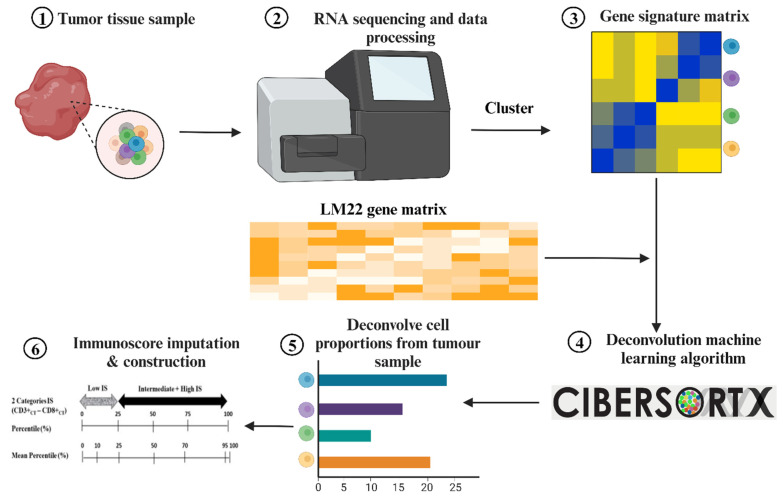
Transcriptomic data was collected under the Total Cancer Care Protocol (NCT03977402) Avatar project. The real-world immunoscore for each patient was calculated based on the estimated densities of tumor CD3+ and CD8+ T cells utilizing CIBERSORTx and the LM22 gene signature matrix. Then, the immunoscore association with overall survival (OS) was estimated using Cox regression and analyzed using Kaplan-Meier curves. The OS predictions were assessed using Harrell's concordance index (C-index). The Youden index was used to identify the optimal cut-off point. Statistical significance was assessed using the log-rank test.
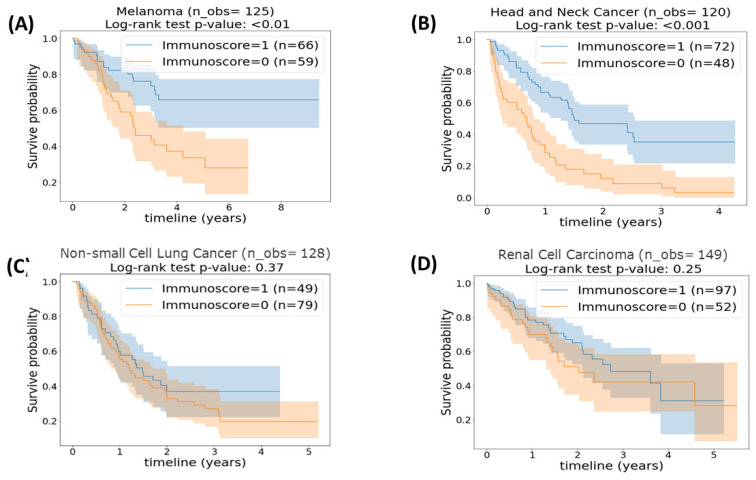
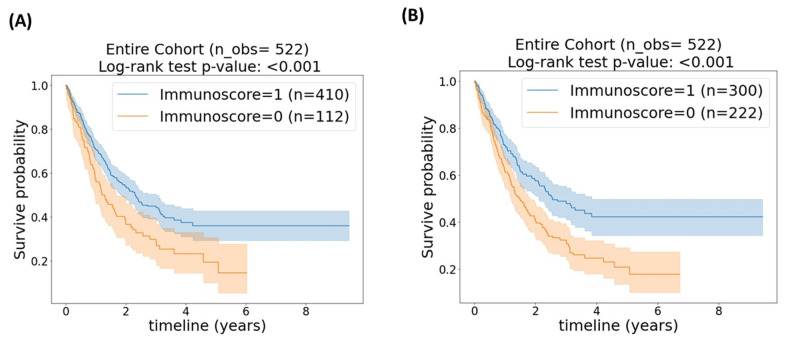
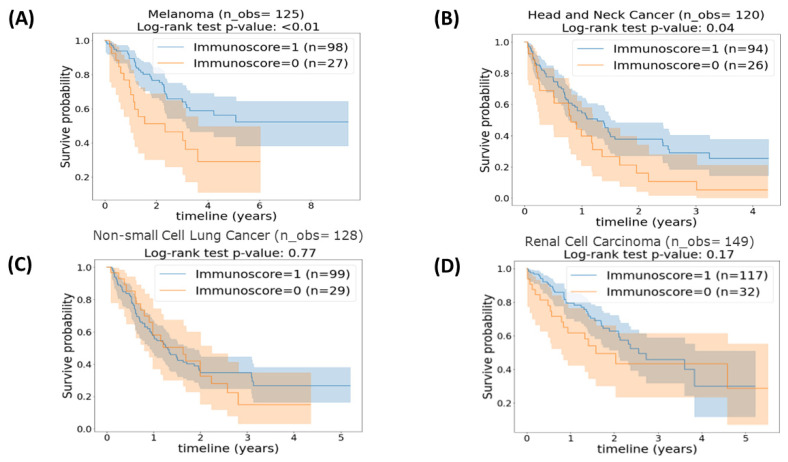
Our study encompassed 522 patients with four cancer types. The median duration to death was 10.5 months for the 275 participants who encountered an event. For the entire cohort, the results demonstrated that transcriptomics-based immunoscore could significantly predict patients at risk of death (-value < 0.001). Notably, patients with an intermediate-high immunoscore achieved better OS than those with a low immunoscore. In subgroup analysis, the prediction of OS was significant for melanoma and head and neck cancer patients but did not reach significance in the non-small cell lung cancer or renal cell carcinoma cohorts.
Calculating CD3+ and CD8+ T cell immunoscore using real-world transcriptomic data represents a promising signature for estimating OS with ICIs and can be used as a reference for future machine learning-based biomarker development.
我们旨在确定免疫评分的预后价值,该免疫评分反映了从接受免疫检查点抑制剂(ICI)治疗的晚期恶性肿瘤患者队列的真实世界转录组数据中估计的CD3 +和CD8 + T细胞密度,以努力验证未来基于机器学习的生物标志物开发的参考标准。
在全癌症护理协议(NCT03977402)阿凡达项目下收集转录组数据。利用CIBERSORTx和LM22基因特征矩阵,根据肿瘤CD3 +和CD8 + T细胞的估计密度计算每个患者的真实世界免疫评分。然后,使用Cox回归估计免疫评分与总生存期(OS)的关联,并使用Kaplan-Meier曲线进行分析。使用Harrell一致性指数(C指数)评估OS预测。Youden指数用于确定最佳截断点。使用对数秩检验评估统计学显著性。
我们的研究纳入了522例患有四种癌症类型的患者。275名发生事件的参与者的中位死亡时间为10.5个月。对于整个队列,结果表明基于转录组学的免疫评分可以显著预测有死亡风险的患者(P值<0.001)。值得注意的是,免疫评分中等偏高的患者比免疫评分低的患者有更好的总生存期。在亚组分析中,总生存期的预测对黑色素瘤和头颈癌患者具有显著性,但在非小细胞肺癌或肾细胞癌队列中未达到显著性。
使用真实世界转录组数据计算CD3 +和CD8 + T细胞免疫评分是一种有前景的标志物,可用于估计ICI治疗的总生存期,并可作为未来基于机器学习的生物标志物开发的参考标准。