Wu Zi-You, Shen Wei, Yue Juan-Qing, Yao Wen-Yan, Liu Shi-Lei, Jin Yun-Peng, Dong Ping, Ma Fei, Wu Xiang-Song, Gong Wei
Department of General Surgery, Xinhua Hospital, Affiliated to Shanghai Jiao Tong University School of Medicine, Shanghai, People's Republic of China.
Shanghai Key Laboratory of Biliary Tract Disease Research, Shanghai, People's Republic of China.
Onco Targets Ther. 2020 Nov 6;13:11359-11376. doi: 10.2147/OTT.S274754. eCollection 2020.
The aim of this study was to determine the Immunoscore as an independent prognostic factor for cholangiocarcinoma and establish a useful prognostic model for postoperative patients.
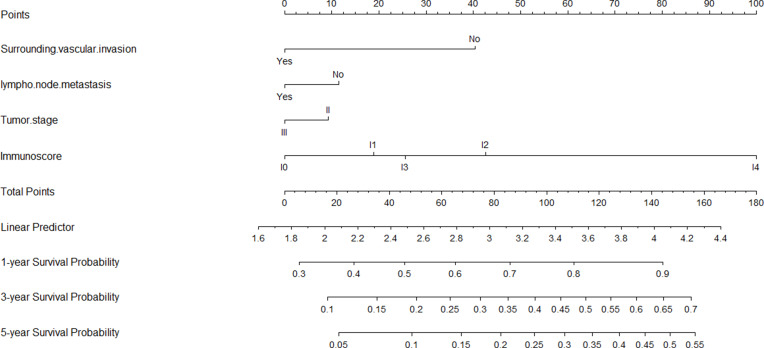
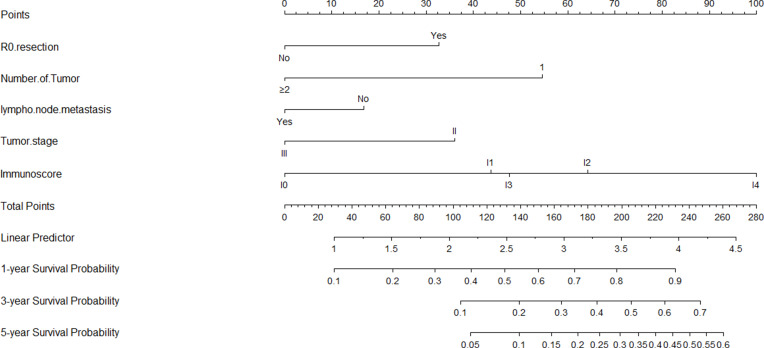
This retrospective study was performed to assess the correlation between the clinicopathological features, tumor immune microenvironment, and prognosis of 76 patients with cholangiocarcinoma. Multivariate analysis was used to identify independent factors significantly associated with local recurrence-free survival (LRFS) and overall survival (OS). Finally, we constructed a nomogram combining the Immunoscore with clinicopathologic features to predict postoperative recurrence and OS.
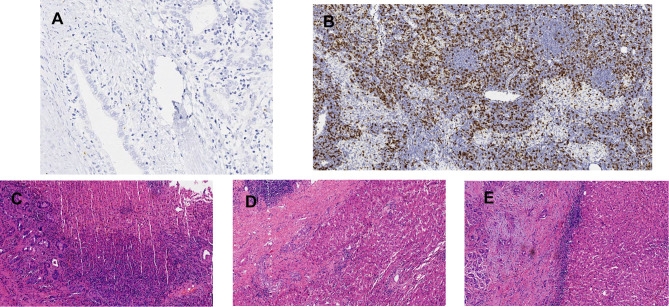
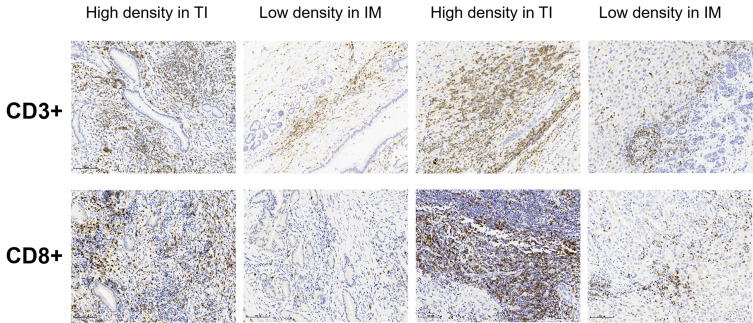
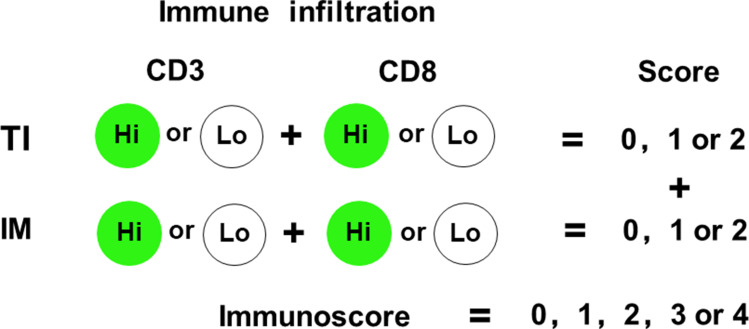
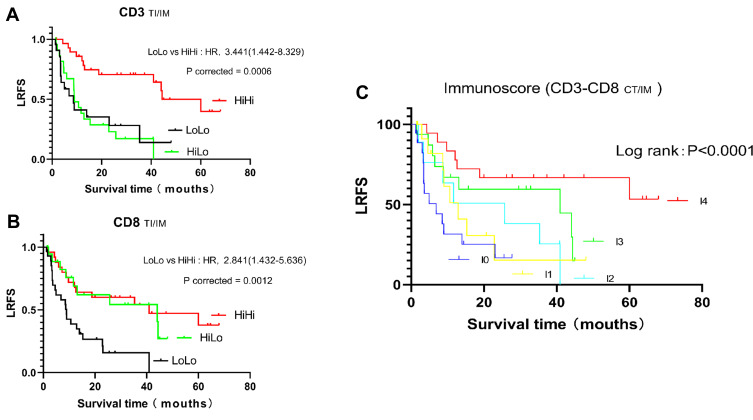
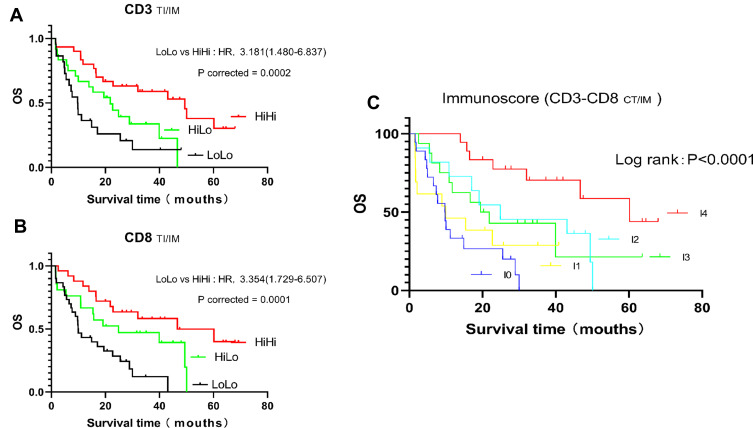
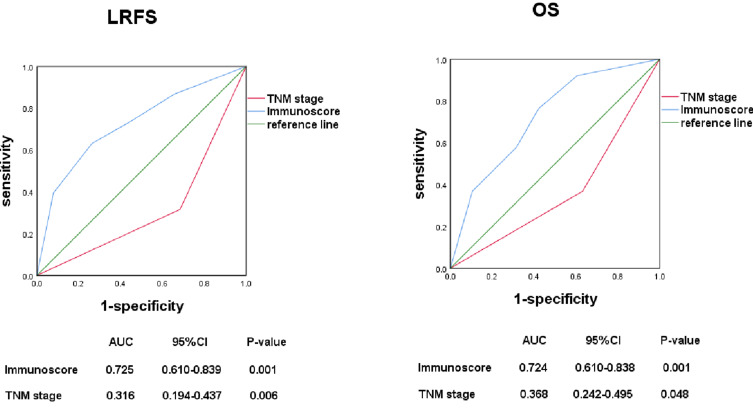
The present study showed that immune cell infiltration was negatively correlated with tumor size, peripheral vascular invasion, lymph node metastasis, and tumor staging. Kaplan-Meier curves indicated that a decreased Immunoscore was associated with poor prognosis. Multivariate analysis demonstrated that resection type, number of tumors, lymph node metastasis, TNM staging, and the Immunoscore were significantly associated with LRFS. For OS, the significantly correlated factors included resection type, peripheral vascular invasion, TNM staging, and the Immunoscore. Immunoscore was superior to TNM staging in predicting both LRFS and OS according to the receiver operating characteristic analysis. Based on the results of the Cox regression analysis, a prognostic nomogram for the postoperative recurrence of cholangiocarcinoma and OS of patients was established.
The results of this study suggest that the Immunoscore may be used as an independent predictor of postoperative recurrence and OS of patients with cholangiocarcinoma. The Immunoscore appears to offer distinct advantages over the TNM staging system. By combining the Immunoscore and clinicopathological features, the proposed nomogram provides a more accurate predictive tool for postoperative patients with cholangiocarcinoma.
本研究旨在确定免疫评分作为胆管癌独立的预后因素,并为术后患者建立一个有用的预后模型。
本回顾性研究旨在评估76例胆管癌患者的临床病理特征、肿瘤免疫微环境与预后之间的相关性。采用多因素分析来确定与无局部复发生存期(LRFS)和总生存期(OS)显著相关的独立因素。最后,我们构建了一个将免疫评分与临床病理特征相结合的列线图,以预测术后复发和总生存期。
本研究表明免疫细胞浸润与肿瘤大小、外周血管侵犯、淋巴结转移及肿瘤分期呈负相关。Kaplan-Meier曲线表明免疫评分降低与预后不良相关。多因素分析表明,切除类型、肿瘤数量、淋巴结转移、TNM分期和免疫评分与LRFS显著相关。对于总生存期,显著相关因素包括切除类型、外周血管侵犯、TNM分期和免疫评分。根据受试者工作特征分析,免疫评分在预测LRFS和总生存期方面均优于TNM分期。基于Cox回归分析结果,建立了胆管癌患者术后复发和总生存期的预后列线图。
本研究结果表明,免疫评分可作为胆管癌患者术后复发和总生存期的独立预测指标。免疫评分似乎比TNM分期系统具有明显优势。通过结合免疫评分和临床病理特征,所提出的列线图为胆管癌术后患者提供了一种更准确的预测工具。