Microbiology and Cell Science Department, Institute of Food and Agricultural Sciences, University of Florida, Gainesville, FL 32611, USA.
Int J Mol Sci. 2023 Oct 11;24(20):15096. doi: 10.3390/ijms242015096.
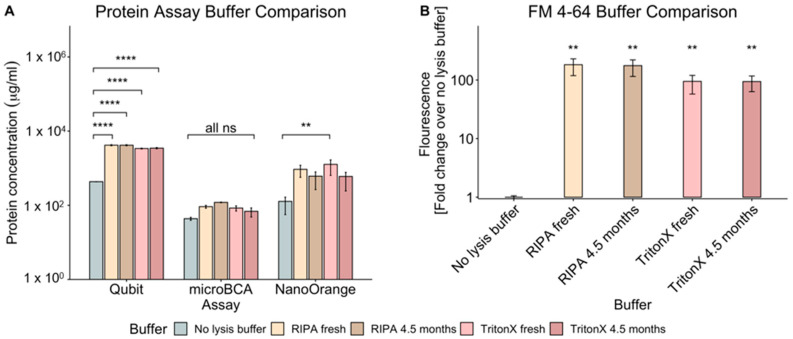
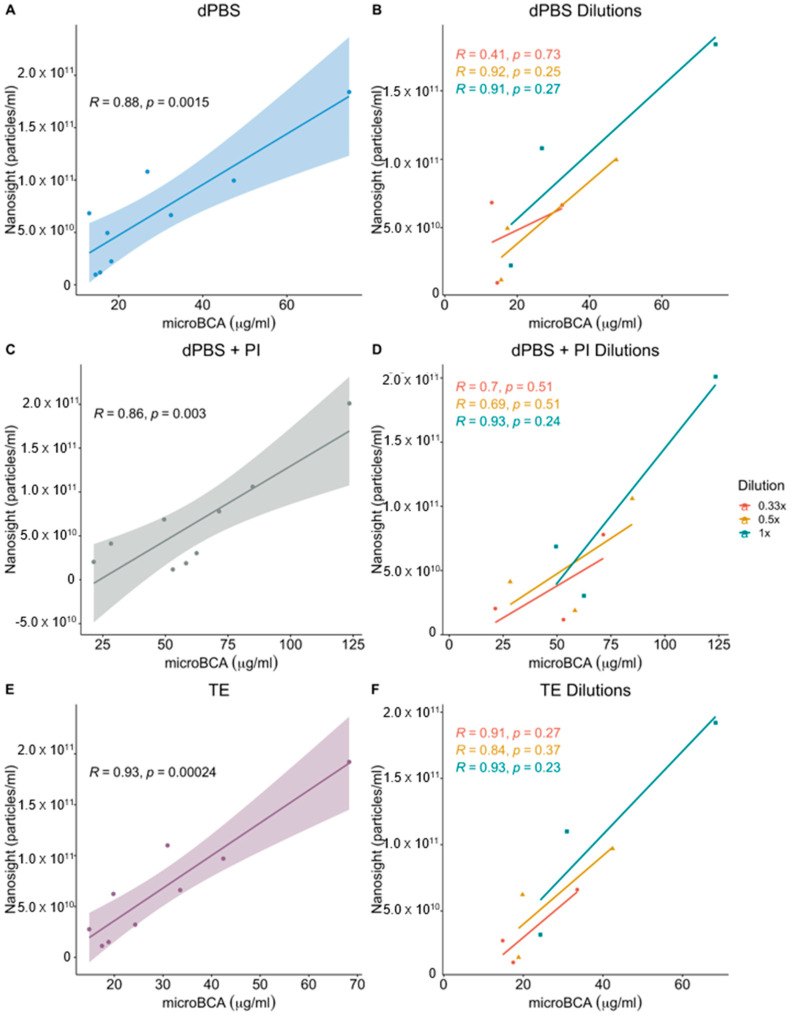
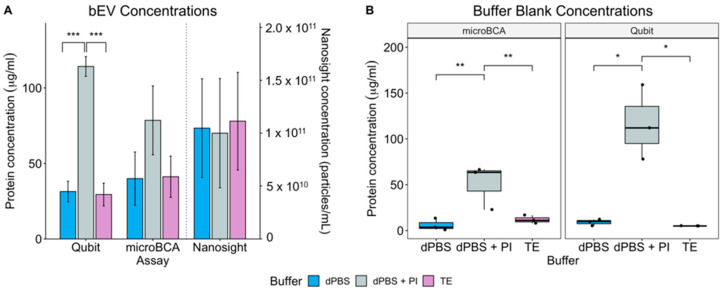
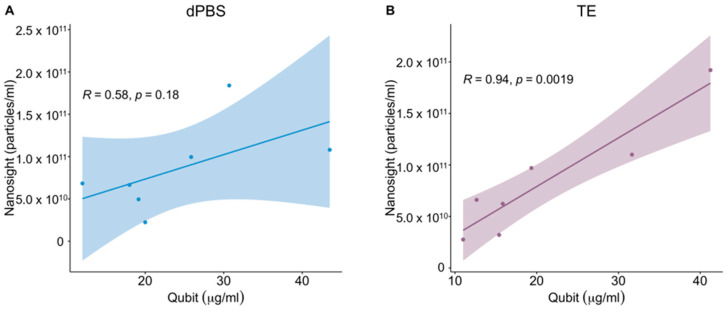
There are a variety of methods employed by laboratories for quantifying extracellular vesicles isolated from bacteria. As a result, the ability to compare results across published studies can lead to questions regarding the suitability of methods and buffers for accurately quantifying these vesicles. Within the literature, there are several common methods for vesicle quantification. These include lipid quantification using the lipophilic dye FM 4-64, protein quantification using microBCA, Qubit, and NanoOrange assays, or direct vesicle enumeration using nanoparticle tracking analysis. In addition, various diluents and lysis buffers are also used to resuspend and treat vesicles. In this study, we directly compared the quantification of a bacterial outer membrane vesicle using several commonly used methods. We also tested the impact of different buffers, buffer age, lysis method, and vesicle diluent on vesicle quantification. The results showed that buffer age had no significant effect on vesicle quantification, but the lysis method impacted the reliability of measurements using Qubit and NanoOrange. The microBCA assay displayed the least variability in protein concentration values and was the most consistent, regardless of the buffer or diluent used. MicroBCA also demonstrated the strongest correlation to the NTA-determined particle number across a range of vesicle concentrations. Overall, these results indicate that with appropriate diluent and buffer choice, microBCA vs. NTA standard curves could be generated and the microBCA assay used to estimate the particle number when NTA instrumentation is not readily available.
实验室采用了多种方法来定量从细菌中分离出的细胞外囊泡。因此,比较已发表研究结果的能力会引发对方法和缓冲液是否适合准确定量这些囊泡的质疑。在文献中,有几种常见的囊泡定量方法。这些方法包括使用亲脂性染料 FM 4-64 进行脂质定量、使用微 BCA、Qubit 和 NanoOrange 测定法进行蛋白质定量,或使用纳米颗粒跟踪分析直接对囊泡进行计数。此外,还使用各种稀释剂和裂解缓冲液来重悬和处理囊泡。在这项研究中,我们直接比较了几种常用方法对细菌外膜囊泡的定量。我们还测试了不同缓冲液、缓冲液老化、裂解方法和囊泡稀释剂对囊泡定量的影响。结果表明,缓冲液老化对囊泡定量没有显著影响,但裂解方法会影响 Qubit 和 NanoOrange 测量的可靠性。微 BCA 测定法在蛋白质浓度值的变化方面表现出最小的变异性,并且无论使用哪种缓冲液或稀释剂都最一致。微 BCA 与 NTA 确定的粒子数在一系列囊泡浓度下也具有最强的相关性。总体而言,这些结果表明,通过适当的稀释剂和缓冲液选择,可以生成微 BCA 与 NTA 标准曲线,并在没有 NTA 仪器的情况下使用微 BCA 测定法来估计粒子数。