Bionano, San Diego, CA 92121, USA.
Center for Genetic Medicine Research, Children's National Hospital, Washington, DC 20010, USA.
Genes (Basel). 2023 Sep 26;14(10):1868. doi: 10.3390/genes14101868.
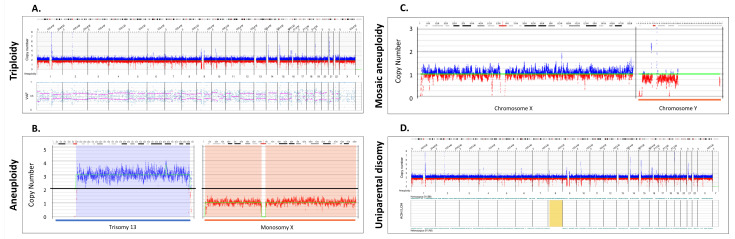
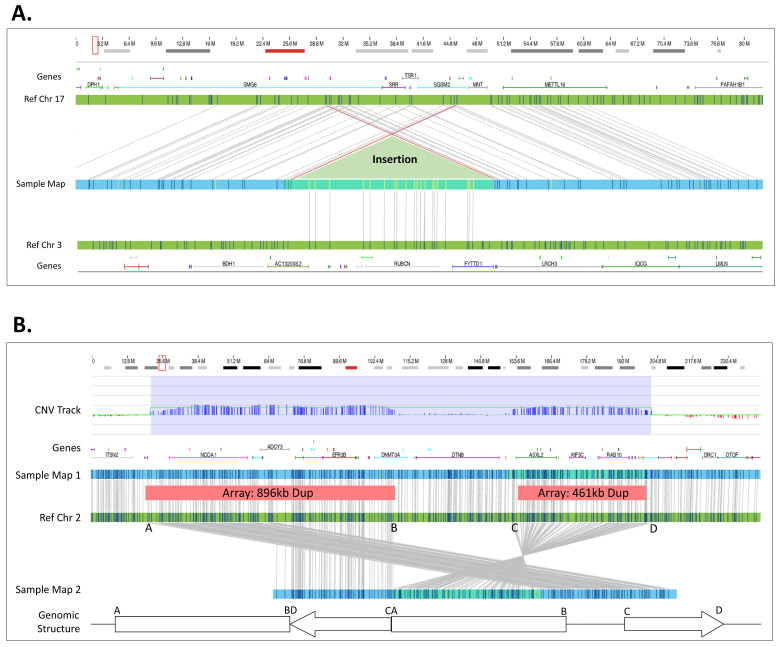
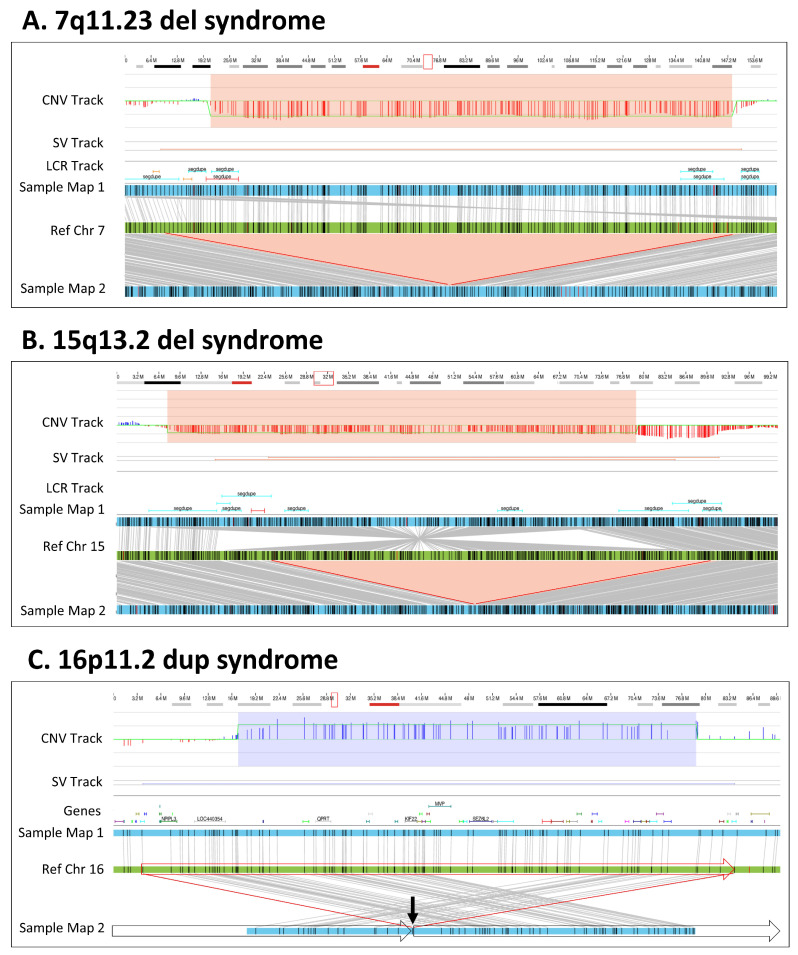
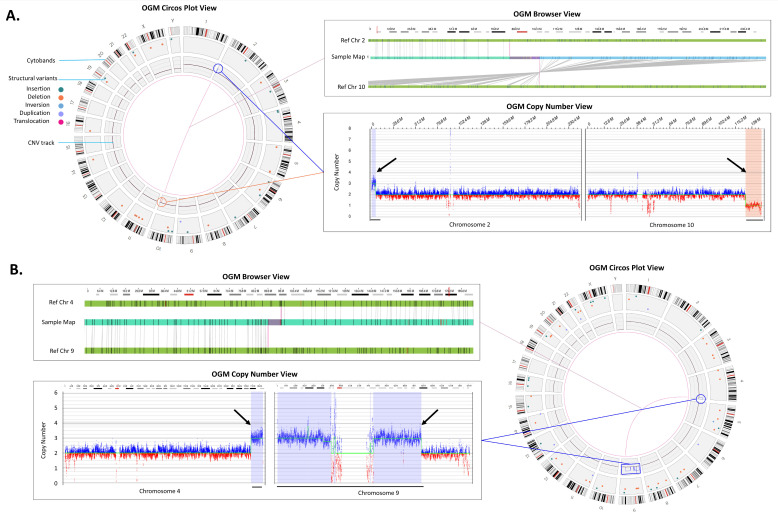
The recommended practice for individuals suspected of a genetic etiology for disorders including unexplained developmental delay/intellectual disability (DD/ID), autism spectrum disorders (ASD), and multiple congenital anomalies (MCA) involves a genetic testing workflow including chromosomal microarray (CMA), Fragile-X testing, karyotype analysis, and/or sequencing-based gene panels. Since genomic imbalances are often found to be causative, CMA is recommended as first tier testing for many indications. Optical genome mapping (OGM) is an emerging next generation cytogenomic technique that can detect not only copy number variants (CNVs), triploidy and absence of heterozygosity (AOH) like CMA, but can also define the location of duplications, and detect other structural variants (SVs), including balanced rearrangements and repeat expansions/contractions. This study compares OGM to CMA for clinically reported genomic variants, some of these samples also have structural characterization by fluorescence in situ hybridization (FISH). OGM was performed on IRB approved, de-identified specimens from 55 individuals with genomic abnormalities previously identified by CMA (61 clinically reported abnormalities). SVs identified by OGM were filtered by a control database to remove polymorphic variants and against an established gene list to prioritize clinically relevant findings before comparing with CMA and FISH results. OGM results showed 100% concordance with CMA findings for pathogenic variants and 98% concordant for all pathogenic/likely pathogenic/variants of uncertain significance (VUS), while also providing additional insight into the genomic structure of abnormalities that CMA was unable to provide. OGM demonstrates equivalent performance to CMA for CNV and AOH detection, enhanced by its ability to determine the structure of the genome. This work adds to an increasing body of evidence on the analytical validity and ability to detect clinically relevant abnormalities identified by CMA. Moreover, OGM identifies translocations, structures of duplications and complex CNVs intractable by CMA, yielding additional clinical utility.
对于疑似遗传病因引起的疾病(包括原因不明的发育迟缓/智力障碍(DD/ID)、自闭症谱系障碍(ASD)和多发先天畸形(MCA))的个体,建议采用包括染色体微阵列(CMA)、脆性 X 检测、核型分析和/或基于测序的基因面板在内的基因检测工作流程。由于基因组失衡通常被认为是致病原因,因此 CMA 被推荐作为许多适应证的一线检测方法。光学基因组图谱(OGM)是一种新兴的下一代细胞基因组技术,不仅可以检测到拷贝数变异(CNVs)、三倍体和杂合性缺失(AOH),如 CMA 所示,还可以确定重复序列的位置,并检测其他结构变异(SVs),包括平衡重排和重复扩展/收缩。本研究将 OGM 与 CMA 进行比较,以评估其对临床报告的基因组变异的检测能力,其中一些样本还通过荧光原位杂交(FISH)进行了结构特征分析。OGM 是在经过 IRB 批准、去识别的 55 个个体的标本上进行的,这些个体的基因组异常先前已通过 CMA 确定(61 个临床报告异常)。通过对照数据库过滤由 OGM 识别的 SVs,以去除多态性变异,并根据既定基因列表对具有临床相关性的发现进行优先级排序,然后与 CMA 和 FISH 结果进行比较。OGM 结果与 CMA 对致病性变异的检测结果完全一致,对所有致病性/可能致病性/意义不明的变异(VUS)的检测结果也有 98%的一致性,同时还提供了对 CMA 无法提供的异常基因组结构的更多了解。OGM 在检测 CNV 和 AOH 方面与 CMA 具有等效性能,其能够确定基因组结构的能力使其性能得到增强。这项工作增加了越来越多的关于分析有效性和检测 CMA 确定的临床相关异常能力的证据。此外,OGM 可识别 CMA 难以检测的易位、重复结构和复杂的 CNVs,从而提供额外的临床应用。