Lew Jin Hau, Matar Omar K, Müller Erich A, Luckham Paul F, Sousa Santos Adrielle, Myo Thant Maung Maung
Department of Chemical Engineering, Imperial College London, London SW7 2AZ, UK.
PETRONAS Research Sdn. Bhd., Lot 3288 & 3289, Off Jalan Ayer Itam, Kawasan Institusi Bangi, Kajang 43000, Selangor, Malaysia.
Polymers (Basel). 2023 Oct 10;15(20):4037. doi: 10.3390/polym15204037.
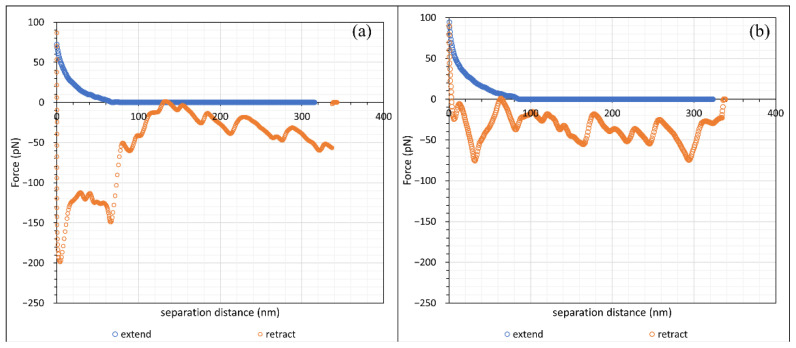
In this work, the interaction of hydrolysed polyacrylamide (HPAM) of two molecular weights (F3330, 11-13 MDa; F3530, 15-17 MDa) with calcium carbonate (CaCO) was studied via atomic force microscopy (AFM). In the absence of polymers at 1.7 mM and 1 M NaCl, good agreement with DLVO theory was observed. At 1.7 mM NaCl, repulsive interaction during approach at approximately 20 nm and attractive adhesion of approximately 400 pN during retraction was measured, whilst, at 1 M NaCl, no repulsion during approach was found. Still, a significantly larger adhesion of approximately 1400 pN during retraction was observed. In the presence of polymers, results indicated that F3330 displayed higher average adhesion (450-625 pN) and interaction energy (43-145 aJ) with CaCO than F3530's average adhesion (85-88 pN) and interaction energy (8.4-11 aJ). On the other hand, F3530 exerted a longer steric repulsion distance (70-100 nm) than F3330 (30-70 nm). This was likely due to the lower molecular weight. F3330 adopted a flatter configuration on the calcite surface, creating more anchor points with the surface in the form of train segments. The adhesion and interaction energy of both HPAM with CaCO can be decreased by increasing the salt concentration. At 3% NaCl, the average adhesion and interaction energy of F3330 was 72-120 pN and 5.6-17 aJ, respectively, while the average adhesion and interaction energy of F3530 was 11.4-48 pN and 0.3-2.98 aJ, respectively. The reduction of adhesion and interaction energy was likely due to the screening of the COO charged group of HPAM by salt cations, leading to a reduction of electrostatic attraction between the negatively charged HPAM and the positively charged CaCO.
在这项工作中,通过原子力显微镜(AFM)研究了两种分子量(F3330,11 - 13 MDa;F3530,15 - 17 MDa)的水解聚丙烯酰胺(HPAM)与碳酸钙(CaCO₃)的相互作用。在1.7 mM和1 M NaCl且不存在聚合物的情况下,观察到与DLVO理论有良好的一致性。在1.7 mM NaCl时,测量到接近过程中约20 nm处的排斥相互作用以及回缩过程中约400 pN的吸引粘附力,而在1 M NaCl时,接近过程中未发现排斥力。不过,在回缩过程中仍观察到明显更大的约1400 pN的粘附力。在有聚合物存在的情况下,结果表明F3330与CaCO₃相比,表现出更高的平均粘附力(450 - 625 pN)和相互作用能(43 - 145 aJ),而F3530的平均粘附力(85 - 88 pN)和相互作用能(8.4 - 11 aJ)。另一方面,F3530比F3330(30 - 70 nm)表现出更长的空间排斥距离(70 - 100 nm)。这可能是由于分子量较低。F3330在方解石表面采用更扁平的构型,以链段形式与表面形成更多锚固点。通过增加盐浓度,两种HPAM与CaCO₃的粘附力和相互作用能均可降低。在3% NaCl时,F3330的平均粘附力和相互作用能分别为72 - 120 pN和5.6 - 17 aJ,而F3530的平均粘附力和相互作用能分别为11.4 - 48 pN和0.3 - 2.98 aJ。粘附力和相互作用能的降低可能是由于盐阳离子对HPAM带负电的 - COO⁻基团的屏蔽作用,导致带负电的HPAM与带正电的CaCO₃之间的静电吸引力降低。