Hematology Department, Hospital Clínico Universitario, 46017 Valencia, Spain.
INCLIVA, Biomedical Research Institute, 46017 Valencia, Spain.
Viruses. 2023 Oct 8;15(10):2066. doi: 10.3390/v15102066.
Scarce data exist that analyze the outcomes of hematological patients with SARS-CoV-2 infection during the Omicron variant period who received treatment with remdesivir or nirmatrelvir/ritonavir.
This study aims to address this issue by using a retrospective observational registry, created by the Spanish Hematopoietic Stem Cell Transplantation and Cell Therapy Group, spanning from 27 December 2021 to 30 April 2023.
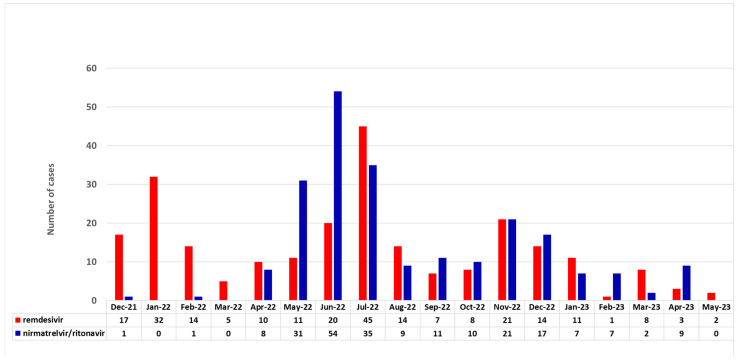
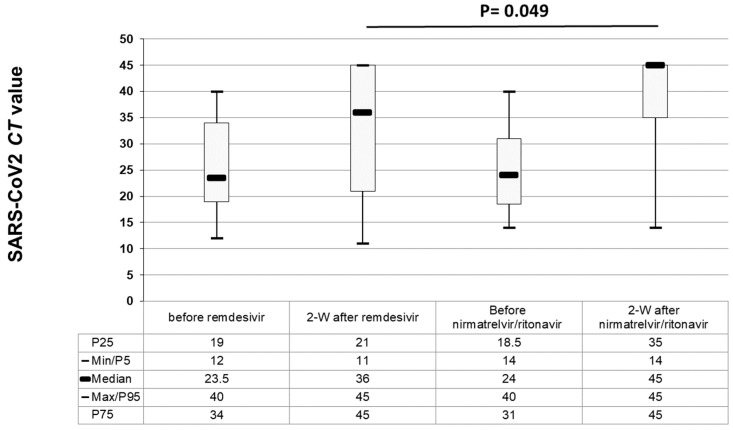
This study included 466 patients, 243 (52%) who were treated with remdesivir and 223 (48%) with nirmatrelvir/ritonavir. Nirmatrelvir/ritonavir was primarily used for mild cases, resulting in a lower COVID-19-related mortality rate (1.3%), while remdesivir was preferred for moderate to severe cases (40%), exhibiting a higher mortality rate (9%). A multivariate analysis in the remdesivir cohort showed that male gender (odds ratio (OR) 0.35, = 0.042) correlated with a lower mortality risk, while corticosteroid use (OR 9.4, < 0.001) and co-infection (OR 2.8, = 0.047) were linked to a higher mortality risk. Prolonged virus shedding was common, with 52% of patients shedding the virus for more than 25 days. In patients treated with remdesivir, factors associated with prolonged shedding included B-cell malignancy as well as underlying disease, severe disease, a later onset of and shorter duration of remdesivir treatment and a higher baseline viral load. Nirmatrelvir/ritonavir demonstrated a comparable safety profile to remdesivir, despite a higher risk of drug interactions.
Nirmatrelvir/ritonavir proved to be a safe and effective option for treating mild cases in the outpatient setting, while remdesivir was preferred for severe cases, where corticosteroids and co-infection significantly predicted worse outcomes. Despite antiviral therapy, prolonged shedding remains a matter of concern.
关于在奥密克戎变异株流行期间接受瑞德西韦或奈玛特韦/利托那韦治疗的伴有 SARS-CoV-2 感染的血液系统疾病患者结局的分析数据十分有限。
本研究旨在通过使用西班牙造血干细胞移植和细胞治疗组创建的回顾性观察性登记来解决这一问题,该登记从 2021 年 12 月 27 日持续至 2023 年 4 月 30 日。
本研究纳入了 466 例患者,其中 243 例(52%)接受了瑞德西韦治疗,223 例(48%)接受了奈玛特韦/利托那韦治疗。奈玛特韦/利托那韦主要用于轻症病例,导致 COVID-19 相关死亡率较低(1.3%),而瑞德西韦则主要用于中重度病例(40%),死亡率较高(9%)。在瑞德西韦组的多变量分析中,男性(比值比(OR)0.35, = 0.042)与较低的死亡率风险相关,而皮质类固醇的使用(OR 9.4, < 0.001)和合并感染(OR 2.8, = 0.047)与较高的死亡率风险相关。病毒持续排出较为常见,52%的患者病毒排出持续超过 25 天。在接受瑞德西韦治疗的患者中,与病毒持续排出相关的因素包括 B 细胞恶性肿瘤和基础疾病、严重疾病、瑞德西韦治疗开始较晚、持续时间较短以及基线病毒载量较高。尽管奈玛特韦/利托那韦有更高的药物相互作用风险,但它被证明是治疗轻症病例的安全且有效的选择。
奈玛特韦/利托那韦在门诊环境中治疗轻症病例是一种安全且有效的选择,而瑞德西韦则更适用于重症病例,其中皮质类固醇和合并感染显著预测了较差的结局。尽管进行了抗病毒治疗,但病毒持续排出仍然是一个令人关注的问题。