Hassan First University of Settat, Higher Institute of Health Sciences, Laboratory of Health Sciences and Technologies, Settat, Morocco.
Hassan II University, Ibn Rochd University Hospital of Casablanca, Medical Biology Laboratory, Casablanca, Morocco.
Pan Afr Med J. 2023 Aug 15;45:161. doi: 10.11604/pamj.2023.45.161.36150. eCollection 2023.
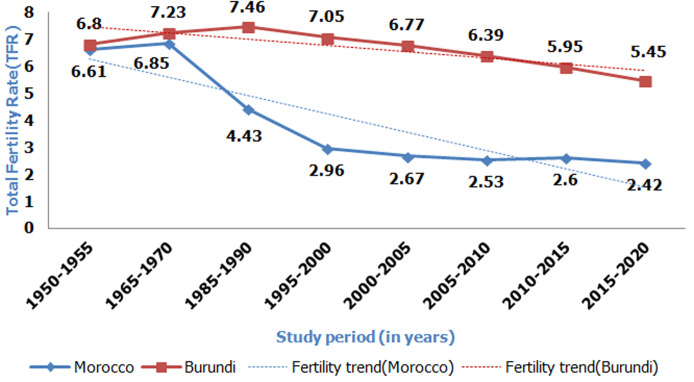
few studies have examined the factors influencing fertility differentials and the variation in their effects in countries with different socioeconomic and cultural backgrounds and different fertility transition paces. To address this gap, our study sought to first identify the factors that influenced fertility differentials in Morocco and Burundi during their fertility transition periods, and then to compare the effects of these factors between the two countries.
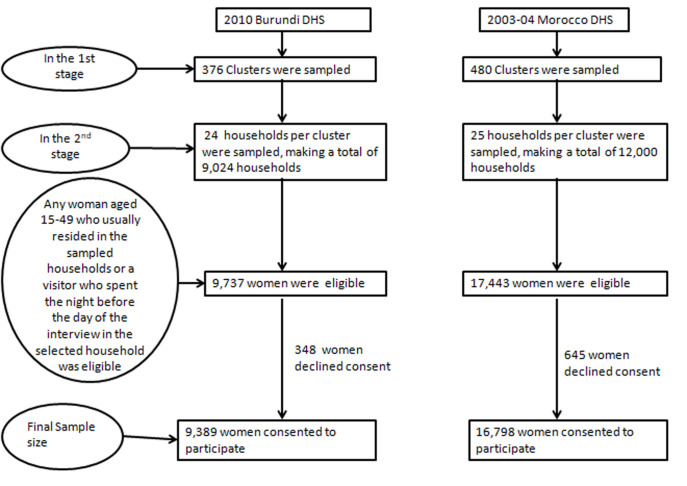
using data from the 2003-4 Morocco and 2010 Burundi Demographic and Health Surveys, bivariable and multivariable Poisson regression analyses offset by the natural logarithm of the women´s age were performed to identify the socioeconomic and cultural factors that influenced fertility differentials in Morocco and Burundi during their fertility transition.
our main findings showed that the total number of children ever born ranged from 0 to 17 with a mean of 2.71 ± 2.89 in Burundi and from 0 to 16 with a mean of 1.88 ± 2.80 in Morocco. In Burundi, both socioeconomic and cultural factors like rural residence adjusted incident rate ratio (AIRR) = 1.159, 95% CI: 1.103 - 1.217, P=0.020), women´s illiteracy (AIRR=1.465, 95% CI: 1.241- 1.729, P <0.001) and agricultural profession (AIRR=1. 332, 95% CI: 1.263 - 1.401, P = 0.004), household poverty (AIRR= 1.381, 95% CI: 1.223 - 1.431, p<0.001), infant mortality (AIRR= 1.602, 95% CI: 1.562 - 1.643, p<0.001), early marriage (AIRR= 1.313, 95% CI: 1.264 - 1.364, p<0.001), lack of knowledge of any contraceptives (AIRR= 1.263, 95% CI: 1.125 - 1.310, p = 0.003) and failure to use modern contraceptives (AIRR= 1.520, 95% CI: 1.487 - 1.611, p<0.001) were associated with high number of children ever born. However, in Morocco socioeconomic factors like residence place, women´s agricultural profession and household poverty were not significant. In this country, women´s illiteracy (AIRR=1.428, 95% CI: 1.315 - 1.551, P <0.001), lack of access to mass media (AIRR= 1.241, 95% CI: 1.108 - 1.375, p = 0.006), infant mortality (AIRR=1.222, 95%CI: 1.184 - 1.361, p<0.001), early marriage (AIRR1.481, 95% CI: 1.435 - 1.529, p<0.001), lack of knowledge of any contraceptives (AIRR1.508, 95% CI: 1.409 - 1.613, p<0.001) and failure to use modern contraceptives (AIRR1.745, 95% CI: 1.627 - 1.863, p<0.001) were associated with high fertility but with different effects than in Burundi.
the evidence from this study suggests that interventions to accelerate the fertility transition processes in Burundi and many other countries with slow fertility transitions should be designed and implemented according to each country's local context.
很少有研究探讨影响生育差异的因素以及在具有不同社会经济和文化背景以及不同生育转型阶段的国家中这些因素的变化。为了弥补这一空白,我们的研究首先试图确定摩洛哥和布隆迪在生育转型期间影响生育差异的因素,然后比较这两个国家这些因素的影响。
使用来自 2003-2004 年摩洛哥和 2010 年布隆迪人口与健康调查的数据,采用双变量和多变量泊松回归分析,对女性年龄的自然对数进行了校正,以确定在生育转型期间影响摩洛哥和布隆迪生育差异的社会经济和文化因素。
我们的主要发现表明,布隆迪的总生育数从 0 到 17 不等,平均为 2.71 ± 2.89,而摩洛哥的总生育数从 0 到 16 不等,平均为 1.88 ± 2.80。在布隆迪,社会经济和文化因素,如农村居住(调整后发病率比,AIRR=1.159,95%CI:1.103-1.217,P=0.020)、妇女文盲(AIRR=1.465,95%CI:1.241-1.729,P<0.001)和农业职业(AIRR=1.332,95%CI:1.263-1.401,P=0.004)、家庭贫困(AIRR=1.381,95%CI:1.223-1.431,p<0.001)、婴儿死亡率(AIRR=1.602,95%CI:1.562-1.643,p<0.001)、早婚(AIRR=1.313,95%CI:1.264-1.364,p<0.001)、缺乏任何避孕知识(AIRR=1.263,95%CI:1.125-1.310,p=0.003)和未能使用现代避孕药具(AIRR=1.520,95%CI:1.487-1.611,p<0.001)与生育子女数量较多有关。然而,在摩洛哥,社会经济因素如居住地、妇女的农业职业和家庭贫困并不显著。在这个国家,妇女文盲(AIRR=1.428,95%CI:1.315-1.551,P<0.001)、缺乏接触大众媒体(AIRR=1.241,95%CI:1.108-1.375,p=0.006)、婴儿死亡率(AIRR=1.222,95%CI:1.184-1.361,p<0.001)、早婚(AIRR=1.481,95%CI:1.435-1.529,p<0.001)、缺乏任何避孕知识(AIRR=1.508,95%CI:1.409-1.613,p<0.001)和未能使用现代避孕药具(AIRR=1.745,95%CI:1.627-1.863,p<0.001)与高生育率有关,但与布隆迪的影响不同。
这项研究的证据表明,为了加速布隆迪和许多其他生育率转型缓慢的国家的生育率转型过程,应该根据每个国家的当地情况设计和实施干预措施。