Mottl Amy K, Bomback Andrew S, Mariani Laura H, Coppock Gaia, Jennette J Charles, Almaani Salem, Gipson Debbie S, Kelley Sara, Kidd Jason, Laurin Louis-Philippe, Mucha Krzysztof, Oliverio Andrea, Palmer Matthew, Rizk Dana, Sanghani Neil, Stokes M Barry, Susztak Katalin, Wadhwani Shikha, Nast Cynthia C
UNC Kidney Center, University of North Carolina School of Medicine, Chapel Hill, NC, USA.
Division of Nephrology, Columbia University Medical Center, New York, NY, USA.
Glomerular Dis. 2023 Jun 26;3(1):155-164. doi: 10.1159/000531679. eCollection 2023 Jan-Dec.
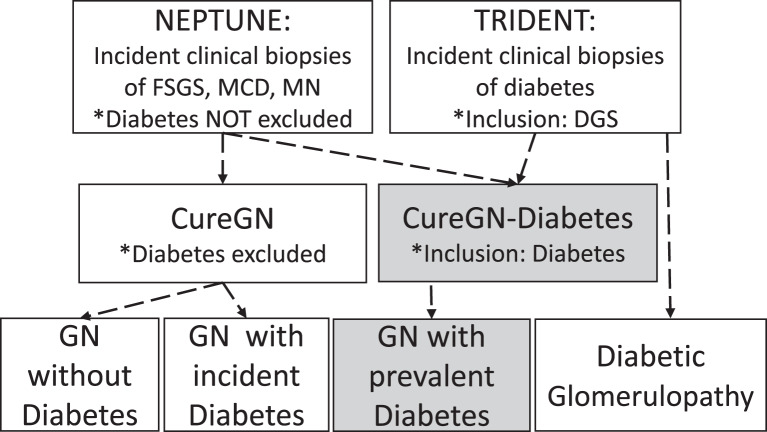
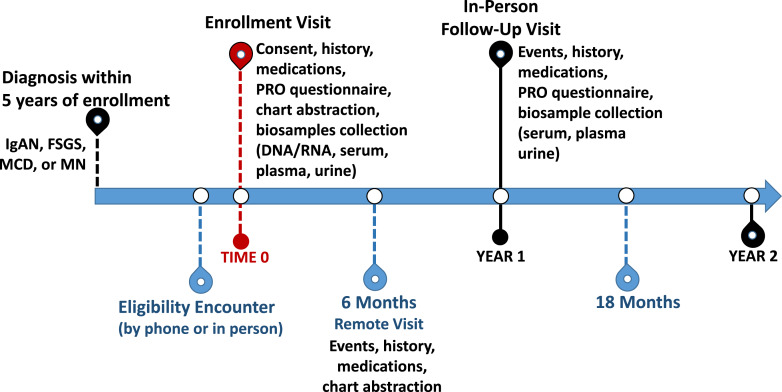
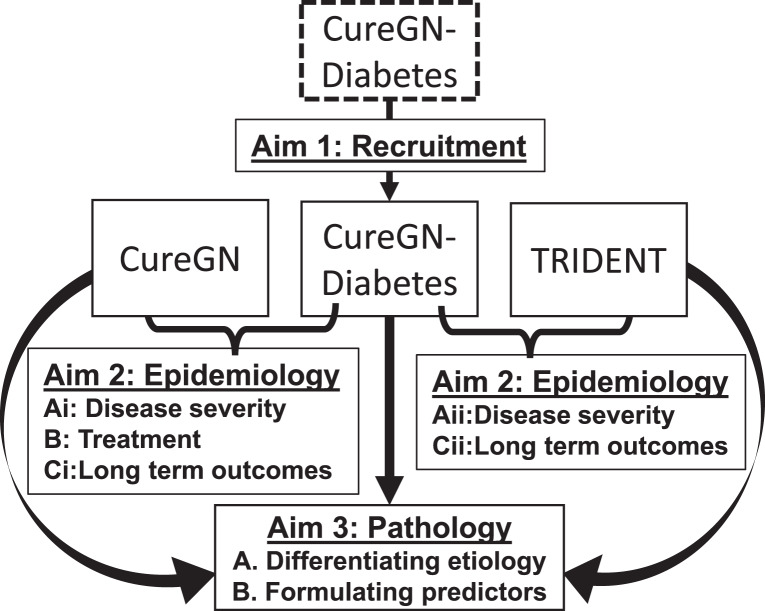
Glomerular diseases (GDs) represent the third leading cause of end-stage kidney disease (ESKD) in the US Diabetes was excluded from the CureGN Study, an NIH/NIDDK-sponsored observational cohort study of four leading primary GDs: IgA nephropathy (IgAN), membranous nephropathy (MN), focal segmental glomerulosclerosis (FSGS), and minimal change disease (MCD). CureGN-Diabetes, an ancillary study to CureGN, seeks to understand how diabetes influences the diagnosis, treatment, and outcomes of GD. It is a multicenter, prospective cohort study, targeting an enrollment of 300 adults with prevalent type 1 or type 2 diabetes and MCD, FSGS, MN, or IgAN, with first kidney biopsy obtained within 5 years of enrollment in 80% (20% allowed if biopsy after 2010). CureGN and Transformative Research in DiabEtic NephropaThy (TRIDENT) provide comparator cohorts. Retrospective and prospective clinical data and patient-reported outcomes are obtained. Blood and urine specimens are collected at study visits annually. Kidney biopsy reports and digital images are obtained, and standardized pathologic evaluations performed. Light microscopy images are uploaded to the NIH pathology repository. Outcomes include relapse and remission rates, changes in proteinuria and estimated glomerular filtration rate, infections, cardiovascular events, malignancy, ESKD, and death. Multiple analytical approaches will be used leveraging the baseline and longitudinal data to compare disease presentation and progression across subgroups of interest. With 300 patients and an average of 3 years of follow-up, the study has 80% power to detect a HR of 1.4-1.8 for time to complete remission of proteinuria, a rate ratio for hospitalizations of 1.18-1.56 and difference in eGFR slope of 6.0-8.6 mL/min/year between two groups of 300 participants each. CureGN-Diabetes will enhance our understanding of diabetes as a modifying factor of the pathology and outcomes of GDs and support studies to identify disease mechanisms and improve patient outcomes in this understudied patient population.
肾小球疾病(GDs)是美国终末期肾病(ESKD)的第三大主要病因。糖尿病被排除在CureGN研究之外,该研究是一项由美国国立卫生研究院(NIH)/国立糖尿病、消化和肾脏疾病研究所(NIDDK)赞助的观察性队列研究,涉及四种主要原发性肾小球疾病:IgA肾病(IgAN)、膜性肾病(MN)、局灶节段性肾小球硬化症(FSGS)和微小病变病(MCD)。CureGN糖尿病研究是CureGN的一项辅助研究,旨在了解糖尿病如何影响肾小球疾病的诊断、治疗和预后。这是一项多中心前瞻性队列研究,目标是招募300名患有1型或2型糖尿病且患有MCD、FSGS、MN或IgAN的成年人,80%的参与者在入组后5年内进行首次肾活检(2010年后活检的允许比例为20%)。CureGN和糖尿病肾病转化研究(TRIDENT)提供了对照队列。获取回顾性和前瞻性临床数据以及患者报告的结局。每年在研究访视时采集血液和尿液样本。获取肾活检报告和数字图像,并进行标准化病理评估。光学显微镜图像上传至NIH病理学储存库。结局包括复发和缓解率、蛋白尿和估计肾小球滤过率的变化、感染、心血管事件、恶性肿瘤、ESKD和死亡。将使用多种分析方法,利用基线数据和纵向数据来比较感兴趣亚组之间的疾病表现和进展。该研究有300名患者,平均随访3年,有80%的把握度检测到两组各300名参与者蛋白尿完全缓解时间的风险比为1.4 - 1.8、住院率比为1.18 - 1.56以及估算肾小球滤过率斜率差异为6.0 - 8.6 mL/(min·年)。CureGN糖尿病研究将增进我们对糖尿病作为肾小球疾病病理和结局的修饰因素的理解,并支持相关研究以确定疾病机制并改善这一研究不足患者群体的患者结局。