Andersson Emil, Rothenberg Ellen V, Peterson Carsten, Olariu Victor
Computational Biology and Biological Physics, Centre for Environmental and Climate Science, Lund University, Lund, Sweden.
Division of Biology and Biological Engineering, 156-29, California Institute of Technology, Pasadena, CA 91125, USA.
bioRxiv. 2023 Oct 20:2023.10.18.562905. doi: 10.1101/2023.10.18.562905.
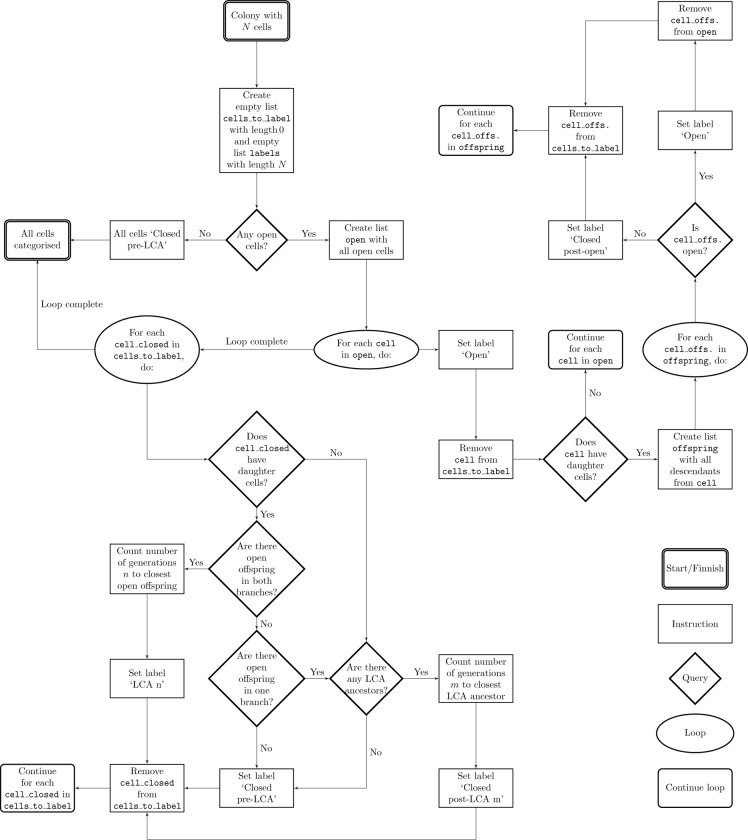
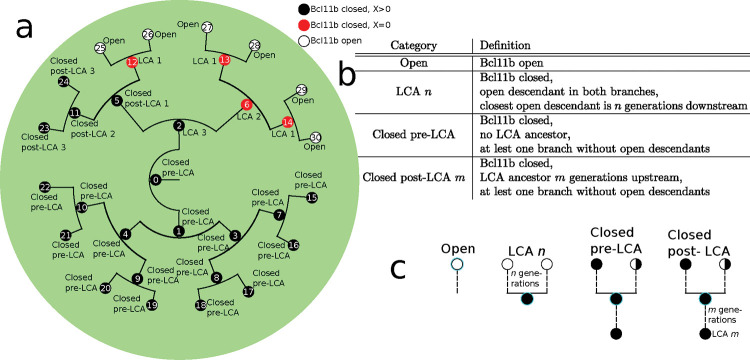
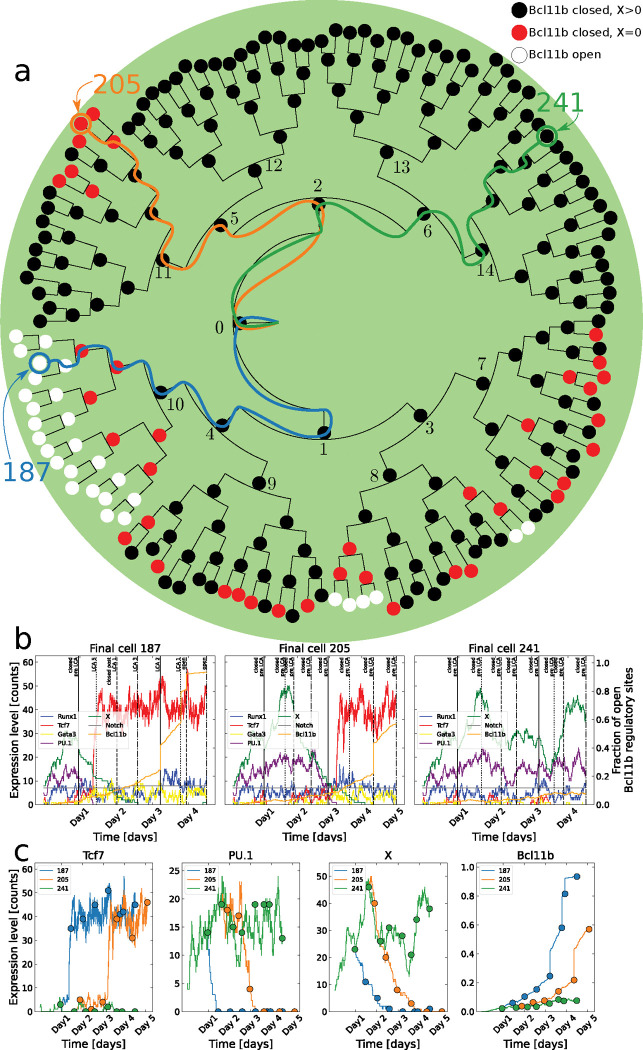
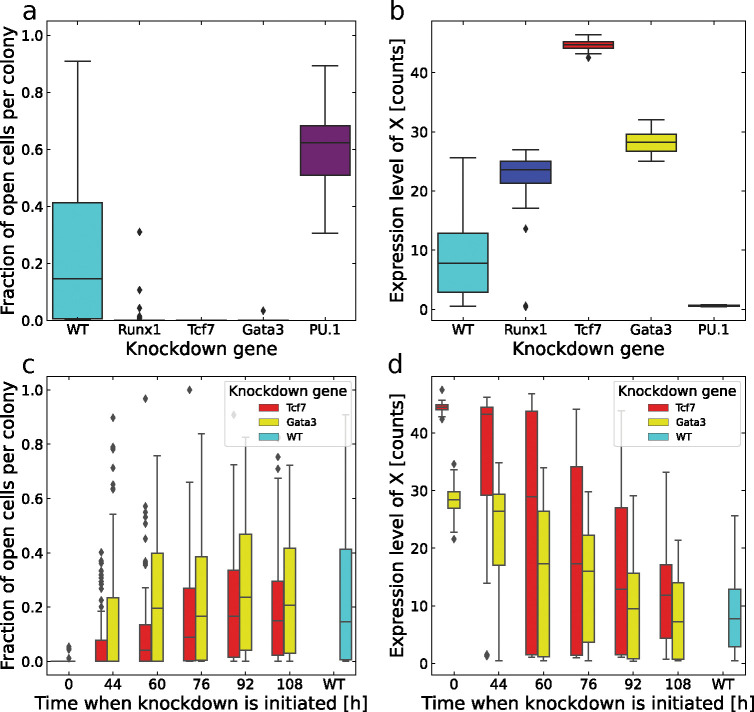
T-cell development provides an excellent model system for studying lineage commitment from a multipotent progenitor. The intrathymic development process has been thoroughly studied. The molecular circuitry controlling it has been dissected and the necessary steps like programmed shut off of progenitor genes and T-cell genes upregulation have been revealed. However, the exact timing between decision-making and commitment stage remains unexplored. To this end, we implemented an agent-based multi-scale model to investigate inheritance in early T-cell development. Treating each cell as an agent provides a powerful tool as it tracks each individual cell of a simulated T-cell colony, enabling the construction of lineage trees. Based on the lineage trees, we introduce the concept of the last common ancestors (LCA) of committed cells and analyse their relations, both at single-cell level and population level. In addition to simulating wild-type development, we also conduct knockdown analysis. Our simulations showed that the commitment is a three-step process over several cell generations where a cell is first prepared by a transcriptional switch. This is followed by the loss of the Bcl11b-opposing function two to three generations later which is when the decision to commit is taken. Finally, after another one to two generations, the cell becomes committed by transitioning to the DN2b state. Our results showed that there is inheritance in the commitment mechanism.
T细胞发育为研究多能祖细胞的谱系定向提供了一个出色的模型系统。胸腺内发育过程已得到充分研究。控制该过程的分子回路已被剖析,并且揭示了诸如祖细胞基因的程序性关闭和T细胞基因上调等必要步骤。然而,决策阶段和定向阶段之间的确切时间仍未被探索。为此,我们实施了一个基于主体的多尺度模型来研究早期T细胞发育中的遗传现象。将每个细胞视为一个主体提供了一个强大的工具,因为它可以追踪模拟T细胞群体中的每个个体细胞,从而构建谱系树。基于谱系树,我们引入了定向细胞的最后共同祖先(LCA)的概念,并在单细胞水平和群体水平上分析它们之间的关系。除了模拟野生型发育,我们还进行了基因敲低分析。我们的模拟结果表明,定向是一个跨越几个细胞世代的三步过程,其中细胞首先通过转录开关进行准备。接下来,在两到三代后失去Bcl11b的拮抗功能,此时做出定向决定。最后,在又过了一到两代后,细胞通过转变为DN2b状态而实现定向。我们的结果表明,定向机制中存在遗传现象。