Ding Yuping, Deng Quanjun, Yang Mei, Niu Haiyan, Wang Zuoyu, Xia Shihai
Department of Gastroenterology and Hepatology, Characteristic Medical Center of the Chinese People's Armed Police Force, Tianjin, 300162, People's Republic of China.
Tianjin Key Laboratory of Hepatopancreatic Fibrosis and Molecular Diagnosis & Treatment, Tianjin, 300162, People's Republic of China.
Diabetes Metab Syndr Obes. 2023 Oct 25;16:3303-3329. doi: 10.2147/DMSO.S431251. eCollection 2023.
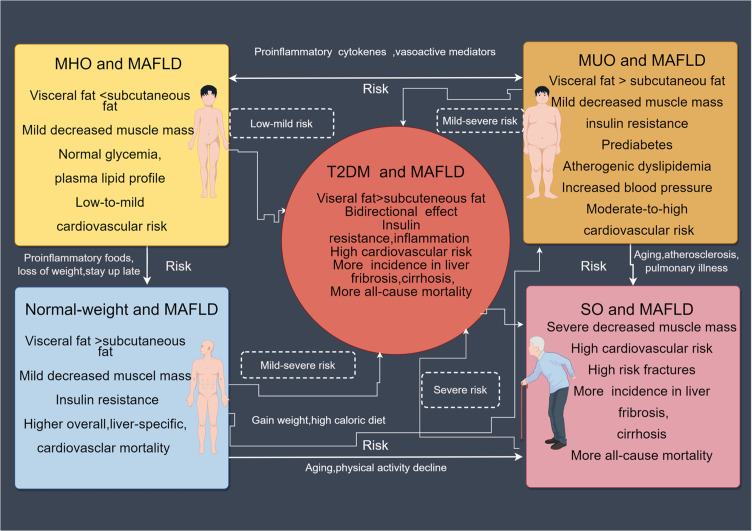
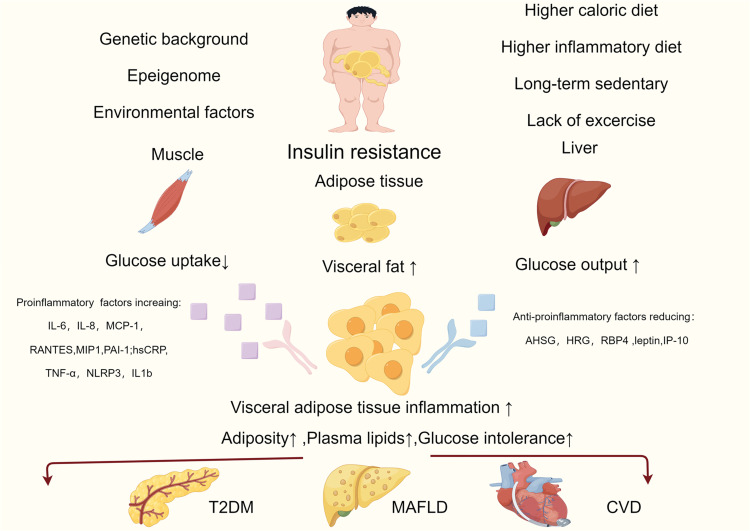
Obesity,and metabolic dysfunction-associated fatty liver disease (MAFLD) have reached epidemic proportions globally. Obesity and MAFLD frequently coexist and act synergistically to increase the risk of adverse clinical outcomes (both hepatic and extrahepatic). Type 2 diabetes mellitus (T2DM) is the most important risk factor for rapid progression of steatohepatitis and advanced fibrosis. Conversely, the later stages of MAFLD are associated with an increased risk of T2DM incident. According to the proposed criteria, MAFLD is diagnosed in patients with liver steatosis and in at least one in three: overweight or obese, T2DM, or signs of metabolic dysregulation if they are of normal weight. However, the clinical classification and correlation between obesity and MAFLD is more complex than expected. In addition, treatment for obesity and MAFLD are associated with a reduced risk of T2DM, suggesting that liver-based treatments could reduce the risk of developing T2DM. This review describes the clinical classification of obesity and MAFLD, discusses the clinical features of various types of obesity and MAFLD, emphasizes the role of visceral obesity and insulin resistance (IR) in the development of MAFLD,and summarizes the existing treatments for obesity and MAFLD that reduce the risk of developing T2DM.
肥胖以及代谢功能障碍相关脂肪性肝病(MAFLD)在全球范围内已达到流行程度。肥胖与MAFLD常常共存,并协同作用增加不良临床结局(包括肝脏和肝外)的风险。2型糖尿病(T2DM)是脂肪性肝炎快速进展和肝纤维化晚期的最重要风险因素。相反,MAFLD晚期与T2DM发病风险增加相关。根据提议的标准,肝脏脂肪变性且至少符合以下三项之一的患者可诊断为MAFLD:超重或肥胖、T2DM,或体重正常但有代谢失调迹象。然而,肥胖与MAFLD之间的临床分类及相关性比预期更为复杂。此外,肥胖和MAFLD的治疗与T2DM风险降低相关,这表明基于肝脏的治疗可降低发生T2DM的风险。本综述描述了肥胖和MAFLD的临床分类,讨论了各类肥胖和MAFLD的临床特征,强调了内脏肥胖和胰岛素抵抗(IR)在MAFLD发生中的作用,并总结了现有降低T2DM发生风险的肥胖和MAFLD治疗方法。