Rodriguez Castells Marta, Baraibar Iosune, Ros Javier, Saoudi Nadia, Salvà Francesc, García Ariadna, Alcaraz Adriana, Tabernero Josep, Élez Elena
Medical Oncology Department, Vall d'Hebron University Hospital, Barcelona, Spain.
Vall d'Hebron Institute of Oncology (VHIO), Barcelona, Spain.
Front Oncol. 2023 Oct 16;13:1272561. doi: 10.3389/fonc.2023.1272561. eCollection 2023.
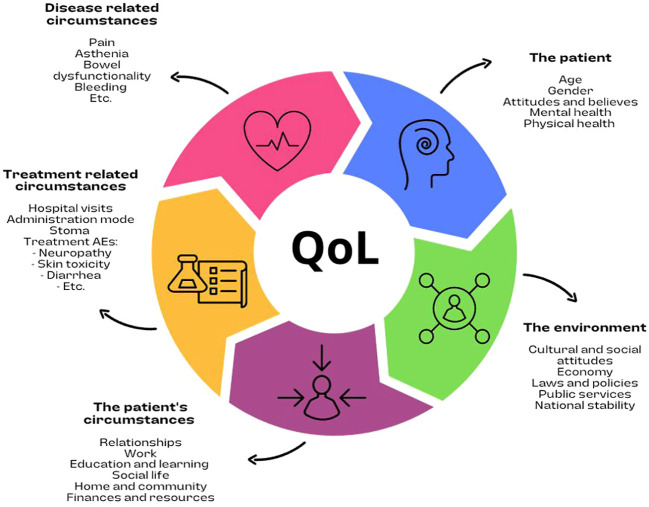
The journey of metastatic colorectal cancer patients is complex and challenging, requiring coordination and collaboration between multiple healthcare providers. Understanding patients' needs, fears, feelings, concerns, and behaviors is essential for providing individualized patient-centered care. In recent years, mCRC patients have experienced improvements in clinical outcomes, from 16 months of overall survival to 32 months, thanks to research. However, there is still room for improvement, and integrating clinical and translational research into routine practice can help patients benefit from treatments and techniques that would not be an option. In the Journey of mCRC patients, living well with cancer and quality of life becomes a priority given the outcomes of the disease. Patient reported outcomes (PRO) and Patient Reported Outcome Measures (PROMs) are becoming therefore new estimands in Oncology. Patient advocates represent important figures in this process by prioritizing issues and research questions; evaluating research designs and the performance of the research; the analysis and interpretation of data; and how results are disseminated. Multidisciplinary Tumor Boards and shared decision-making is essential for designing treatment strategies for individual patients. Quality of Life is often prioritized only when it comes to refractory advanced disease and end-of-life care, but it has to be integrated from the beginning, as the emotional impact of diagnosis leads to a vulnerable situation where patients' needs and preferences can be easily overseen. First-line treatment will be chosen among more treatment options than subsequent lines, with longer progression-free survival and a bigger impact on the outcomes. Practicing patient-centered care and optimizing first-line treatment for colorectal cancer patients requires a comprehensive understanding of patient experience and treatment outcomes, which can guide clinical practice and inform regulatory decisions for the benefit of patients.
转移性结直肠癌患者的治疗过程复杂且具有挑战性,需要多个医疗服务提供者之间的协调与合作。了解患者的需求、恐惧、感受、担忧和行为对于提供以患者为中心的个性化护理至关重要。近年来,由于研究的开展,转移性结直肠癌患者的临床结局有所改善,总生存期从16个月延长至32个月。然而,仍有改进空间,将临床和转化研究纳入常规实践可帮助患者受益于原本无法选择的治疗方法和技术。在转移性结直肠癌患者的治疗过程中,鉴于疾病的转归,与癌症共存并提高生活质量成为首要任务。因此,患者报告结局(PRO)和患者报告结局测量指标(PROMs)正成为肿瘤学领域新的评估指标。患者权益倡导者在这一过程中扮演着重要角色,他们通过确定问题和研究问题的优先级、评估研究设计和研究表现、分析和解读数据以及结果的传播方式来发挥作用。多学科肿瘤委员会和共同决策对于为个体患者设计治疗策略至关重要。生活质量通常仅在涉及难治性晚期疾病和临终关怀时才被优先考虑,但必须从一开始就将其纳入,因为诊断带来的情感影响会导致患者处于脆弱状态,其需求和偏好很容易被忽视。一线治疗的选择比后续治疗更多,无进展生存期更长,对治疗结果的影响更大。对结直肠癌患者实施以患者为中心的护理并优化一线治疗需要全面了解患者体验和治疗结果,这可为临床实践提供指导,并为监管决策提供依据,以造福患者。