School of Psychology, South China Normal University, Guangzhou, China.
Key Laboratory of Brain, Cognition and Education Sciences, Ministry of Education, Guangzhou, China.
JMIR Public Health Surveill. 2023 Nov 1;9:e47233. doi: 10.2196/47233.
Bullying victimization is highly prevalent among sexual minority youths, particularly in educational settings, negatively affecting their mental health. However, previous studies have scarcely explored the symptomatic relationships among anxiety, depression, and posttraumatic stress disorder (PTSD) among sexual minority youths who experienced bullying on college campuses.
The objectives of our study were to (1) characterize the anxiety-depression-PTSD network structures of gay or lesbian, bisexuals, and other sexual minority youths previously bullied on college campuses; and (2) compare symptomatic associations in the anxiety-depression-PTSD networks among bullied sexual minority youths and heterosexual youths' groups.
This cross-sectional study recruited college participants from Jilin Province, China. Data were analyzed using a subset of the data extracted after screening for sexual orientation and history of bullying victimization. Sexual minority youths were then divided into 3 subgroups: gay or lesbian (homosexual), bisexual, and other. Mental health symptom severity was assessed using scales: the 7-item Generalized Anxiety Disorder Scale measuring anxiety, the 9-item Patient Health Questionnaire measuring depression, and the 10-item Trauma Screening Questionnaire measuring PTSD symptoms. Combining the undirected and Bayesian network analyses, the anxiety-depression-PTSD networks were compared among sexual minority youths subgroups, and the difference between heterosexual youths and sexual minority youths was investigated. Chi-square tests were used to compare the difference in categorical variables, while independent-sample t tests were run on continuous variables.
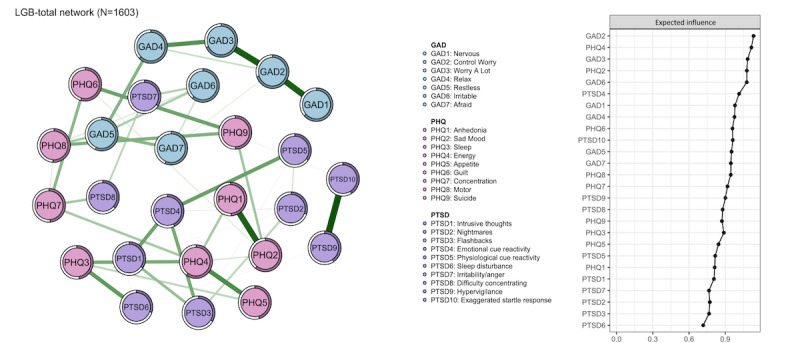
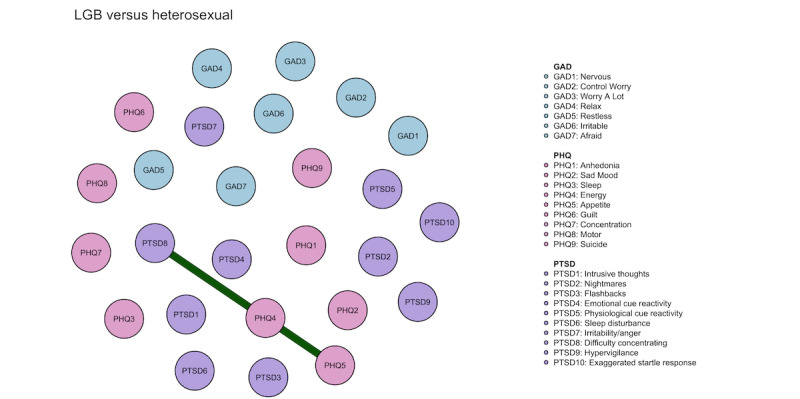
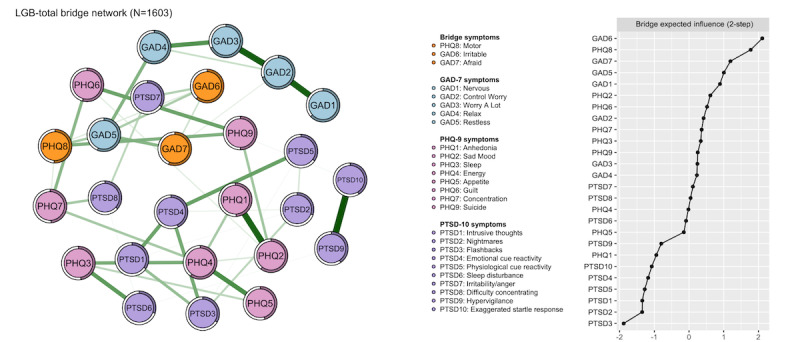
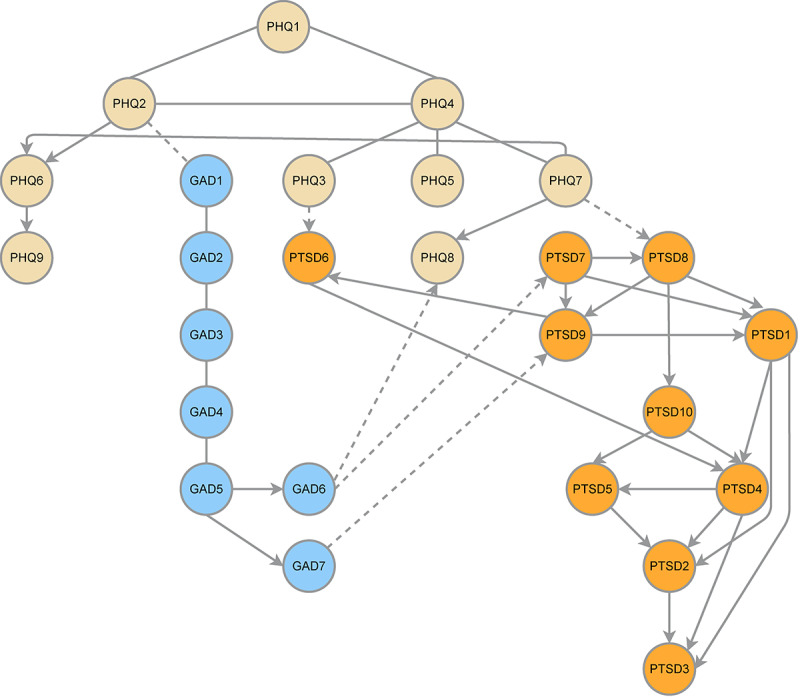
In this large-scale sample of 89,342 participants, 12,249 identified as sexual minority youths, of which 1603 (13.1%, 95% CI 12.5%-13.7%) reported being bullied on college campuses in the past year. According to the expected influence (EI) and bridge expected influence (bEI) index, in the global network structure of anxiety, depression, and PTSD, sad mood (EI=1.078, bEI=0.635) and irritability (EI=1.077, bEI=0.954) were identified as central and bridge symptoms; emotional cue reactivity (EI=1.015) was a central symptom of PTSD in this global network. In the anxiety-depression-PTSD Bayesian network, anhedonia had the highest prediction priority for activating other symptoms; and feeling afraid linked symptoms from anxiety to the PTSD community. Compared to their heterosexual counterparts, sexual minority youths exhibited a stronger association between difficulty concentrating and appetite. The "sad mood-appetite" edge was strongest in the gay or lesbian network; the "irritability-exaggerated startle response" edge was strongest in the bisexual network.
For the first time, this study identified the most central and bridge symptoms (sad mood and irritability) within the depression-anxiety-PTSD network of sexual minority youths with past bullying-victim experiences on college campuses. Emotional cue reactivity, anhedonia, and feeling afraid were other vital symptoms in the comorbid network. Symptomatic relationships existed showing heterogeneity in bullied heterosexual youths and sexual minority youth networks, which also was present within the sexual minority youth subgroups. Consequently, refined targeted interventions are required to relieve anxiety, depression, and PTSD symptoms.
性少数群体青少年中欺凌受害现象十分普遍,尤其是在教育环境中,这对他们的心理健康产生了负面影响。然而,先前的研究几乎没有探讨过在大学校园里经历过欺凌的性少数群体青少年中焦虑、抑郁和创伤后应激障碍(PTSD)之间的症状关系。
本研究的目的是:(1)描述曾在大学校园里遭受欺凌的同性恋、双性恋和其他性少数群体青少年的焦虑-抑郁-PTSD 网络结构;(2)比较有欺凌经历的性少数群体青少年和异性恋青少年群体在焦虑-抑郁-PTSD 网络中的症状关联。
本横断面研究从中国吉林省招募了大学生参与者。使用筛选性取向和欺凌受害史后提取的数据子集进行数据分析。然后,将性少数群体青少年分为 3 个亚组:同性恋(同性恋)、双性恋和其他。使用以下量表评估心理健康症状严重程度:7 项广泛性焦虑障碍量表评估焦虑,9 项患者健康问卷评估抑郁,10 项创伤筛查问卷评估 PTSD 症状。通过结合无向和贝叶斯网络分析,比较性少数群体青少年亚组之间的焦虑-抑郁-PTSD 网络,并调查异性恋青少年和性少数群体青少年之间的差异。使用卡方检验比较分类变量的差异,使用独立样本 t 检验比较连续变量的差异。
在这个大规模的 89342 名参与者样本中,有 12249 名被确定为性少数群体青少年,其中 1603 名(13.1%,95%CI 12.5%-13.7%)报告在过去一年中曾在大学校园里遭受欺凌。根据预期影响(EI)和桥梁预期影响(bEI)指数,在焦虑、抑郁和 PTSD 的全球网络结构中,悲伤情绪(EI=1.078,bEI=0.635)和易怒(EI=1.077,bEI=0.954)被确定为中心和桥梁症状;情绪线索反应性(EI=1.015)是该全球网络中 PTSD 的中心症状。在焦虑-抑郁-PTSD 贝叶斯网络中,快感缺失对激活其他症状具有最高的预测优先级;而感到害怕则将症状从焦虑连接到 PTSD 社区。与异性恋者相比,性少数群体青少年在注意力不集中和食欲减退之间表现出更强的关联。在同性恋网络中,快感缺失与食欲之间的“悲伤情绪-食欲”边缘最强;在双性恋网络中,“易怒-过度惊吓反应”边缘最强。
这是首次在曾遭受大学校园欺凌的性少数群体青少年的抑郁-焦虑-PTSD 网络中确定了最中心和桥梁症状(悲伤情绪和易怒)。情绪线索反应性、快感缺失和感到害怕是共病网络中的其他重要症状。在有欺凌经历的异性恋青少年和性少数群体青少年网络中存在症状关系,这种关系在性少数群体青少年亚组中也存在。因此,需要进行精细化的有针对性的干预,以缓解焦虑、抑郁和 PTSD 症状。