University College London, London, UK.
East London NHS Foundation Trust, London, UK.
Eur Eat Disord Rev. 2023 Jan;31(1):46-64. doi: 10.1002/erv.2952. Epub 2022 Nov 11.
Sexual orientation is usually developed during the adolescence, which coincides with the eating disorders peak onset. This paper aims to explore existing literature to identify whether there is an association between sexual orientation and eating disorder-related eating behaviours (EDrEBs) in this age-group.
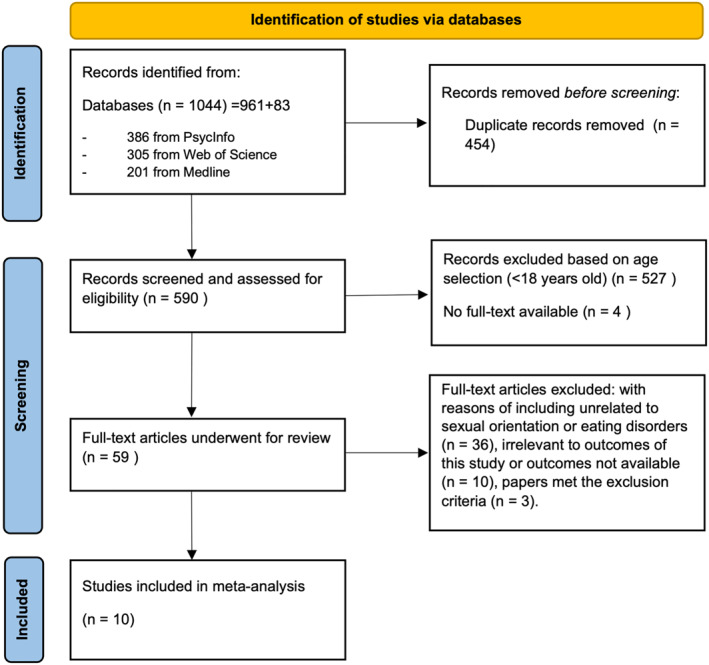
This review was based on the PRISMA guidelines, covering the published articles between 1990 and 2021. A meta-analysis of the proportion of sexual orientation and the adjusted odds ratio (OR) with 95% confident intervals was reported.
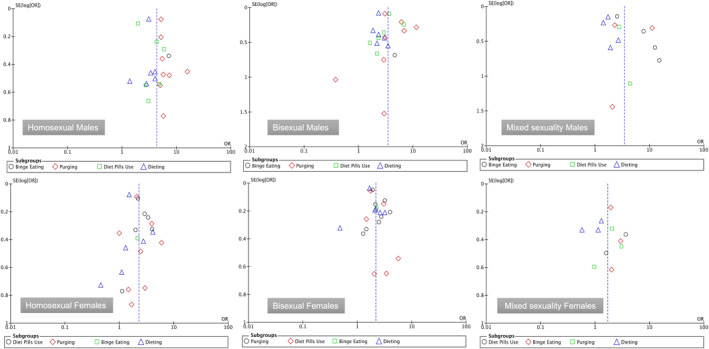
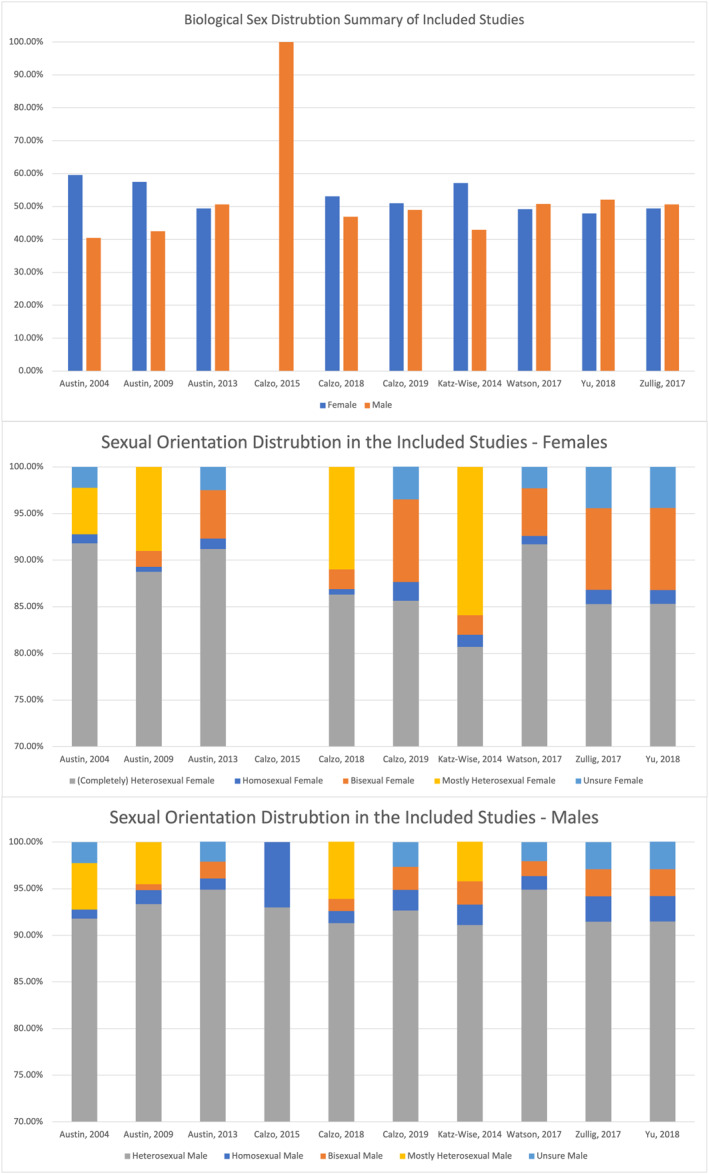
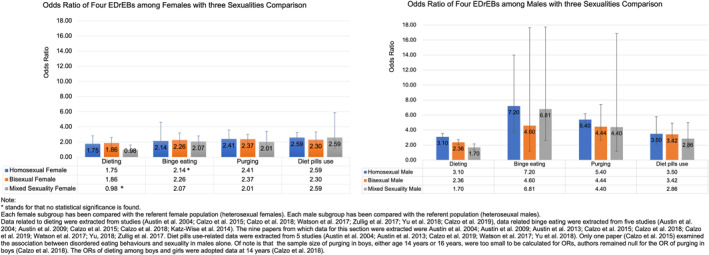
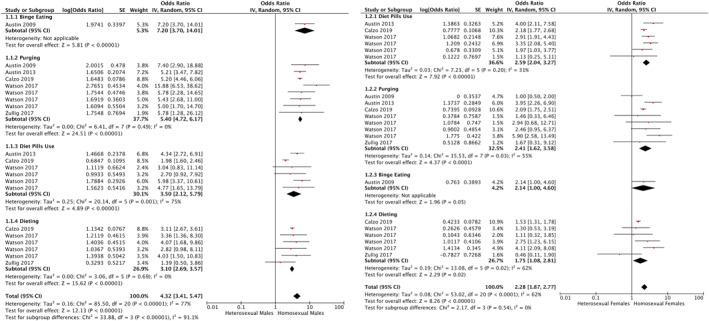
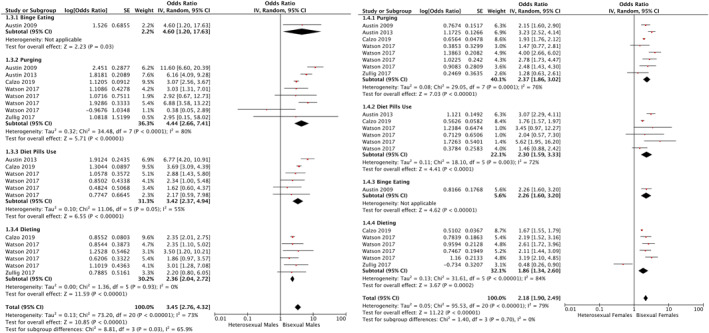
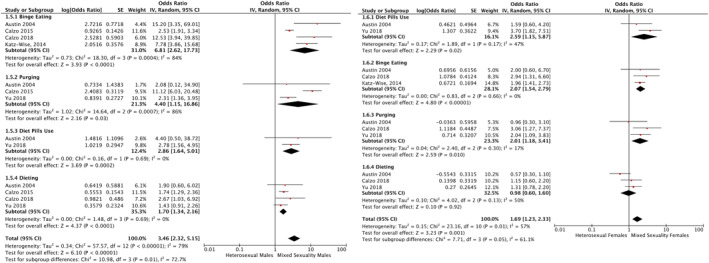
Ten studies (412,601 participants) were included in this review. The results demonstrated adolescents identified as minority sexual orientation, particularly homosexual males were with higher OR of EDrEBs, as follows: Homosexual (binge eating: M = 7.20, F = 2.14; purging: M = 5.40, F = 2.41; diet pills use: M = 3.50, F = 2.59; dieting: M = 3.10, F = 1.75); Bisexual (binge eating: M = 4.60, F = 2.26; purging: M = 4.44, F = 2.37; diet pills use: M = 3.42, F = 2.30; dieting: M = 2.36, F = 1.86).
Adolescents who were of a minority sexual orientation were more vulnerable to EDrEBs than their heterosexual peers. Healthcare professionals and sexual minority communities should be primed to facilitate earlier recognition and access to services in these vulnerable groups.
性取向通常在青春期形成,而这一时期正好是饮食失调症的发病高峰期。本文旨在探讨现有文献,以确定在这一年龄组中,性取向与饮食失调相关的进食行为(EDrEBs)之间是否存在关联。
本综述基于 PRISMA 指南,涵盖了 1990 年至 2021 年期间发表的文章。报告了性取向比例和调整后的优势比(OR)与 95%置信区间的荟萃分析结果。
本综述纳入了 10 项研究(412601 名参与者)。结果表明,被认定为少数性取向的青少年,特别是同性恋男性,更有可能出现 EDrEBs,具体表现为:同性恋者(暴食:M=7.20,F=2.14;催吐:M=5.40,F=2.41;使用减肥药:M=3.50,F=2.59;节食:M=3.10,F=1.75);双性恋者(暴食:M=4.60,F=2.26;催吐:M=4.44,F=2.37;使用减肥药:M=3.42,F=2.30;节食:M=2.36,F=1.86)。
少数性取向的青少年比异性恋同龄人更容易出现 EDrEBs。医疗保健专业人员和性少数群体社区应做好准备,以便在这些弱势群体中更早地识别和获得服务。