Zhu Yirui, Shi Jiulin, Alvarez-Arenas Tomas E Gomez, Li Chenxi, Wang Haohao, Cai Hongling, Zhang Dong, He Xingdao, Wu Xiaoshan
School of Testing and Opto-electric Engineering, Nanchang Hangkong University, Nanchang 330063, China.
Ultrasonic and Sensors Technologies Department, Information and Physical Technologies Institute, Spanish National Research Council, Serrano 144, 28006 Madrid, Spain.
APL Bioeng. 2023 Oct 30;7(4):046107. doi: 10.1063/5.0160213. eCollection 2023 Dec.
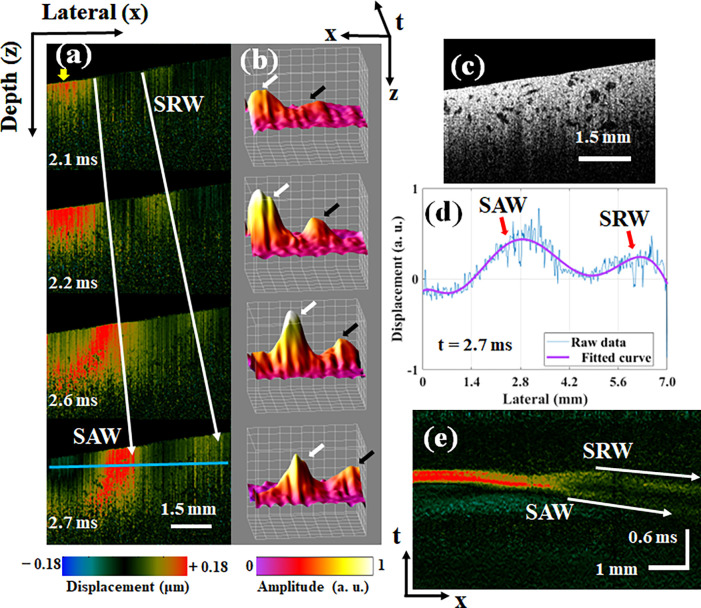
Recently, supershear Rayleigh waves (SRWs) have been proposed to characterize the biomechanical properties of soft tissues. The SRWs propagate along the surface of the medium, unlike surface Rayleigh waves, SRWs propagate faster than bulk shear waves. However, their behavior and application in biological tissues is still elusive. In brain tissue elastography, shear waves combined with magnetic resonance elastography or ultrasound elastography are generally used to quantify the shear modulus, but high spatial resolution elasticity assessment in 10 m scale is still improving. Here, we develop an air-coupled ultrasonic transducer for noncontact excitation of SRWs and Rayleigh waves in brain tissue, use optical coherent elastography (OCE) to detect, and reconstruct the SRW propagation process; in combing with a derived theoretical model of SRWs on a free boundary surface, we quantify the shear modulus of brain tissue with high spatial resolution. We first complete validation experiments using a homogeneous isotropic agar phantom, and the experimental results clearly show the SRW is 1.9649 times faster than the bulk shear waves. Furthermore, the propagation velocity of SRWs in both the frontal and parietal lobe regions of the brain is all 1.87 times faster than the bulk shear wave velocity. Finally, we evaluated the anisotropy in different brain regions, and the medulla oblongata region had the highest anisotropy index. Our study shows that the OCE system using the SRW model is a new potential approach for high-resolution assessment of the biomechanical properties of brain tissue.
最近,超剪切瑞利波(SRWs)已被提出用于表征软组织的生物力学特性。与表面瑞利波不同,SRWs沿介质表面传播,其传播速度比体剪切波快。然而,它们在生物组织中的行为和应用仍然难以捉摸。在脑组织弹性成像中,通常使用剪切波与磁共振弹性成像或超声弹性成像相结合来量化剪切模量,但在10μm尺度上的高空间分辨率弹性评估仍在不断改进。在此,我们开发了一种空气耦合超声换能器,用于在脑组织中对SRWs和瑞利波进行非接触激发,利用光学相干弹性成像(OCE)进行检测,并重建SRW传播过程;结合在自由边界表面上推导的SRWs理论模型,我们以高空间分辨率量化了脑组织的剪切模量。我们首先使用均匀各向同性琼脂模型完成了验证实验,实验结果清楚地表明SRW比体剪切波快1.9649倍。此外,SRWs在脑额叶和顶叶区域的传播速度均比体剪切波速度快1.87倍。最后,我们评估了不同脑区的各向异性,延髓区域的各向异性指数最高。我们的研究表明,使用SRW模型的OCE系统是一种用于高分辨率评估脑组织生物力学特性的新的潜在方法。