Department of Translational Research, Translational Sciences, MorphoSys AG, Planegg, Germany.
Department of Analytical Sciences, Translational Sciences, MorphoSys AG, Planegg, Germany.
Front Immunol. 2023 Oct 20;14:1274556. doi: 10.3389/fimmu.2023.1274556. eCollection 2023.
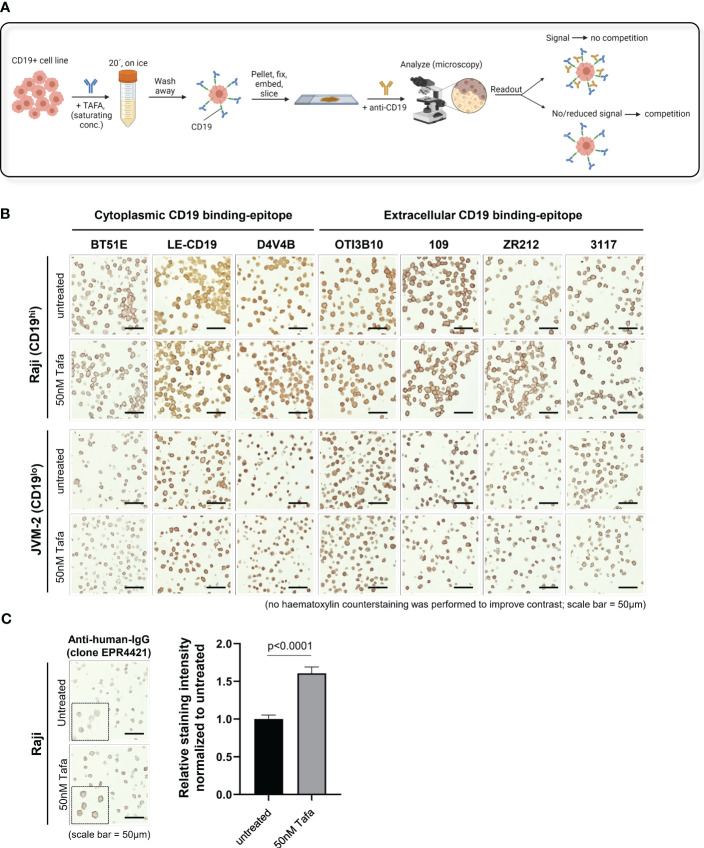
Several CD19 targeted antibody-based therapeutics are currently available for patients with diffuse large B-cell lymphoma (DLBCL), including the Fc-modified antibody immunotherapy tafasitamab. This therapeutic landscape warrants the evaluation of potential sequencing approaches. Prior to a subsequent CD19-targeted therapy, CD19 expression on tafasitamab-treated patient biopsy samples may be assessed. However, no standardized methods for its detection are currently available. In this context, selecting a tafasitamab-competing CD19 detection antibody for immunohistochemistry (IHC) or flow cytometry (FC) may lead to misinterpreting epitope masking by tafasitamab as antigen loss or downregulation.
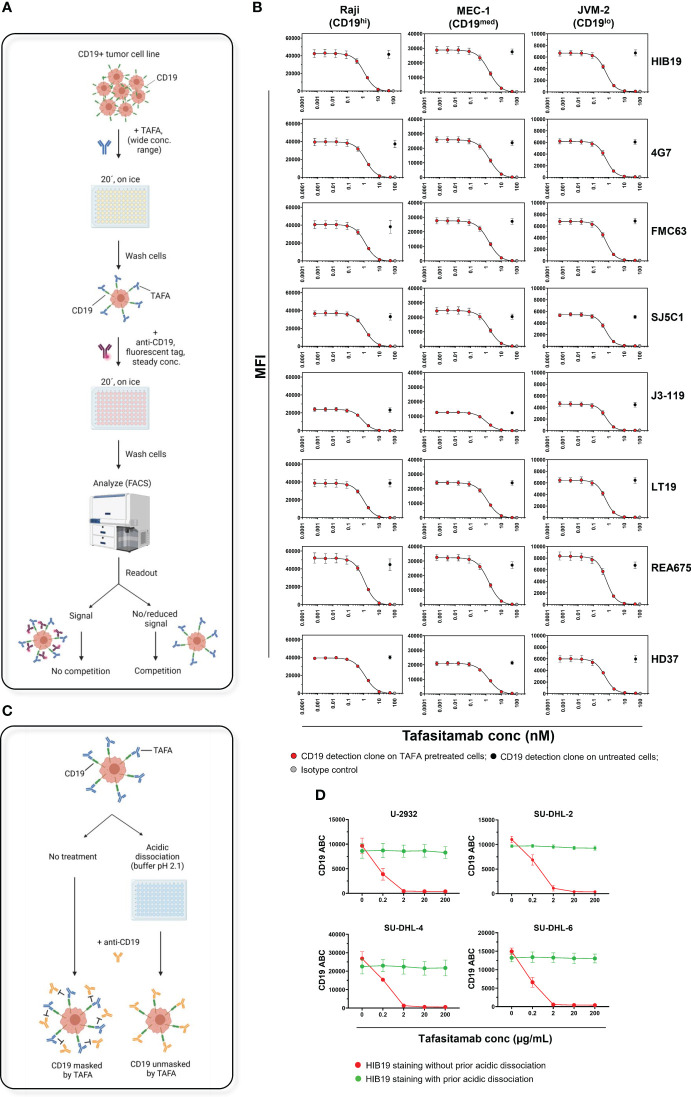
We analyzed a comprehensive panel of commercially available CD19 detection antibody clones for IHC and FC using competition assays on tafasitamab pre-treated cell lines. To remove bound tafasitamab from the cell surface, an acidic dissociation protocol was used. Antibody affinities for CD19 were measured using Surface Plasmon Resonance (SPR) or Bio-Layer Interferometry (BLI).
While CD19 was successfully detected on tafasitamab pre-treated samples using all 7 tested IHC antibody clones, all 8 tested FC antibody clones were confirmed to compete with tafasitamab. An acidic dissociation was demonstrated essential to circumvent CD19 masking by tafasitamab and avoid false negative FC results.
The current study highlights the importance of selecting appropriate CD19 detection tools and techniques for correct interpretation of CD19 expression. The findings presented herein can serve as a guideline to investigators and may help navigate treatment strategies in the clinical setting.
目前有几种针对 CD19 的抗体药物疗法可用于治疗弥漫性大 B 细胞淋巴瘤(DLBCL)患者,包括 Fc 修饰的抗体免疫疗法 tafasitamab。这种治疗方法需要评估潜在的测序方法。在进行后续的 CD19 靶向治疗之前,可能需要评估 tafasitamab 治疗的患者活检样本中的 CD19 表达。然而,目前尚无检测 CD19 的标准化方法。在这种情况下,选择用于免疫组织化学(IHC)或流式细胞术(FC)的与 tafasitamab 竞争的 CD19 检测抗体可能导致将 tafasitamab 引起的表位掩盖误解为抗原丢失或下调。
我们使用竞争测定法在 tafasitamab 预处理的细胞系上分析了用于 IHC 和 FC 的商业上可获得的 CD19 检测抗体克隆的综合面板。为了从细胞表面解离结合的 tafasitamab,我们使用了酸性解离方案。使用表面等离子体共振(SPR)或生物层干涉(BLI)测量抗体与 CD19 的亲和力。
虽然使用所有 7 种测试的 IHC 抗体克隆都可以成功地在 tafasitamab 预处理的样本中检测到 CD19,但所有 8 种测试的 FC 抗体克隆均被证实与 tafasitamab 竞争。酸性解离被证明对于避免 tafasitamab 引起的 CD19 掩盖和避免错误的 FC 阴性结果至关重要。
本研究强调了选择适当的 CD19 检测工具和技术对于正确解释 CD19 表达的重要性。本文的研究结果可以为研究人员提供指导,并有助于在临床环境中制定治疗策略。