Thanh Ngo Van, Hien Nguyen Sinh, Son Pham Nguyen, Pho Dinh Cong, Son Pham Truong
Hanoi Heart Hospital, Hanoi, Vietnam.
108 Military Central Hospital, Hanoi, Vietnam.
Int J Gen Med. 2023 Oct 31;16:4919-4930. doi: 10.2147/IJGM.S435901. eCollection 2023.
An association between heart rate variability (HRV) and cardiac events in certain diseases has been demonstrated. However, the association with new-onset atrial fibrillation (AF) after coronary artery bypass grafting (CABG) is still controversial. This study aimed to investigate the association between HRV and new-onset AF in patients undergoing CABG during a 6-month follow-up.
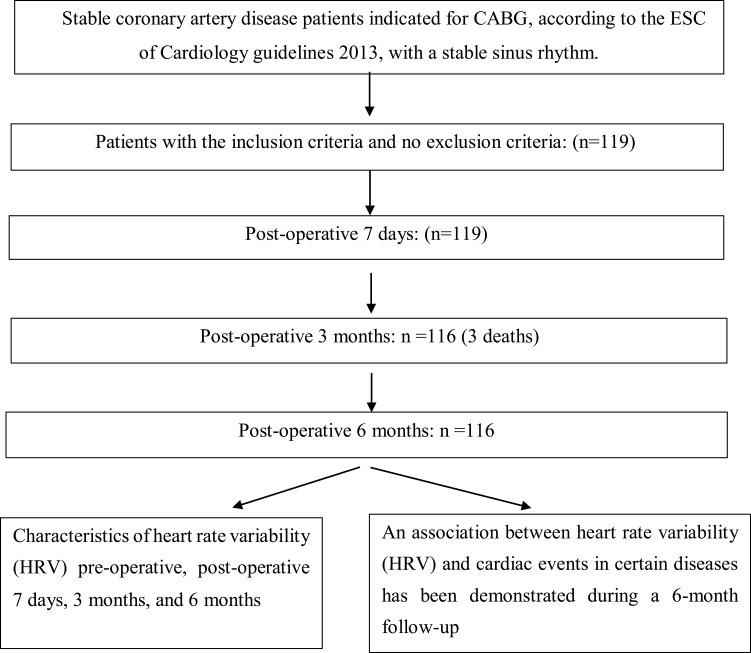
This prospective study included 119 consecutive patients who underwent off-pump CABG. All patients were assessed using 24-hour Holter recordings 2 days before CABG and 1 week, 3 months, and 6 months postoperatively. HRV was analyzed, and AF was detected from its recordings.
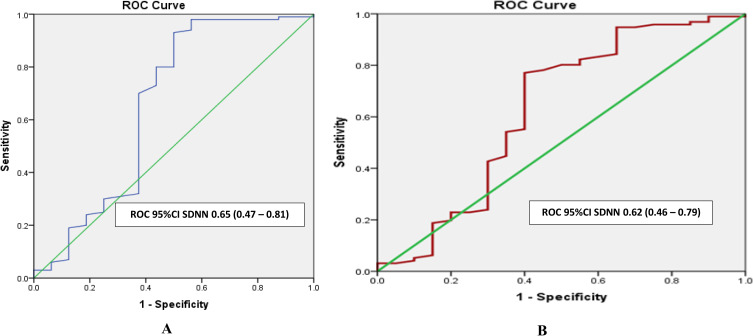
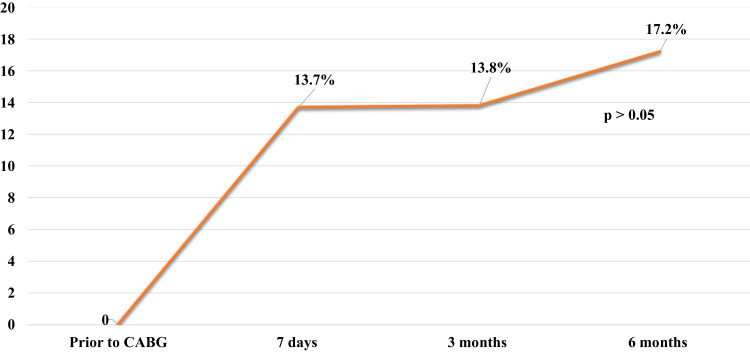
In patients undergoing CABG, NYHA III increased the AF rate 7 days postoperatively, and advanced age and diabetes were associated with AF 6 months postoperatively. A reduction in time-domain measurements before surgery was significantly associated with a higher risk of developing AF seven days postoperatively; no association between preoperative HRV and AF was found at six months. Reduced preoperative HRV (SDNN (standard deviation of all normal-to-normal intervals [) < 50 ms) was an independent predictor of AF at 3 (AUC = 0.65) and 6 months (AUC = 0.62) following surgery.
A reduction in the time domain measurements before CABG was associated with a higher risk of new-onset AF at 7 days postoperatively but not at 6 months. An SDNN <50 ms was a weak independent predictor of a higher incidence of AF at 3 and 6 months post-surgery.
心率变异性(HRV)与某些疾病中的心脏事件之间的关联已得到证实。然而,冠状动脉旁路移植术(CABG)后与新发心房颤动(AF)的关联仍存在争议。本研究旨在调查CABG患者在6个月随访期间HRV与新发AF之间的关联。
这项前瞻性研究纳入了119例连续接受非体外循环CABG的患者。所有患者在CABG前2天以及术后1周、3个月和6个月均使用24小时动态心电图记录进行评估。分析HRV,并从记录中检测AF。
在接受CABG的患者中,纽约心脏协会(NYHA)III级在术后7天增加了AF发生率,高龄和糖尿病与术后6个月的AF相关。术前时域测量值的降低与术后7天发生AF的较高风险显著相关;术前HRV与术后6个月的AF之间未发现关联。术前HRV降低(所有正常RR间期的标准差[SDNN]<50毫秒)是术后3个月(曲线下面积[AUC]=0.65)和6个月(AUC=0.62)时AF的独立预测因素。
CABG术前时域测量值降低与术后7天新发AF的较高风险相关,但与术后6个月无关。SDNN<50毫秒是术后3个月和6个月AF发生率较高的弱独立预测因素。