Sanguanwong Natthawan, Jantarangsi Nattawat, Ngeyvijit Jinjuta, Owattanapanich Natthida, Phoophiboon Vorakamol
Department of Physiology, Faculty of Medicine Chulalongkorn University.
Excellence Center for Sleep Disorders King Chulalongkorn Memorial Hospital.
Can J Respir Ther. 2023 Nov 3;59:232-244. doi: 10.29390/001c.89284. eCollection 2023.
Primary studies have demonstrated the effectiveness of noninvasive respiratory supports, including noninvasive positive pressure ventilation (NIPPV) and high flow nasal cannula (HFNC), for improving oxygenation and ventilation in patients with interstitial lung diseases (ILDs) and acute respiratory failure (ARF). These studies have not been synthesized and are not included in current practice guidelines. This systematic review with meta-analysis synthesizes studies that compared the effectiveness of NIPPV, HFNC and conventional oxygen therapy (COT) for improving oxygenation and ventilation in ILD patients with ARF.
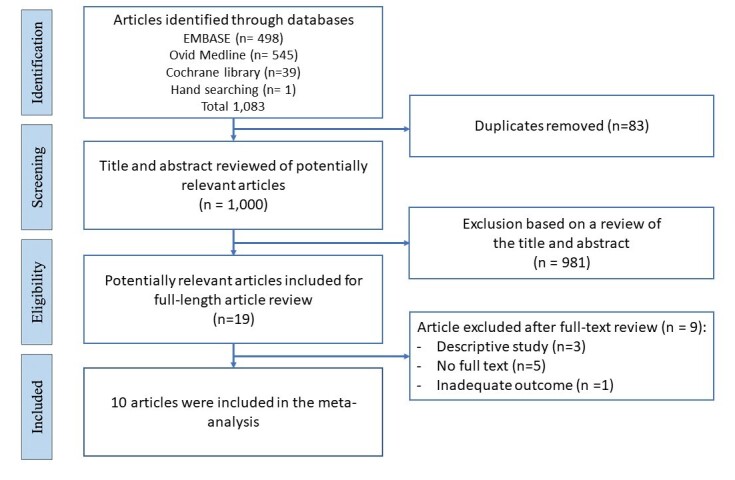
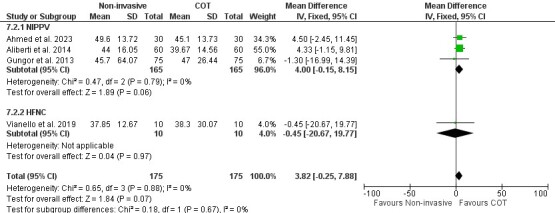
MEDLINE, EMBASE and the Cochrane Library searches were conducted from inception to August 2023. An additional search of relevant primary literature and review articles was also performed. A random effects model was used to estimate the PF ratio (ratio of arterial oxygen partial pressure to fractional inspired oxygen), PaCO (partial pressure of carbon dioxide), mortality, intubation rate and hospital length of stay.
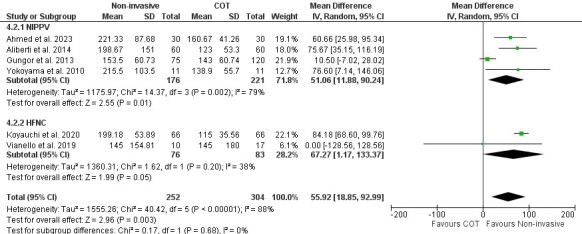
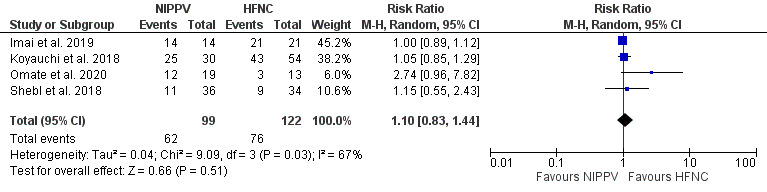
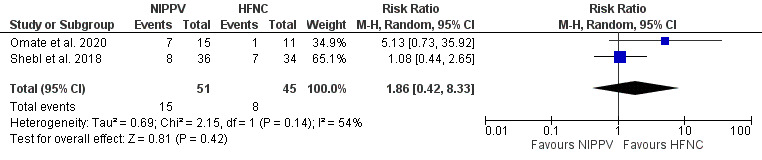
Ten studies were included in the systematic review and meta-analysis. Noninvasive respiratory supports demonstrated a significant improvement in PF ratio compared to conventional oxygen therapy (COT); the mean difference was 55.92 (95% CI [18.85-92.99]; =0.003). Compared to HFNC, there was a significant increase in PF ratio in NIPPV (mean difference 0.45; 95% CI [0.12-0.79]; =0.008). There were no mortality and intubation rate benefits when comparing NIPPV and HFNC; the mean difference was 1.1; 95% CI [0.83-1.44]; =0.51 and 1.86; 95% CI [0.42-8.33]; =0.42, respectively. In addition, there was a significant decrease in hospital length of stay in HFNC compared to NIPPV (mean difference 9.27; 95% Cl [1.45 - 17.1]; =0.02).
Noninvasive respiratory supports might be an alternative modality in ILDs with ARF. NIPPV demonstrated a potential to improve the PF ratio compared to HFNC. There was no evidence to support the benefit of NIPPV or HFNC in terms of mortality and intubation rate.
初步研究已证明无创呼吸支持,包括无创正压通气(NIPPV)和高流量鼻导管吸氧(HFNC),对于改善间质性肺疾病(ILD)和急性呼吸衰竭(ARF)患者的氧合和通气有效。这些研究尚未进行综合分析,也未纳入当前的实践指南。这项系统评价和荟萃分析综合了比较NIPPV、HFNC和传统氧疗(COT)在改善ILD合并ARF患者氧合和通气方面有效性的研究。
从数据库建库至2023年8月进行了MEDLINE、EMBASE和Cochrane图书馆检索。还对相关的原始文献和综述文章进行了额外检索。采用随机效应模型估计氧合指数(动脉血氧分压与吸入氧分数之比)、动脉血二氧化碳分压(PaCO₂)、死亡率、插管率和住院时间。
系统评价和荟萃分析纳入了10项研究。与传统氧疗(COT)相比,无创呼吸支持显著改善了氧合指数;平均差值为55.92(95%可信区间[18.85 - 92.99];P = 0.003)。与HFNC相比,NIPPV的氧合指数显著升高(平均差值0.45;95%可信区间[0.12 - 0.79];P = 0.008)。比较NIPPV和HFNC时,在死亡率和插管率方面没有益处;平均差值分别为1.1;9