Institute of Crop Sciences, Chinese Academy of Agricultural Sciences (CAAS), Beijing, China.
Department of Plant and Soil Sciences, Oklahoma State University, Stillwater, OK, USA.
Plant Biotechnol J. 2024 Mar;22(3):635-649. doi: 10.1111/pbi.14211. Epub 2023 Nov 8.
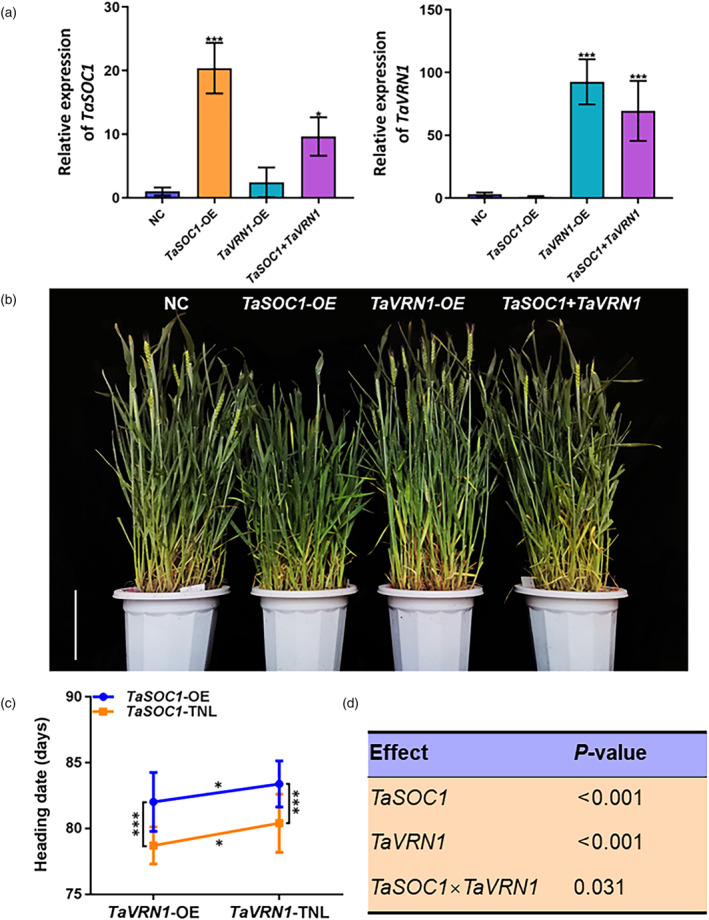
Wheat needs different durations of vernalization, which accelerates flowering by exposure to cold temperature, to ensure reproductive development at the optimum time, as that is critical for adaptability and high yield. TaVRN1 is the central flowering regulator in the vernalization pathway and encodes a MADS-box transcription factor (TF) that usually works by forming hetero- or homo-dimers. We previously identified that TaVRN1 bound to an MADS-box TF TaSOC1 whose orthologues are flowering activators in other plants. The specific function of TaSOC1 and the biological implication of its interaction with TaVRN1 remained unknown. Here, we demonstrated that TaSOC1 was a flowering repressor in the vernalization and photoperiod pathways by overexpression and knockout assays. We confirmed the physical interaction between TaSOC1 and TaVRN1 in wheat protoplasts and in planta, and further validated their genetic interplay. A Flowering Promoting Factor 1-like gene TaFPF1-2B was identified as a common downstream target of TaSOC1 and TaVRN1 through transcriptome and chromatin immunoprecipitation analyses. TaSOC1 competed with TaVRT2, another MADS-box flowering regulator, to bind to TaVRN1; their coding genes synergistically control TaFPF1-2B expression and flowering initiation in response to photoperiod and low temperature. We identified major haplotypes of TaSOC1 and found that TaSOC1-Hap1 conferred earlier flowering than TaSOC1-Hap2 and had been subjected to positive selection in wheat breeding. We also revealed that wheat SOC1 family members were important domestication loci and expanded by tandem and segmental duplication events. These findings offer new insights into the regulatory mechanism underlying flowering control along with useful genetic resources for wheat improvement.
小麦需要不同时间的春化作用,通过暴露在低温下加速开花,以确保在最佳时间进行生殖发育,因为这对适应性和高产量至关重要。TaVRN1 是春化途径中的中央开花调节剂,编码 MADS 框转录因子(TF),通常通过形成异源或同源二聚体起作用。我们之前发现 TaVRN1 与 MADS 框 TF TaSOC1 结合,其同源物是其他植物中的开花激活剂。TaSOC1 的具体功能及其与 TaVRN1 相互作用的生物学意义尚不清楚。在这里,我们通过过表达和敲除实验证明 TaSOC1 是春化和光周期途径中的开花抑制剂。我们在小麦原生质体和体内证实了 TaSOC1 和 TaVRN1 之间的物理相互作用,并进一步验证了它们的遗传相互作用。通过转录组和染色质免疫沉淀分析,鉴定出一个类似于开花促进因子 1 的基因 TaFPF1-2B 是 TaSOC1 和 TaVRN1 的共同下游靶标。TaSOC1 与另一个 MADS 框开花调节剂 TaVRT2 竞争与 TaVRN1 结合;它们的编码基因协同控制 TaFPF1-2B 的表达和开花启动,以响应光周期和低温。我们鉴定了 TaSOC1 的主要单倍型,发现 TaSOC1-Hap1 比 TaSOC1-Hap2 更早开花,并且在小麦育种中经历了正选择。我们还揭示了小麦 SOC1 家族成员是重要的驯化基因座,并通过串联和片段重复事件扩展。这些发现为开花调控的调控机制提供了新的见解,并为小麦改良提供了有用的遗传资源。