Department of Medical Oncology, Center Georges François Leclerc, 1 rue du Professeur Marion, Dijon, 21000, France.
Cancer Biology Transfer Platform, Dijon, France.
BMC Cancer. 2023 Nov 9;23(1):1080. doi: 10.1186/s12885-023-11534-6.
Immunotherapy targeting the PD-1/PD-L1 pathway is a standard of care in a number of metastatic malignancies, but less than a fifth of patients are expected to respond to ICIs (Immune Checkpoint Inhibitors). In a clinical trial, combining the anti-TIGIT (T cell immunoreceptor with Ig and ITIM domains) Mab (monoclonal antibody) tiragolumab with atezolizumab improved outcomes in non-small cell lung cancer. In preclinical models, SBRT (Stereotactic Body Radiation Therapy) could increase expression levels of the inhibitory co-receptors TIGIT and PD-L1. We aim to assess the combination of tiragolumab with atezolizumab and SBRT in metastatic, previously treated by ICIs, non-small cell lung cancer, head and neck cancer, bladder cancer, and renal cell cancer.
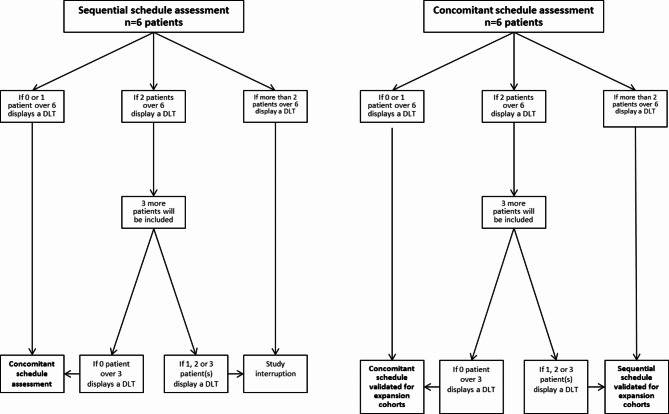
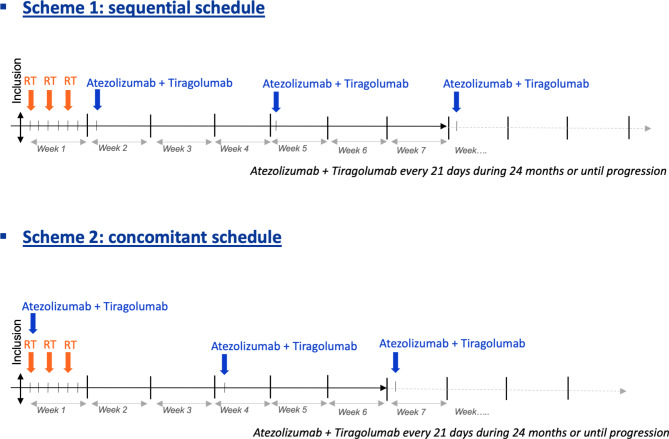
This phase I study (ClinicalTrials.gov NCT05259319) will assess the efficacy and safety of the combination of atezolizumab with tiragolumab and stereotactic body radiation therapy in patients with histologically proven metastatic non-small cell lung cancer, renal cell cancer, bladder cancer, and head and neck cancer previously treated. First part: 2 different schedules of SBRT in association with a fixed dose of atezolizumab and tiragolumab will be investigated only with metastatic non-small cell lung cancer patients (cohort 1). The expansion cohorts phase will be a multicentric, open-label study at the recommended scheme of administration and enroll additional patients with metastatic bladder cancer, renal cell cancer, and head and neck cancer (cohort 2, 3 and 4). Patients will be treated until disease progression, unacceptable toxicity, intercurrent conditions that preclude continuation of treatment, or patient refusal in the absence of progression or intolerance. The primary endpoint of the first phase is the safety of the combination in a sequential or concomitant scheme and to determine the expansion cohorts phase recommended scheme of administration. The primary endpoint of phase II is to evaluate the efficacy of tiragolumab + atezolizumab + SBRT in terms of 6-month PFS (Progression-Free Survival). Ancillary analyses will be performed with peripheral and intratumoral immune biomarker assessments.
This study is registered on ClinicalTrials.gov: NCT05259319, since February 28th, 2022.
针对 PD-1/PD-L1 通路的免疫疗法是许多转移性恶性肿瘤的标准治疗方法,但预计只有不到五分之一的患者对免疫检查点抑制剂 (ICIs) 有反应。在一项临床试验中,抗 TIGIT(T 细胞免疫受体与 Ig 和 ITIM 结构域)单克隆抗体 tiragolumab 与 atezolizumab 联合使用改善了非小细胞肺癌的预后。在临床前模型中,SBRT(立体定向体部放射治疗)可以增加抑制性共受体 TIGIT 和 PD-L1 的表达水平。我们旨在评估 tiragolumab 与 atezolizumab 和 SBRT 联合用于转移性、已接受 ICI 治疗的非小细胞肺癌、头颈部癌、膀胱癌和肾细胞癌的疗效和安全性。
这项 I 期研究(ClinicalTrials.gov NCT05259319)将评估在先前接受过治疗的组织学证实的转移性非小细胞肺癌、肾细胞癌、膀胱癌和头颈部癌患者中,atezolizumab 联合 tiragolumab 和立体定向体部放射治疗的联合治疗的疗效和安全性。第一部分:仅在转移性非小细胞肺癌患者中(队列 1)研究 2 种不同的 SBRT 方案与固定剂量 atezolizumab 和 tiragolumab 的联合治疗。扩展队列阶段将是一项多中心、开放性研究,采用推荐的给药方案,并招募更多转移性膀胱癌、肾细胞癌和头颈部癌患者(队列 2、3 和 4)。患者将继续治疗,直到疾病进展、不可接受的毒性、排除继续治疗的并发疾病,或在没有进展或不耐受的情况下患者拒绝治疗。第一阶段的主要终点是序贯或同时方案下联合治疗的安全性,并确定扩展队列阶段推荐的给药方案。第二阶段的主要终点是评估 tiragolumab+atezolizumab+SBRT 在 6 个月无进展生存期 (PFS) 方面的疗效。将进行辅助分析,包括外周和肿瘤内免疫生物标志物评估。
该研究于 2022 年 2 月 28 日在 ClinicalTrials.gov 上注册:NCT05259319。