Department of Critical Care Medicine, the First Affiliated Hospital of Guangzhou Medical University, Guangzhou, 510120, China.
Guangzhou Institute of Respiratory Health, Guangzhou, 510120, China.
BMC Pulm Med. 2023 Nov 9;23(1):435. doi: 10.1186/s12890-023-02729-5.
Sepsis is a common cause of mortality in critically ill patients, and chronic obstructive pulmonary disease (COPD) is one of the most common comorbidities in septic patients. However, the impact of COPD on patients with sepsis remained unclear. Therefore, the purpose of this study aimed to assess the effect of COPD on the prognosis of septic patients based on Medical Information Mart for Intensive Care (MIMIC-III) database.
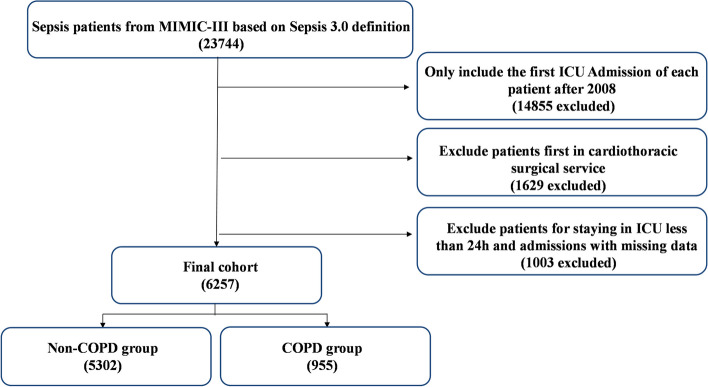
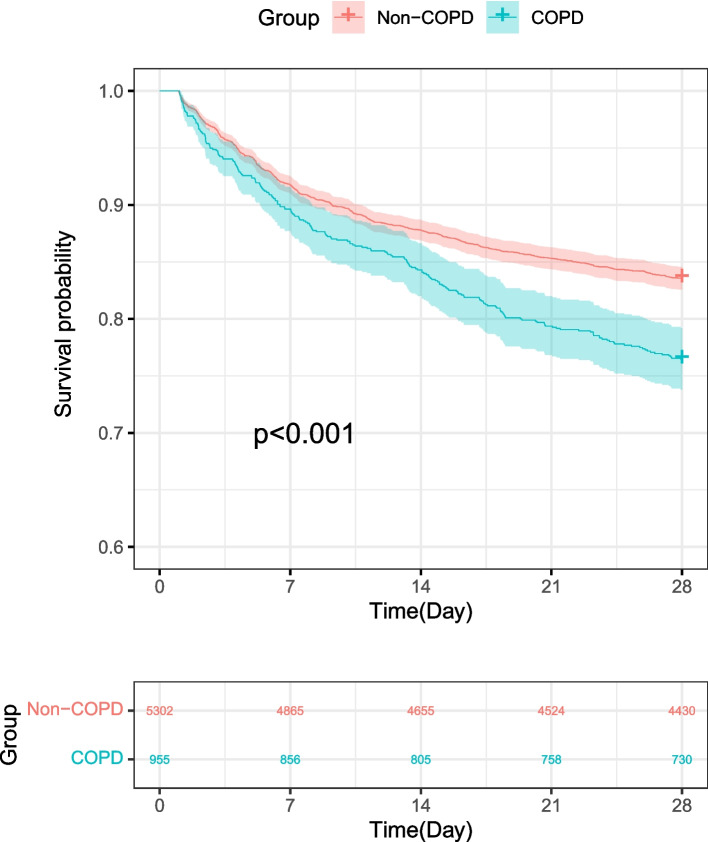
In this retrospective study based on the (MIMIC)-III database version 1.4 (v1.4), we collected clinical data and 28-day all-cause mortality from patients with sepsis in intensive care unit (ICU) and these patients met the diagnostic criteria of Sepsis 3 on ICU admission between 2008 and 2012. International Classification of Diseases (ICD-9) (4660, 490, 4910, 4911, 49120, 49121, 4918, 4919, 4920, 4928, 494, 4940, 4941, 496) was used to identified COPD. We applied Kaplan-Meier analysis to compare difference of 28-day all-cause mortality between septic patients with and without COPD. Cox proportional-hazards model was applied to explore the risk factor associated with 28-day all-cause mortality in patients with sepsis.
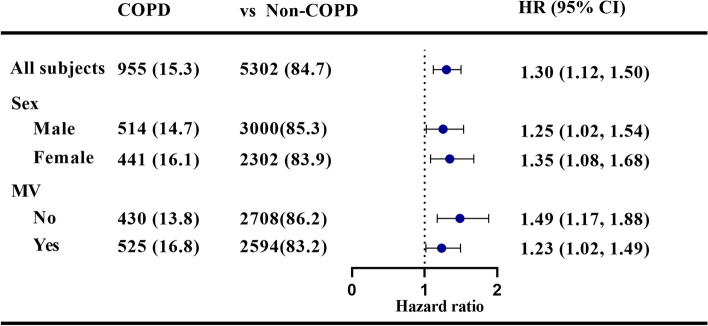
Six thousand two hundred fifty seven patients with sepsis were included in this study, including 955 (15.3%) patients with COPD and 5302 patients without COPD (84.7%). Compared with patients without COPD, patients with COPD were older (median: 73.5 [64.4, 82.0] vs 65.8 [52.9, 79.1], P < 0.001), had higher simplified acute physiology score II (SAPSII) (median: 40.0 [33.0, 49.0] vs 38.0 [29.0,47.0], P < 0.001) and greater proportion of mechanical ventilatory support (MV) (55.0% vs 48.9%, P = 0.001). In our study, septic patients with COPD had higher 28-day all-cause mortality (23.6% vs 16.4%, P < 0.001) than patients without COPD. After adjusting for covariates, the results showed that COPD was an independent risk factor for the 28-day all-cause mortality of patients with sepsis (HR 1.30, 95%CI: 1.12-1.50, P = 0.001).
COPD was an independent risk factor of 28-day all-cause mortality in septic patients. Clinically, septic patients with COPD should be given additional care.
脓毒症是危重病患者死亡的常见原因,慢性阻塞性肺疾病(COPD)是脓毒症患者最常见的合并症之一。然而,COPD 对脓毒症患者的影响仍不清楚。因此,本研究旨在基于医学信息监护(MIMIC-III)数据库评估 COPD 对脓毒症患者预后的影响。
本回顾性研究基于 MIMIC-III 数据库版本 1.4(v1.4),收集了重症监护病房(ICU)脓毒症患者的临床数据和 28 天全因死亡率,这些患者在 2008 年至 2012 年间 ICU 入院时符合 Sepsis 3 的诊断标准。国际疾病分类(ICD-9)(4660、490、4910、4911、49120、49121、4918、4919、4920、4928、494、4940、4941、496)用于确定 COPD。我们应用 Kaplan-Meier 分析比较了 COPD 与非 COPD 脓毒症患者 28 天全因死亡率的差异。应用 Cox 比例风险模型探讨脓毒症患者 28 天全因死亡率的相关危险因素。
本研究纳入了 6257 例脓毒症患者,其中 955 例(15.3%)患者患有 COPD,5302 例患者无 COPD(84.7%)。与无 COPD 的患者相比,患有 COPD 的患者年龄更大(中位数:73.5 [64.4,82.0] vs 65.8 [52.9,79.1],P < 0.001),简化急性生理学评分 II(SAPSII)更高(中位数:40.0 [33.0,49.0] vs 38.0 [29.0,47.0],P < 0.001),机械通气支持(MV)的比例更高(55.0% vs 48.9%,P = 0.001)。在本研究中,患有 COPD 的脓毒症患者 28 天全因死亡率(23.6% vs 16.4%,P < 0.001)高于无 COPD 的患者。调整混杂因素后,结果表明 COPD 是脓毒症患者 28 天全因死亡率的独立危险因素(HR 1.30,95%CI:1.12-1.50,P = 0.001)。
COPD 是脓毒症患者 28 天全因死亡率的独立危险因素。临床上,应给予患有 COPD 的脓毒症患者额外的护理。