
使用深度学习技术对荧光透视吞咽研究中的团注进行分割。
Use of deep learning to segment bolus during videofluoroscopic swallow studies.
机构信息
Department of Medical Physics, University of Wisconsin-Madison, Madison, WI, United States of America.
Department of Communication Sciences & Disorders, University of Wisconsin-Madison, Madison, WI, United States of America.
出版信息
Biomed Phys Eng Express. 2023 Nov 23;10(1). doi: 10.1088/2057-1976/ad0bb3.
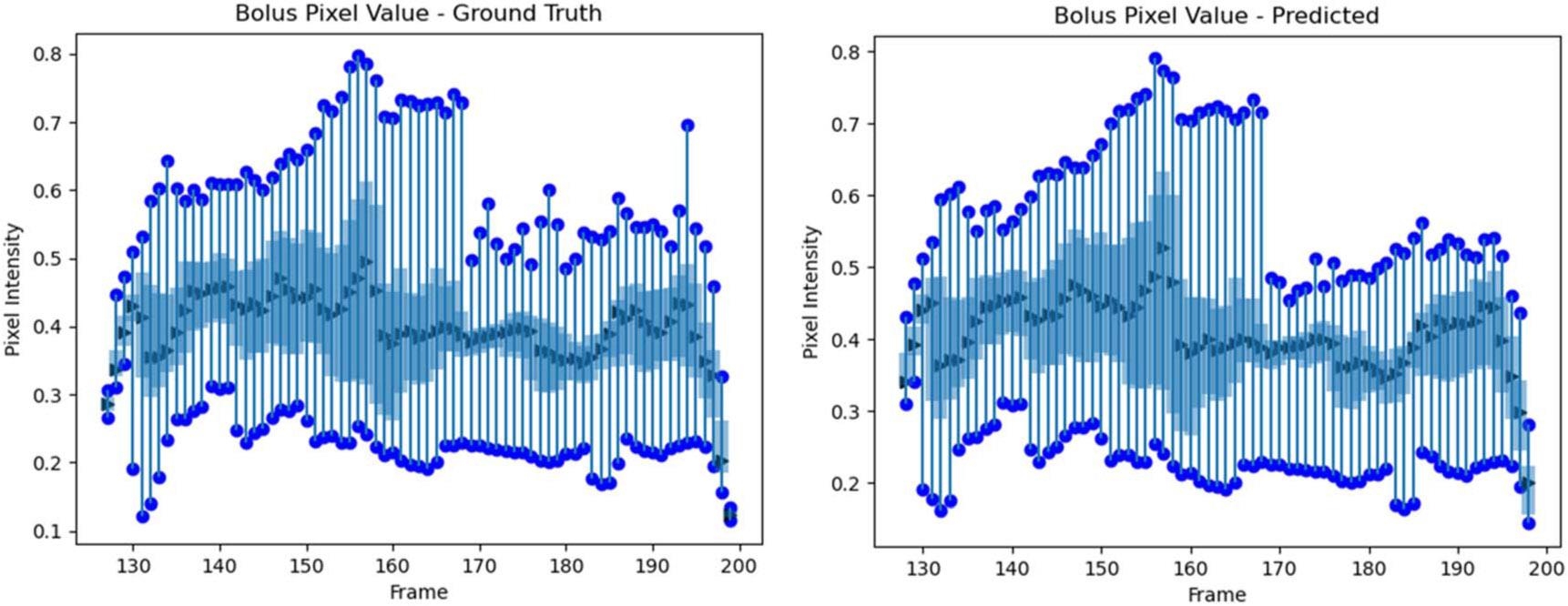
Anatomical segmentations generated using artificial intelligence (AI) have the potential to significantly improve video fluoroscopic swallow study (VFS) analysis. AI segments allow for various metrics to be determined without additional time constraints streamlining and creating new opportunities for analysis. While the opportunity is vast, it is important to understand the challenges and limitations of the underlying AI task. This work evaluates a bolus segmentation network. The first swallow of thin or liquid bolus from 80 unique patients were manually contoured from bolus first seen in the oral cavity to end of swallow motion. The data was split into a 75/25 training and validation set and a 4-fold cross validation was done. A U-Net architecture along with variations were tested with the dice coefficient as the loss function and overall performance metric. The average validation set resulted in a dice coefficient of 0.67. Additional analysis to characterize the variability of images and performance on sub intervals was conducted indicating high variability among the processes required for training the network. It was found that bolus in the oral cavity consistently degrades performance due to misclassification of teeth and unimportant residue. The dice coefficients dependence on structure size can have substantial effects on the reported value. This work shows the efficacy of bolus segmentation and identifies key areas that are detriments to the performance of the network.
使用人工智能(AI)生成的解剖分割有潜力显著改善视频透视吞咽研究(VFS)分析。AI 分割允许确定各种指标,而不会增加额外的时间限制,从而简化并为分析创造新的机会。虽然机会很大,但了解底层 AI 任务的挑战和局限性很重要。这项工作评估了一个团注分割网络。从 80 位独特患者的第一个稀薄或液体团注中,从口腔中首次看到的团注到吞咽运动结束,手动勾勒出团注的轮廓。数据分为 75/25 的训练集和验证集,以及 4 倍交叉验证。使用 Dice 系数作为损失函数和整体性能指标,测试了 U-Net 架构及其变体。验证集的平均 Dice 系数为 0.67。进行了额外的分析以表征图像的可变性和子间隔上的性能,表明训练网络所需的过程存在很高的可变性。结果表明,由于牙齿和不重要的残留物的错误分类,口腔中的团注会一直降低性能。Dice 系数对结构大小的依赖性可能会对报告的值产生重大影响。这项工作展示了团注分割的功效,并确定了对网络性能不利的关键领域。


 Zotero 插件