Division of Orthodontics, University of Florida, Gainesville, FL, USA.
Department of Preventive Dental Sciences, College of Dentistry, Princess Nourah bint Abdulrahman University, Riyadh, Saudi Arabia.
Prog Orthod. 2023 Nov 13;24(1):37. doi: 10.1186/s40510-023-00490-3.
To systematically assess the efficacy of the various interventions used to intrude maxillary molars. Furthermore, to evaluate associated root resorption, stability of intrusion, subsequent vertical movement of mandibular molars, cost effectiveness, compliance, patient reported outcomes and adverse events.
A pre-registered and comprehensive literature search of published and unpublished trials until March 22nd 2023 with no language restriction applied in PubMed/Medline, Embase, Scopus, DOSS, CENTRAL, CINAHL Plus with Full Text, Web of Science, Global Index Medicus, Dissertation and Theses Global, ClinicalTrials.gov, and Trip (PROSPERO: CRD42022310562). Randomized controlled trials involving a comparative assessment of treatment modalities used to intrude maxillary molars were included. Pre-piloted data extraction forms were used. The Cochrane Risk of Bias tool was used for risk of bias assessment, and The Grading of Recommendations Assessment, Development, and Evaluation (GRADE) system was used for certainty of evidence appraisal.
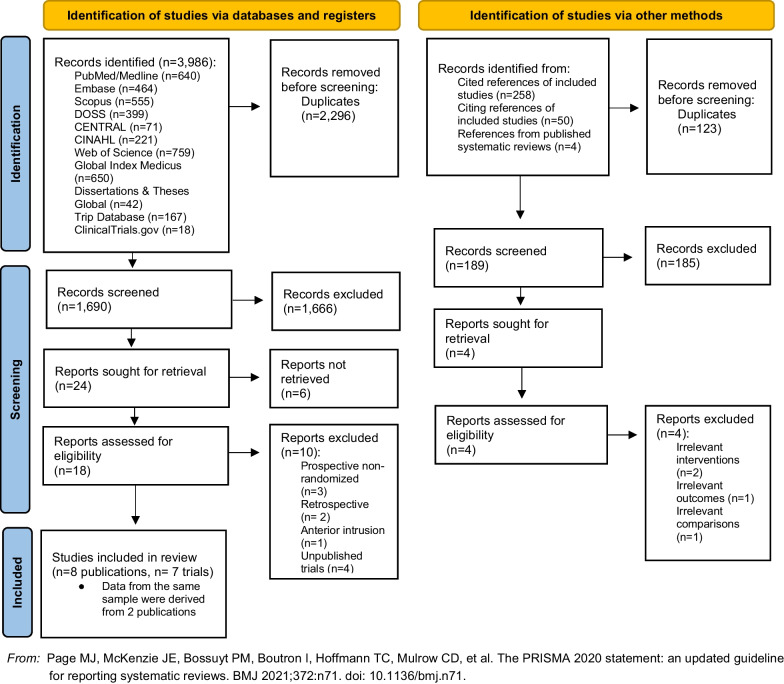
A total of 3986 records were identified through the electronic data search, of which 24 reports were sought for retrieval. Of these, 7 trials were included. One trial was judged at high risk of bias, while the others had some concerns. Based on individual small sample studies, maxillary molar intrusion was achieved using temporary anchorage devices (TADs) and rapid molar intruder appliance (RMI). It was also observed to a lesser extent with the use of open bite bionator (OBB) and posterior bite blocks. The molar intruder appliance and the posterior bite blocks (spring-loaded or magnetic) also intruded the lower molars. Root resorption was reported in two studies involving TADs. None of the identified studies involved a comparison of conventional and TAD-based treatments for intrusion of molars. No studies reported outcomes concerning stability, cost-effectiveness, compliance and patient-reported outcomes. Insufficient homogeneity between the included trials precluded quantitative synthesis. The level of evidence was very low.
Maxillary molar intrusion can be attained with different appliances (removable and fixed) and with the use of temporary anchorage devices. Posterior bite blocks (spring-loaded or magnetic) and the RMI offer the additional advantage of intruding the mandibular molars. However, stability of the achieved maxillary molar intrusion long term is unclear. Further high-quality randomized controlled trials are needed.
系统评估用于上颌磨牙内倾的各种干预措施的疗效。此外,评估相关的牙根吸收、内倾稳定性、下颌磨牙随后的垂直移动、成本效益、顺应性、患者报告的结果和不良事件。
在 PubMed/Medline、Embase、Scopus、DOSS、CENTRAL、CINAHL Plus with Full Text、Web of Science、Global Index Medicus、Dissertation and Theses Global、ClinicalTrials.gov 和 Trip(PROSPERO:CRD42022310562)中进行了预注册且全面的文献检索,对发表和未发表的试验进行了检索,无语言限制。纳入了比较治疗上颌磨牙内倾的治疗方式的随机对照试验。使用预试验数据提取表格。使用 Cochrane 偏倚风险工具评估偏倚风险,使用推荐评估、制定和评估(GRADE)系统评估证据确定性。
通过电子数据搜索共确定了 3986 条记录,其中有 24 条记录被检索。其中,有 7 项试验被纳入。一项试验被判断为高偏倚风险,而其他试验则存在一些问题。基于个别小样本研究,使用临时锚固装置(TAD)和快速磨牙内倾器(RMI)可实现上颌磨牙内倾。使用开口式合垫(OBB)和后牙垫也可以在一定程度上实现磨牙内倾。磨牙内倾器和后牙垫(弹簧加载或磁性)也可内倾下颌磨牙。有两项研究报告了 TAD 引起的牙根吸收。没有一项已确定的研究涉及传统治疗和基于 TAD 的治疗在磨牙内倾方面的比较。没有研究报告关于稳定性、成本效益、顺应性和患者报告结果的结果。纳入试验之间缺乏足够的同质性,无法进行定量综合。证据水平非常低。
使用不同的矫治器(可摘式和固定式)和临时锚固装置可以实现上颌磨牙内倾。后牙垫(弹簧加载或磁性)和 RMI 具有内倾下颌磨牙的额外优势。然而,长期获得的上颌磨牙内倾的稳定性尚不清楚。需要进一步进行高质量的随机对照试验。