Avula Sreenivas, Jhun Byung Hak, Jo Unhyeok, Heo Seunga, Lee Jun Yeob, You Youngmin
Department of Chemical and Biomolecular Engineering, Yonsei University, Seoul, 03722, Republic of Korea.
School of Chemical Engineering, Sungkyunkwan University, Suwon, Gyeonggi-do, 16419, Republic of Korea.
Adv Sci (Weinh). 2024 Jan;11(1):e2305745. doi: 10.1002/advs.202305745. Epub 2023 Nov 12.
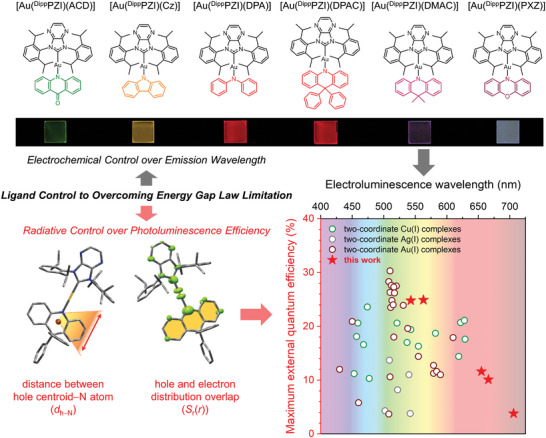
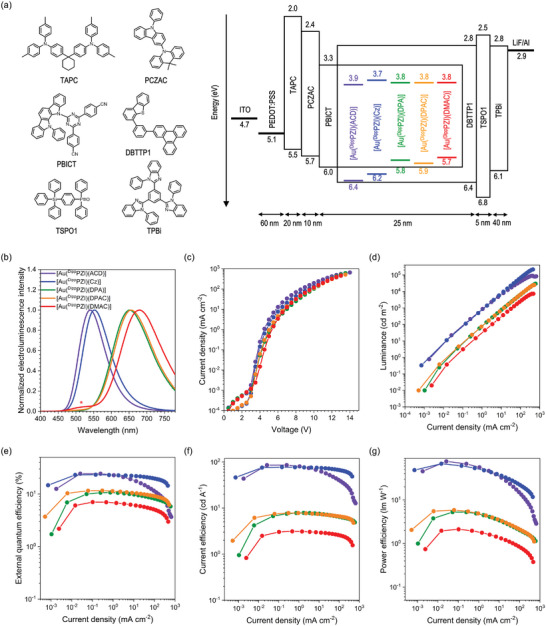
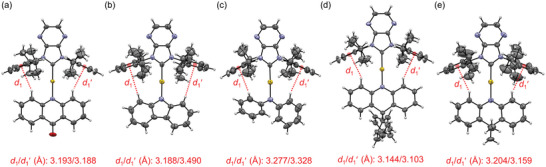
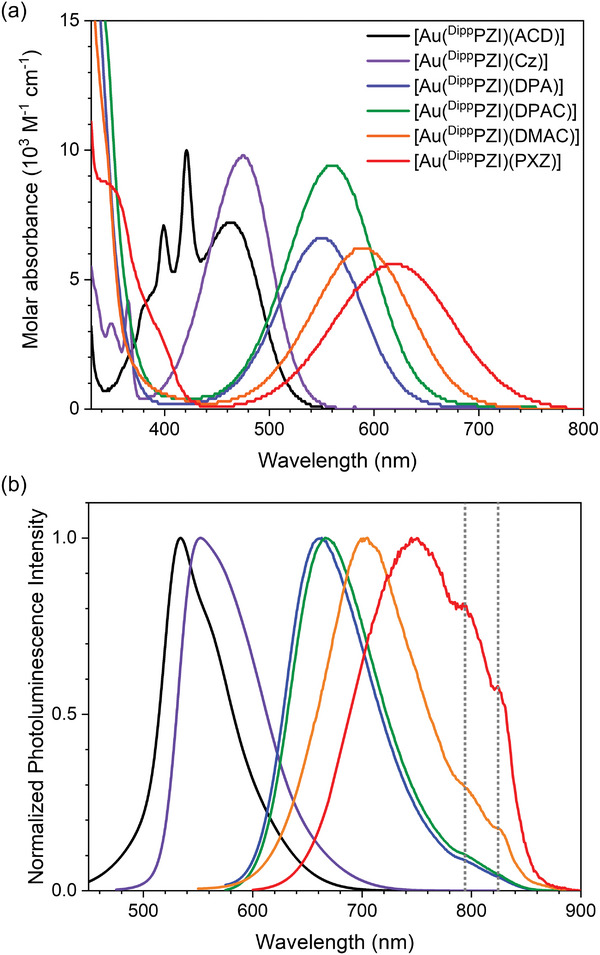
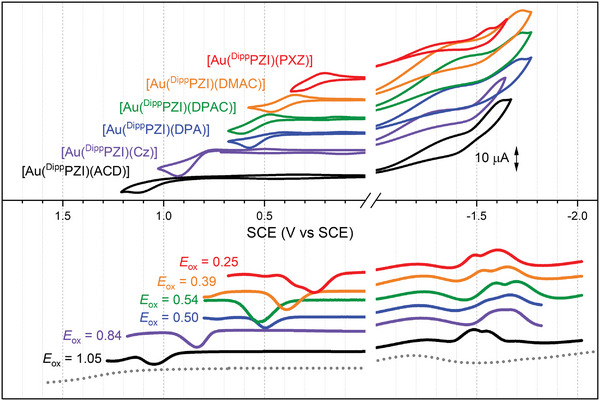
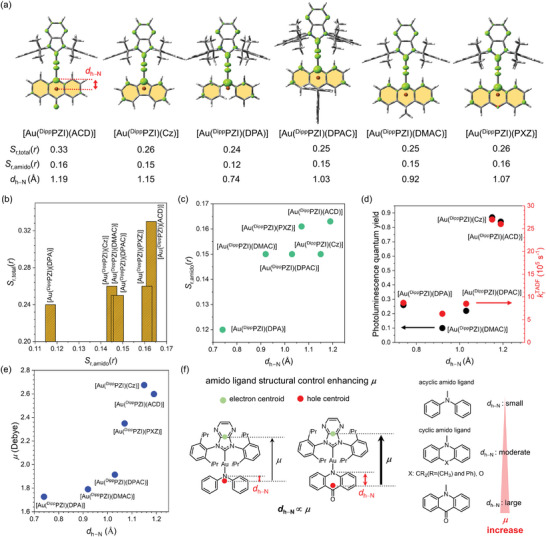
Two-coordinate coinage metal complexes have emerged as promising emitters for highly efficient organic light-emitting devices (OLEDs). However, achieving efficient long-wavelength electroluminescence emission from these complexes remains as a daunting challenge. To address this challenge, molecular design strategies aimed at bolstering the photoluminescence quantum yield (Φ) of Au(I) complex emitters in low-energy emission regions are investigated. By varying amido ligands, a series of two-coordinate Au(I) complexes is developed that exhibit photoluminescence peak wavelengths over a broad range of 533-750 nm. These complexes, in particular, maintain Φ values up to 10% even in the near-infrared emission region, overcoming the constraints imposed by an energy gap. Quantum chemical calculations and photophysical analyses reveal the action of radiative control, which serves to overcome the energy gap law, becomes more pronounced as the overlap between hole and electron distributions (S (r)) in the excited state increases. It is further elucidated that S (r) increases with the distance between the hole-distribution centroid and the nitrogen atom in an amido ligand. Finally, multilayer OLEDs involving the Au(I) complex emitters exhibit performances beyond the borderline of the electroluminescence wavelength-external quantum efficiency space set by previous devices of coinage metal complexes.
双配位金属配合物已成为高效有机发光二极管(OLED)中很有前景的发光体。然而,要实现这些配合物高效的长波长电致发光仍面临巨大挑战。为应对这一挑战,研究了旨在提高金(I)配合物发光体在低能量发射区域的光致发光量子产率(Φ)的分子设计策略。通过改变酰胺配体,开发了一系列双配位金(I)配合物,其光致发光峰值波长在533 - 750 nm的宽范围内。特别是这些配合物,即使在近红外发射区域也能保持高达10%的Φ值,克服了能隙带来的限制。量子化学计算和光物理分析表明,随着激发态中空穴和电子分布重叠(S(r))的增加,用于克服能隙定律的辐射控制作用变得更加显著。进一步阐明,S(r)随着空穴分布质心与酰胺配体中氮原子之间的距离增加而增大。最后,包含金(I)配合物发光体的多层OLED表现出超越先前金属配合物器件所设定的电致发光波长 - 外量子效率空间边界的性能。