Ali Naif H, Al-Kuraishy Hayder M, Al-Gareeb Ali I, Albuhadily Ali K, Hamad Rabab S, Alexiou Athanasios, Papadakis Marios, Saad Hebatallah M, Batiha Gaber El-Saber
Department of Internal Medicine, Medical College, Najran University, Najran, KSA.
Department of Clinical Pharmacology and Medicine, College of Medicine, Mustansiriyah University, Baghdad, Iraq.
CNS Neurosci Ther. 2024 Apr;30(4):e14525. doi: 10.1111/cns.14525. Epub 2023 Nov 12.
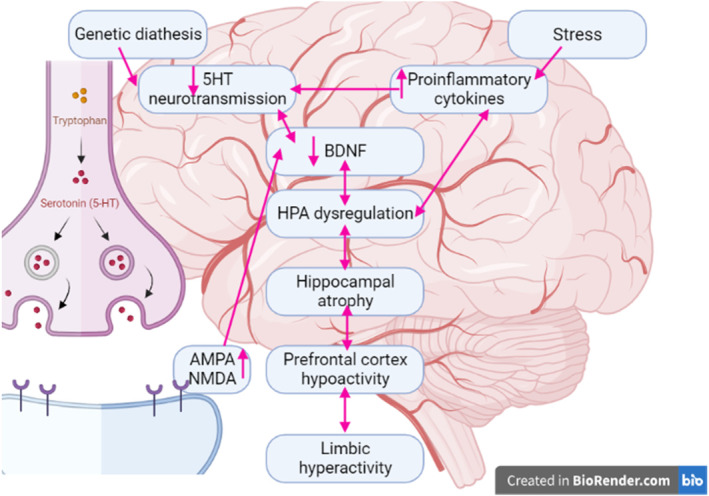
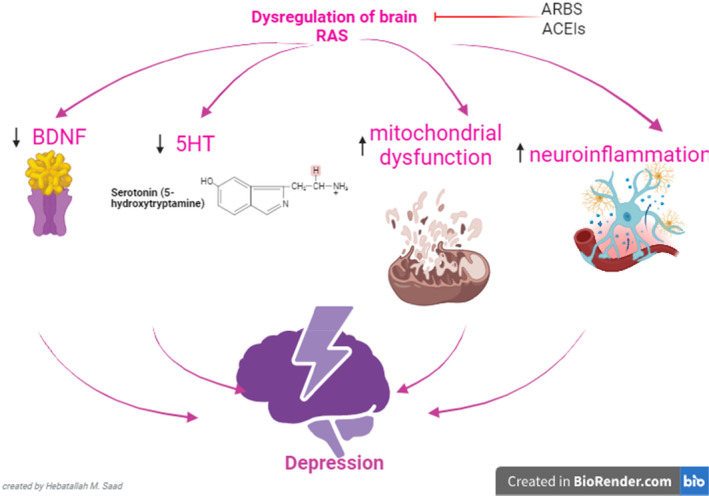
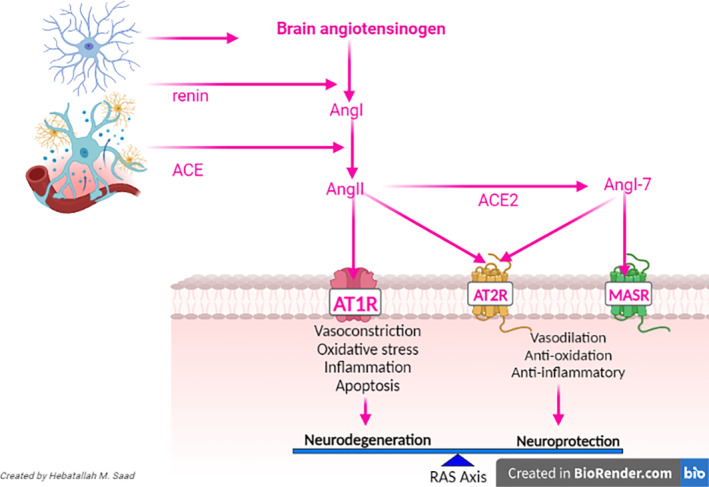
Depression is a mood disorder characterized by abnormal thoughts. The pathophysiology of depression is related to the deficiency of serotonin (5HT), which is derived from tryptophan (Trp). Mitochondrial dysfunction, oxidative stress, and neuroinflammation are involved in the pathogenesis of depression. Notably, the renin-angiotensin system (RAS) is involved in the pathogenesis of depression, and different findings revealed that angiotensin-converting enzyme inhibitors (ACEIs) and angiotensin receptor blockers (ARBs) may be effective in depression. However, the underlying mechanism for the role of dysregulated brain RAS-induced depression remains speculative. Therefore, this review aimed to revise the conceivable role of ACEIs and ARBs and how these agents ameliorate the pathophysiology of depression. Dysregulation of brain RAS triggers the development and progression of depression through the reduction of brain 5HT and expression of brain-derived neurotrophic factor (BDNF) and the induction of mitochondrial dysfunction, oxidative stress, and neuroinflammation. Therefore, inhibition of central classical RAS by ARBS and ACEIs and activation of non-classical RAS prevent the development of depression by regulating 5HT, BDNF, mitochondrial dysfunction, oxidative stress, and neuroinflammation.
抑郁症是一种以异常思维为特征的情绪障碍。抑郁症的病理生理学与血清素(5-羟色胺,5HT)缺乏有关,血清素由色氨酸(Trp)衍生而来。线粒体功能障碍、氧化应激和神经炎症参与了抑郁症的发病机制。值得注意的是,肾素-血管紧张素系统(RAS)参与了抑郁症的发病机制,不同的研究结果表明,血管紧张素转换酶抑制剂(ACEIs)和血管紧张素受体阻滞剂(ARBs)可能对抑郁症有效。然而,大脑RAS失调导致抑郁症的潜在机制仍具有推测性。因此,本综述旨在探讨ACEIs和ARBs可能发挥的作用,以及这些药物如何改善抑郁症的病理生理学。大脑RAS失调通过降低大脑5HT和脑源性神经营养因子(BDNF)的表达,以及诱导线粒体功能障碍、氧化应激和神经炎症,触发抑郁症的发生和发展。因此,ARBs和ACEIs对中枢经典RAS的抑制以及非经典RAS的激活,通过调节5HT、BDNF、线粒体功能障碍、氧化应激和神经炎症,预防抑郁症的发生。