Kim Hana, Park Susan, Kang Heewon, Kang Naeun, Levy David T, Cho Sung-Il
Department of Public Health Science, Graduate School of Public Health, Seoul National University, Seoul, Republic of Korea.
Institute of Health and Environment, Seoul National University, Seoul, Republic of Korea.
Tob Induc Dis. 2023 Nov 9;21:147. doi: 10.18332/tid/174127. eCollection 2023.
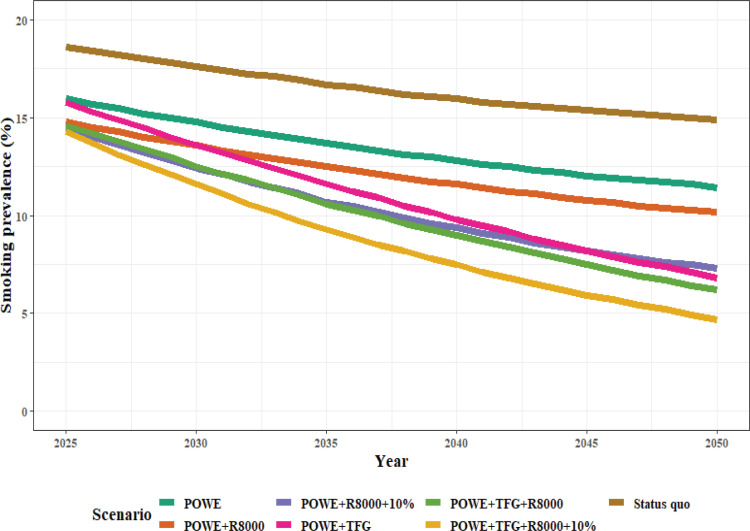
We used a simulation model to assess the feasibility of reaching the tobacco endgame target (reducing the smoking prevalence to below 5% by 2050) and explored potential implementation strategies.
The impact of strengthened tobacco-control policies on smoking prevalence was analyzed using Korea SimSmoke, a discrete-time Markov process. We considered the effects of various scenarios from 2023 and predictions were conducted until 2050. To confirm the stability of the results, deterministic and probabilistic sensitivity analyses were carried out by increasing and decreasing parameter estimates.
The implementation of tobacco-control policies in accordance with the WHO MPOWER (Μonitor tobacco use and prevention policies; Protect people from tobacco smoke; Offer help to quit tobacco smoking; Warn of the dangers of tobacco; Enforce bans on tobacco advertising, promotion, and sponsorship; Raise taxes on tobacco) measures were insufficient to achieve the tobacco endgame objective of 5% by 2050. The overall predicted smoking prevalence in 2050 is 4.7% if all policies are fully implemented in accordance with the FCTC guidelines together with a complete ban on the sale of cigarettes to people born after 2003 and annual 10% increases in price. Sensitivity analyses using the varying policy effect assumptions demonstrated the robustness of the simulation results.
For a substantive reduction in smoking prevalence, it is essential to strongly implement the MPOWER strategy. Beyond this foundational step, the eradication of smoking requires a paradigm shift in the perception of conventional tobacco-control policies, including a tobacco-free generation strategy and radical increases in the price of tobacco products.
我们使用了一个模拟模型来评估实现烟草终极目标(到2050年将吸烟率降至5%以下)的可行性,并探索潜在的实施策略。
使用韩国吸烟模拟模型(Korea SimSmoke)这一离散时间马尔可夫过程分析强化烟草控制政策对吸烟率的影响。我们考虑了从2023年起各种情景的影响,并进行了直到2050年的预测。为确认结果的稳定性,通过增加和减少参数估计进行了确定性和概率性敏感性分析。
按照世界卫生组织的MPOWER(监测烟草使用与预防政策;保护人们免受烟草烟雾危害;提供戒烟帮助;警示烟草危害;执行烟草广告、促销和赞助禁令;提高烟草税)措施实施烟草控制政策,不足以实现到2050年将吸烟率降至5%的烟草终极目标。如果所有政策都按照《烟草控制框架公约》准则全面实施,同时完全禁止向2003年以后出生的人销售香烟,并每年提价10%,那么2050年总体预测吸烟率为4.7%。使用不同政策效果假设进行的敏感性分析证明了模拟结果的稳健性。
为大幅降低吸烟率,强力实施MPOWER战略至关重要。除了这一基础步骤外,根除吸烟需要对传统烟草控制政策的认知发生范式转变,包括无烟草一代战略和大幅提高烟草产品价格。