Goyal Vinod, Rani Dolly, Mehrotra Shweta, Deng Chaoyi, Wang Yi
Department of Botany and Plant Physiology, CCS Haryana Agricultural University, Hisar 125004, Haryana, India.
Department of Microbiology, CCS Haryana Agricultural University, Hisar 125004, Haryana, India.
Plants (Basel). 2023 Nov 1;12(21):3744. doi: 10.3390/plants12213744.
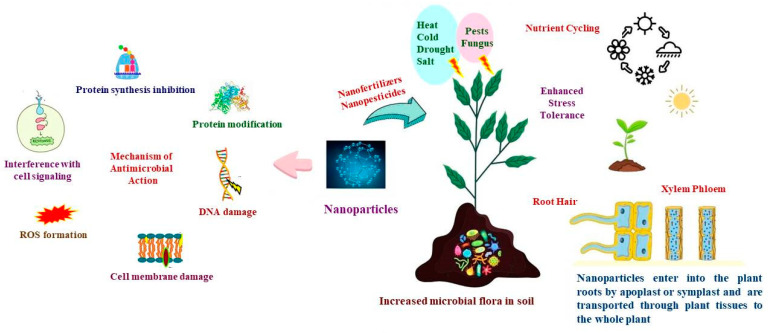
Nanotechnology has attracted remarkable attention due to its unique features and potential uses in multiple domains. Nanotechnology is a novel strategy to boost production from agriculture along with superior efficiency, ecological security, biological safety, and monetary security. Modern farming processes increasingly rely on environmentally sustainable techniques, providing substitutes for conventional fertilizers and pesticides. The drawbacks inherent in traditional agriculture can be addressed with the implementation of nanotechnology. Nanotechnology can uplift the global economy, so it becomes essential to explore the application of nanoparticles in agriculture. In-depth descriptions of the microbial synthesis of nanoparticles, the site and mode of action of nanoparticles in living cells and plants, the synthesis of nano-fertilizers and their effects on nutrient enhancement, the alleviation of abiotic stresses and plant diseases, and the interplay of nanoparticles with the metabolic processes of both plants and microbes are featured in this review. The antimicrobial activity, ROS-induced toxicity to cells, genetic damage, and growth promotion of plants are among the most often described mechanisms of operation of nanoparticles. The size, shape, and dosage of nanoparticles determine their ability to respond. Nevertheless, the mode of action of nano-enabled agri-chemicals has not been fully elucidated. The information provided in our review paper serves as an essential viewpoint when assessing the constraints and potential applications of employing nanomaterials in place of traditional fertilizers.
纳米技术因其独特特性和在多个领域的潜在用途而备受关注。纳米技术是一种提高农业产量的新策略,具有更高的效率、生态安全、生物安全和经济安全。现代农业生产越来越依赖环境可持续技术,为传统化肥和农药提供替代品。传统农业固有的缺点可以通过实施纳米技术来解决。纳米技术可以推动全球经济发展,因此探索纳米颗粒在农业中的应用变得至关重要。本文综述了纳米颗粒的微生物合成、纳米颗粒在活细胞和植物中的作用位点及作用方式、纳米肥料的合成及其对养分增强的影响、对非生物胁迫和植物病害的缓解作用,以及纳米颗粒与植物和微生物代谢过程的相互作用。纳米颗粒的抗菌活性、活性氧诱导的细胞毒性、遗传损伤和植物生长促进作用是最常描述的作用机制。纳米颗粒的大小、形状和剂量决定了它们的反应能力。然而,纳米农用化学品的作用方式尚未完全阐明。我们综述论文中提供的信息在评估使用纳米材料替代传统肥料的限制和潜在应用时是一个重要的观点。