Department of Blood Transfusion, Pingxiang People's Hospital, Pingxiang, Jiangxi, China.
Department of Dermatology, The Second Xiangya Hospital of Central South University, Hunan Key Laboratory of Medical Epigenomics, Changsha, China.
Medicine (Baltimore). 2023 Nov 10;102(45):e35724. doi: 10.1097/MD.0000000000035724.
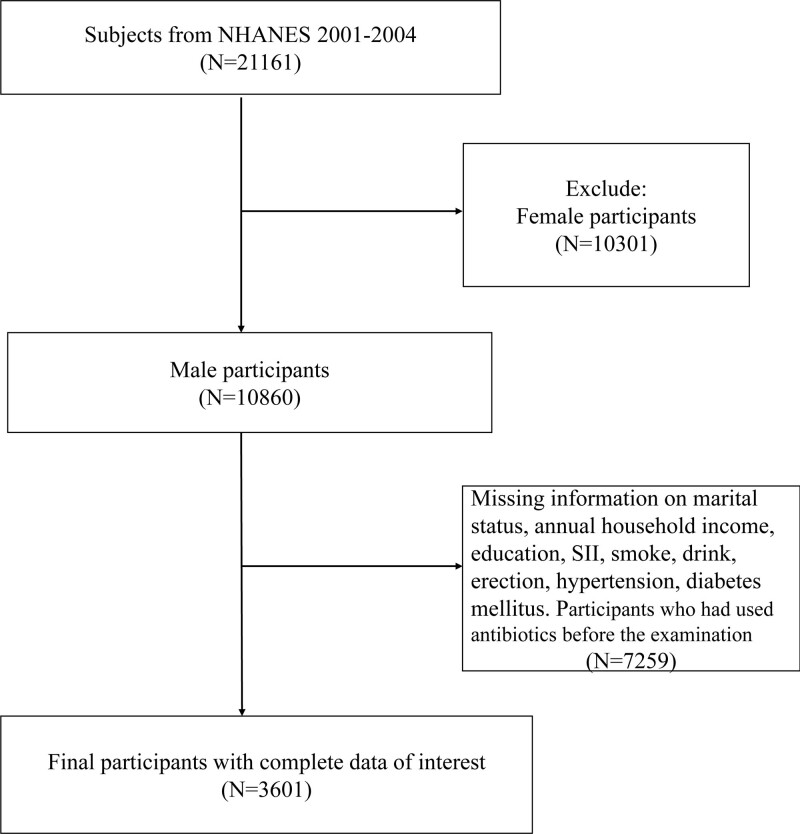
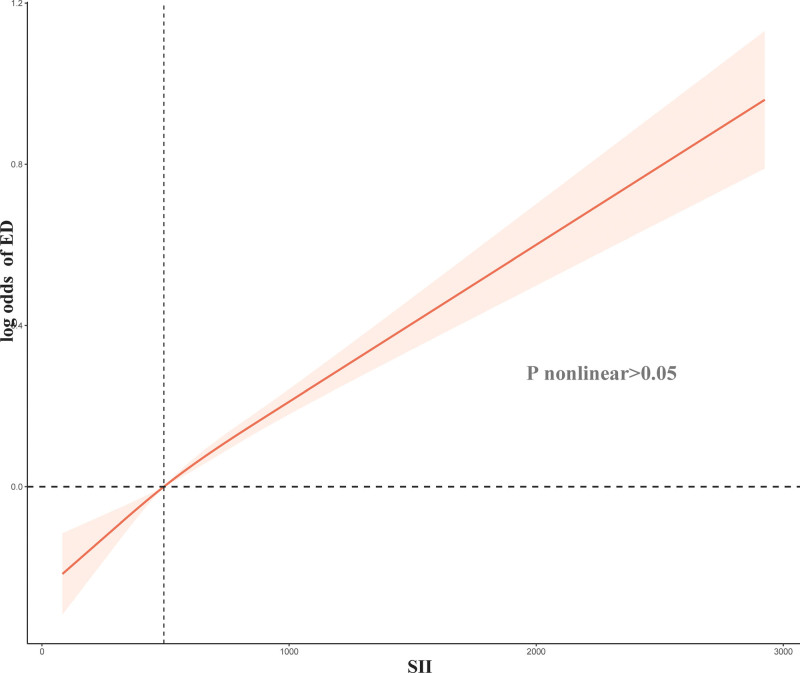
This study utilized data from the National Health and Nutrition Examination Survey (NHANES) to investigate the association between the systemic immune-inflammation index (SII) and erectile dysfunction (ED) in adult males. The SII is a novel index derived from the counts of neutrophils, lymphocytes, and platelets in the peripheral blood and serves as a comprehensive indicator of the immune response and inflammation levels. The study included 3601 participants from the NHANES 2001-2004 cycle. Covariates such as age, race, marital status, education, smoking, alcohol consumption, BMI, hypertension, and diabetes were taken into account. Weighted analysis and logistic regression models were applied to assess the relationship between SII and ED, adjusting for potential confounding factors. The prevalence of ED was found to be 6.28%. Overall, there is a linear correlation between SII (nonlinear P > .05) and ED. After adjusting for various confounding factors, a significant association was observed between high levels of the SII and ED. The odds ratio (OR) for ED in individuals with high SII levels was 1.45 (95% CI: 1.01-2.17, P = .045). Subgroup analysis further identified specific participant subgroups with a significant association between SII and ED. Our findings suggest that higher levels of the SII are independently associated with an increased risk of ED in adult males. The SII may serve as a valuable biomarker for identifying individuals at higher risk of ED and may aid in the development of tailored treatment approaches. Further research is needed to explore the underlying mechanisms and potential therapeutic implications.
本研究利用国家健康和营养检查调查(NHANES)的数据,调查了成年男性系统性免疫炎症指数(SII)与勃起功能障碍(ED)之间的关联。SII 是一种从外周血中性粒细胞、淋巴细胞和血小板计数中得出的新指数,作为免疫反应和炎症水平的综合指标。该研究纳入了来自 NHANES 2001-2004 周期的 3601 名参与者。考虑了年龄、种族、婚姻状况、教育程度、吸烟、饮酒、BMI、高血压和糖尿病等协变量。应用加权分析和逻辑回归模型来评估 SII 和 ED 之间的关系,调整潜在的混杂因素。ED 的患病率为 6.28%。总体而言,SII(非线性 P>.05)与 ED 之间存在线性相关性。在调整了各种混杂因素后,高水平的 SII 与 ED 之间存在显著关联。SII 水平高的个体发生 ED 的比值比(OR)为 1.45(95%CI:1.01-2.17,P=0.045)。亚组分析进一步确定了特定的参与者亚组,SII 与 ED 之间存在显著关联。我们的研究结果表明,SII 水平较高与成年男性 ED 风险增加独立相关。SII 可能是识别 ED 风险较高个体的有价值的生物标志物,并可能有助于制定个性化的治疗方法。需要进一步研究以探索潜在的机制和潜在的治疗意义。