National Council for Science and Technology and Center for Nutrition and Health Research, National Institute of Public Health, Cuernavaca, Mexico.
Center for Population and Health Research, National Institute of Public Health, Cuernavaca, Mexico.
BMJ Glob Health. 2023 Nov;8(Suppl 8). doi: 10.1136/bmjgh-2023-012227.
In 2014, Mexico implemented a one peso-per-litre tax to sugar-sweetened beverage (SSB). Even though this tax reduced household purchases and predicted population health gains, the magnitude is lower compared with taxes implemented in other settings. In this study, we assessed what would happen if Mexico modified its existing tax to get higher benefits based on currently implemented taxes elsewhere.
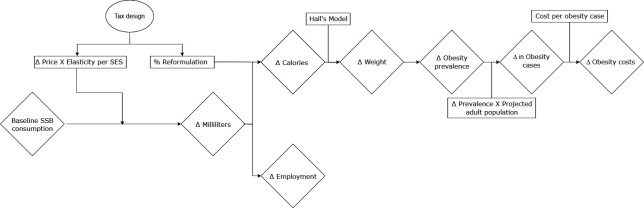
For each tax scenario, we estimated net benefits as the difference between healthcare savings and lost jobs. We created hypothetical scenarios in which the current tax doubled or would be modified based on existing tax designs around the world including specific taxes (sugar-density or volumetric) and ad-valorem taxes.
We found that the largest benefits would correspond to a tax increase of 7.4 Mexican pesos (0.45 US dollars (USD)) per SSB litre, following the current tax in Bahrain (the highest tax rate option). This tax is predicted to yield net benefits equivalent to USD 24.7 billion after 10 years of the tax redesign. We also found that sugar-density taxes can result in larger net benefits since, in addition to reductions in consumption associated with responses to prices, they induce product reformulation. Middle-income households are the most benefited group because they reported the highest baseline prevalence of obesity and the largest price elasticity.
Policymakers should consider pursuing a tax reform adding to the current tax, with significant increases in prices linked to a sugar-density strategy to reach a higher benefit.
2014 年,墨西哥对含糖饮料(SSB)征收每升 1 比索的税。尽管该税降低了家庭购买量,并预计会带来人口健康收益,但与其他地方实施的税收相比,其规模要小。在这项研究中,我们评估了如果墨西哥根据其他地方目前实施的税收修改其现有税收以获得更高收益会发生什么情况。
对于每种税收情况,我们将净收益估计为医疗保健节省和失业损失之间的差异。我们根据世界各地现行的税收设计(包括特定税收(糖密度或体积)和从价税),创建了假设情景,其中当前的税收增加了一倍或根据现有税收进行修改。
我们发现,与目前的巴林(最高税率选项)税收相比,按照当前的 SSB 每升 7.4 比索(0.45 美元(USD))的方式增加税收,将带来最大的收益。重新设计税收 10 年后,预计该税收将产生相当于 247 亿美元的净收益。我们还发现,糖密度税可以带来更大的净收益,因为除了与价格反应相关的消费减少外,它们还会促使产品配方改革。中等收入家庭是受益最大的群体,因为他们报告肥胖的基线患病率最高,价格弹性最大。
政策制定者应考虑进行税收改革,在现有税收基础上增加税收,并通过糖密度策略大幅提高价格,以实现更高的收益。