Zhang Shuqing, Mulder Cassidy, Riddle Suzette, Song Rui, Yue Dongmei
School of Pharmacy, China Medical University, Shenyang, China.
Liberty University College of Osteopathic Medicine, Lynchburg, VA, United States.
Front Cell Dev Biol. 2023 Oct 30;11:1247339. doi: 10.3389/fcell.2023.1247339. eCollection 2023.
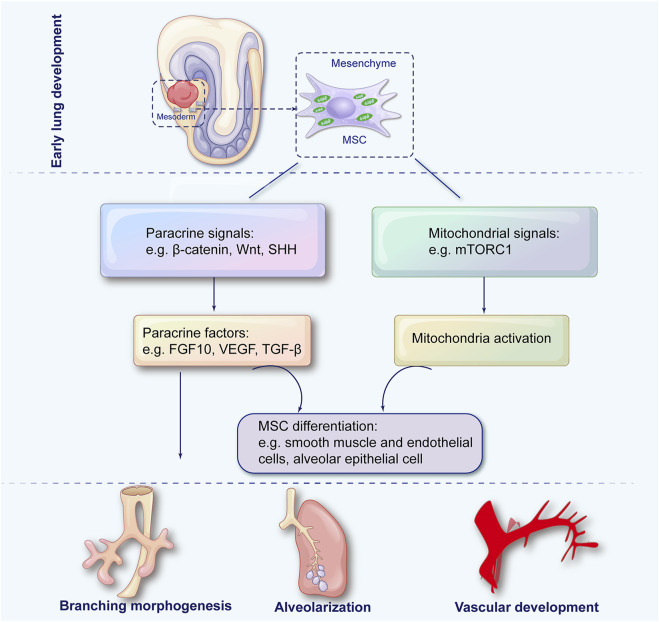
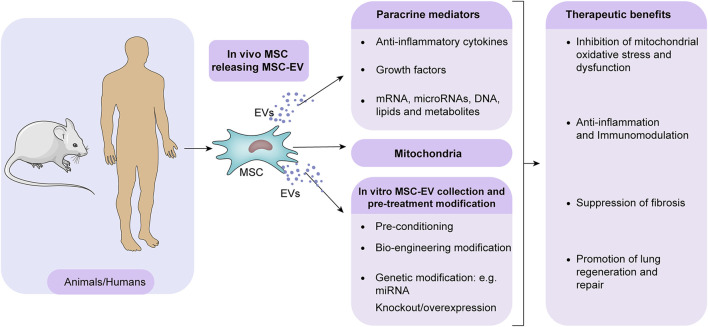
Bronchopulmonary dysplasia (BPD) is a common complication in preterm infants, leading to chronic respiratory disease. There has been an improvement in perinatal care, but many infants still suffer from impaired branching morphogenesis, alveolarization, and pulmonary capillary formation, causing lung function impairments and BPD. There is an increased risk of respiratory infections, pulmonary hypertension, and neurodevelopmental delays in infants with BPD, all of which can lead to long-term morbidity and mortality. Unfortunately, treatment options for Bronchopulmonary dysplasia are limited. A growing body of evidence indicates that mesenchymal stromal/stem cells (MSCs) can treat various lung diseases in regenerative medicine. MSCs are multipotent cells that can differentiate into multiple cell types, including lung cells, and possess immunomodulatory, anti-inflammatory, antioxidative stress, and regenerative properties. MSCs are regulated by mitochondrial function, as well as oxidant stress responses. Maintaining mitochondrial homeostasis will likely be key for MSCs to stimulate proper lung development and regeneration in Bronchopulmonary dysplasia. In recent years, MSCs have demonstrated promising results in treating and preventing bronchopulmonary dysplasia. Studies have shown that MSC therapy can reduce inflammation, mitochondrial impairment, lung injury, and fibrosis. In light of this, MSCs have emerged as a potential therapeutic option for treating Bronchopulmonary dysplasia. The article explores the role of MSCs in lung development and disease, summarizes MSC therapy's effectiveness in treating Bronchopulmonary dysplasia, and delves into the mechanisms behind this treatment.
支气管肺发育不良(BPD)是早产儿常见的并发症,可导致慢性呼吸系统疾病。围产期护理虽有改善,但仍有许多婴儿存在分支形态发生、肺泡化和肺毛细血管形成受损的情况,从而导致肺功能受损和BPD。BPD婴儿发生呼吸道感染、肺动脉高压和神经发育迟缓的风险增加,所有这些都可能导致长期发病和死亡。不幸的是,支气管肺发育不良的治疗选择有限。越来越多的证据表明,间充质基质/干细胞(MSCs)在再生医学中可治疗多种肺部疾病。MSCs是多能细胞,可分化为多种细胞类型,包括肺细胞,并具有免疫调节、抗炎、抗氧化应激和再生特性。MSCs受线粒体功能以及氧化应激反应的调节。维持线粒体稳态可能是MSCs在支气管肺发育不良中刺激肺正常发育和再生的关键。近年来,MSCs在治疗和预防支气管肺发育不良方面已显示出有前景的结果。研究表明,MSC治疗可减轻炎症、线粒体损伤、肺损伤和纤维化。鉴于此,MSCs已成为治疗支气管肺发育不良的一种潜在治疗选择。本文探讨了MSCs在肺发育和疾病中的作用,总结了MSC治疗在治疗支气管肺发育不良方面的有效性,并深入研究了这种治疗背后的机制。