Centre for Mathematical Modelling of Infectious Disease, School of Hygiene and Tropical Medicine, London, UK.
Centre for Respiratory Diseases and Meningitis, National Institute for Communicable Diseases, Johannesburg, South Africa.
BMC Med. 2023 Nov 15;21(1):441. doi: 10.1186/s12916-023-03100-5.
Large-scale prevention of respiratory syncytial virus (RSV) infection may have ecological consequences for co-circulating pathogens, including influenza. We assessed if and for how long RSV infection alters the risk for subsequent influenza infection.
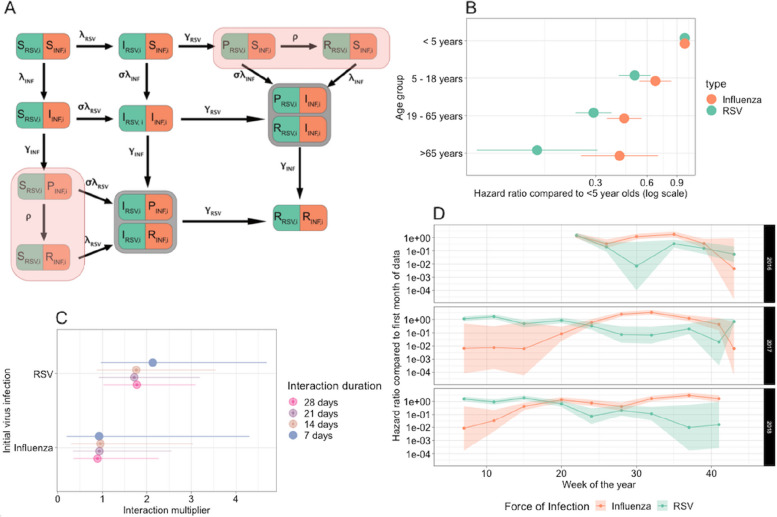
We analysed a prospective longitudinal cohort study conducted in South Africa between 2016 and 2018. For participating households, nasopharyngeal samples were taken twice weekly, irrespective of symptoms, across three respiratory virus seasons, and real-time polymerase chain reaction (PCR) was used to identify infection with RSV and/or influenza. We fitted an individual-level hidden Markov transmission model in order to estimate RSV and influenza infection rates and their interdependence.
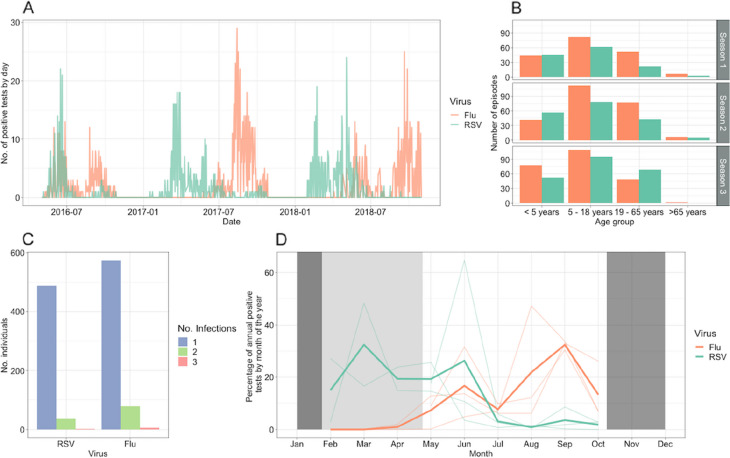
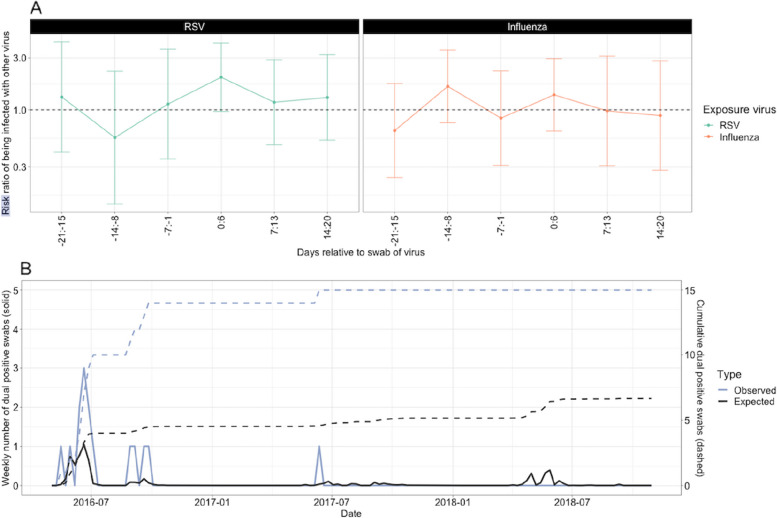
Of a total of 122,113 samples collected, 1265 (1.0%) were positive for influenza and 1002 (0.8%) positive for RSV, with 15 (0.01%) samples from 12 individuals positive for both influenza and RSV. We observed a 2.25-fold higher incidence of co-infection than expected if assuming infections were unrelated. We estimated that infection with influenza is 2.13 (95% CI 0.97-4.69) times more likely when already infected with, and for a week following, RSV infection, adjusted for age. This equates to 1.4% of influenza infections that may be attributable to RSV in this population. Due to the local seasonality (RSV season precedes the influenza season), we were unable to estimate changes in RSV infection risk following influenza infection.
We find no evidence to suggest that RSV was associated with a subsequent reduced risk of influenza infection. Instead, we observed an increased risk for influenza infection for a short period after infection. However, the impact on population-level transmission dynamics of this individual-level synergistic effect was not measurable in this setting.
大规模预防呼吸道合胞病毒(RSV)感染可能对同时传播的病原体(包括流感)产生生态影响。我们评估了 RSV 感染是否以及能持续多久会改变随后感染流感的风险。
我们分析了 2016 年至 2018 年期间在南非进行的一项前瞻性纵向队列研究。对于参与的家庭,无论症状如何,在三个呼吸道病毒季节中,每周采集两次鼻咽样本,并使用实时聚合酶链反应(PCR)来鉴定 RSV 和/或流感感染。我们拟合了个体水平的隐马尔可夫传播模型,以估计 RSV 和流感的感染率及其相互依存关系。
在总共采集的 122113 个样本中,有 1265 个(1.0%)样本对流感呈阳性,1002 个(0.8%)样本对 RSV 呈阳性,有 15 个(0.01%)样本来自 12 个人同时对流感和 RSV 呈阳性。与假设感染无关的情况下,我们观察到合并感染的发生率高出预期 2.25 倍。我们估计,在 RSV 感染后和感染后的一周内,感染流感的可能性增加 2.13 倍(95%CI 0.97-4.69),调整年龄因素后。这相当于该人群中 1.4%的流感感染可能归因于 RSV。由于当地的季节性(RSV 季节先于流感季节),我们无法估计流感感染后 RSV 感染风险的变化。
我们没有发现证据表明 RSV 与随后感染流感的风险降低有关。相反,我们观察到感染后短期内流感感染的风险增加。然而,在这种情况下,这种个体水平的协同作用对人群水平传播动力学的影响无法测量。